


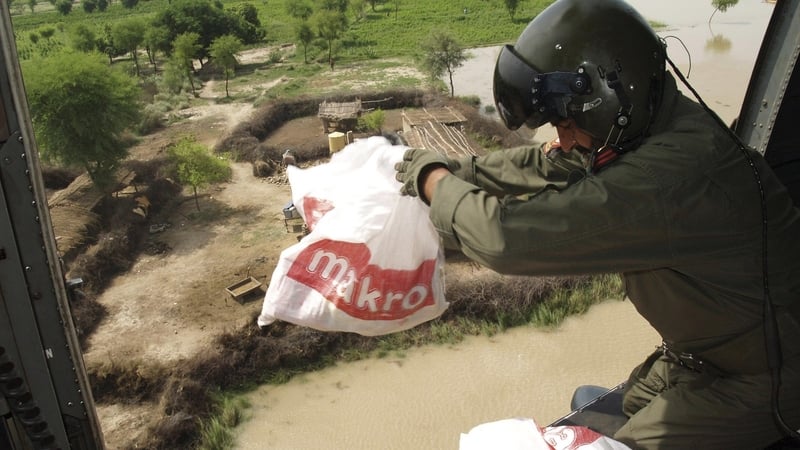
The UN says relief agencies are having trouble obtaining funds to help millions of Pakistan flood victims because the country suffers from an 'image deficit'.
'We note often an image deficit with regards to Pakistan among Western public opinion,' said Elizabeth Byrs, spokeswoman of the UN Office for the Coordination of Humanitarian Affairs.
'As a result, Pakistan is among countries that are poorly financed, like Yemen,' she added.
The United Nations has been struggling to obtain $460 million to provide emergency aid to six million victims of the heavy flooding.
Only a fifth of the required funds have been pledged since the appeal was launched on 11 August.
Melanie Brooks, spokeswoman of the humanitarian group Care International stressed that the UN must explain to donor states that 'the money is not going to go to the hands of the Taliban.'
'The victims are the mothers, the farmers, children. But in the past, information linked to Pakistan has always been linked to Talibans and terrorism,' she said.
Separately, Minister of State for Overseas Development Peter Power met the Pakistani ambassador to discuss Ireland's contribution to the relief effort.
The minister confirmed that 100 large multi-purpose tents had been sent from Ireland to Pakistan.
The tents arrived in Pakistan this morning and will be used to provide emergency shelter to hundreds of affected families.
At least 1,600 people have died in the monsoon floods, while an estimated 20m people have been affected.
A second wave of flooding is expected in Pakistan this week.
Aid agencies have warned of a growing threat of cholera among the victims after the UN confirmed the first case of the water-borne disease at the weekend.
Head of the Red Cross in Pakistan Pascal Cuttat appealed for more aid to deal with the scale of the disaster.
GOAL's emergency co-ordinator in Sindh province, Brian Casey, said that as the rains continue, 300,000 people had been displaced on Saturday alone.
Pakistan authorities have forecast a brief respite in rains.
Water levels in the Indus River feeding Pakistan's plains have fallen in Punjab, the country's most populous and worst hit province, although flooding would stay high where embankments were breached.
In Sindh province, flooding could get worse.
UN Secretary-General Ban Ki-moon urged foreign donors to speed up aid and warned of more destruction.
