


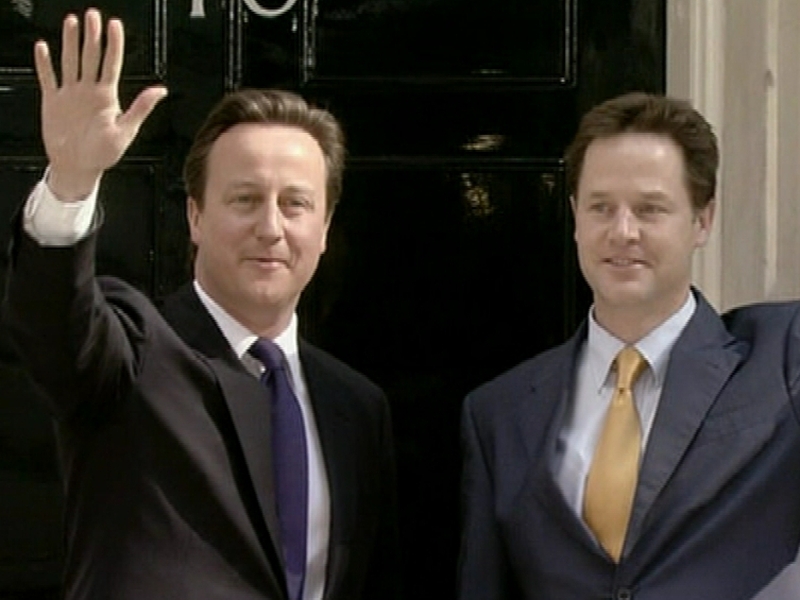
The coalition deal which gave Liberal Democrats a share of power at Westminster for the first time in the party's history won the ‘overwhelming’ approval of activists at a special conference today.
Party sources said that no more than a dozen of the 2,000 delegates opposed the deal in a show of hands at the gathering in Birmingham.
The conference came as Prime Minister David Cameron reaffirmed the warmth of his embrace of the Lib Dems, promising Nick Clegg would be part of his ‘inner core’ in a government he described as a ‘progressive alliance’.
Stirrings of discontent among Lib Dem ranks came into the open today when former party leader Charles Kennedy said he could not support coalition with Tories.
Mr Kennedy, who abstained in a vote on the deal last Tuesday, said it had driven a ‘coach and horses’ through long-cherished hopes for realignment of the centre-left and warned of the danger of assimilation by the Lib Dems' bigger partners.
Polls suggested that Lib Dems had dropped three points to 21% since the election, with Labour the main beneficiaries.
One survey found that around one-third of people who backed Lib Dems last week thought the party had sold out its principles and should have forged a pact with Labour instead.
But Mr Clegg was given a warm reception as he fielded questions from grassroots supporters at Birmingham's National Exhibition Centre, and the motion endorsing the coalition agreement was passed comfortably.
Writing in The Observer, Mr Kennedy said he voiced his concerns over the deal before abstaining at Tuesday's late-night meeting, which took place as Gordon Brown was handing over to David Cameron as Prime Minister.
Other former leaders Paddy Ashdown and Menzies Campbell are understood to have voted in favour.
Mr Kennedy said: 'Paddy Ashdown described last week's events as 'a rather unexpected moment'.
'Certainly they drive a strategic coach and horses through the long-nurtured 'realignment of the centre-left' to which leaders in the Liberal tradition - this one included - have all subscribed since the Jo Grimond era.
'It is hardly surprising that, for some of us at least, our political compass currently feels confused. And that really encapsulates the reasons why I felt personally unable to vote for this outcome when it was presented to Liberal Democrat parliamentarians.'
Mr Kennedy said he had been keen to explore the possibility of a 'progressive coalition' with Labour and made clear he would have preferred to allow Conservatives to form a minority administration while Lib Dems remained in opposition.
Despite his predecessor's abstention, Mr Clegg obtained the 75% majority among both MPs and the Lib Dem federal executive which he needed to avoid activating a 'triple lock' process.
That would have required the deal to be approved by a special conference and perhaps even a postal ballot of members.
Mr Clegg has acknowledged that the coalition deal had caused 'both surprise and with it some offence' to some in his party, but insisted he had no other responsible option.
Mr Clegg told The Guardian: 'There are those on both the left and right who are united in thinking this should not have happened.
'But the truth is this: there was no other responsible way to play the hand dealt to the political parties by the British people at the election.
'The parliamentary arithmetic made a Lib-Lab coalition unworkable and it would have been regarded as illegitimate by the British people.
'Equally, a minority administration would have been too fragile to tackle the political and economic challenges ahead.'
