


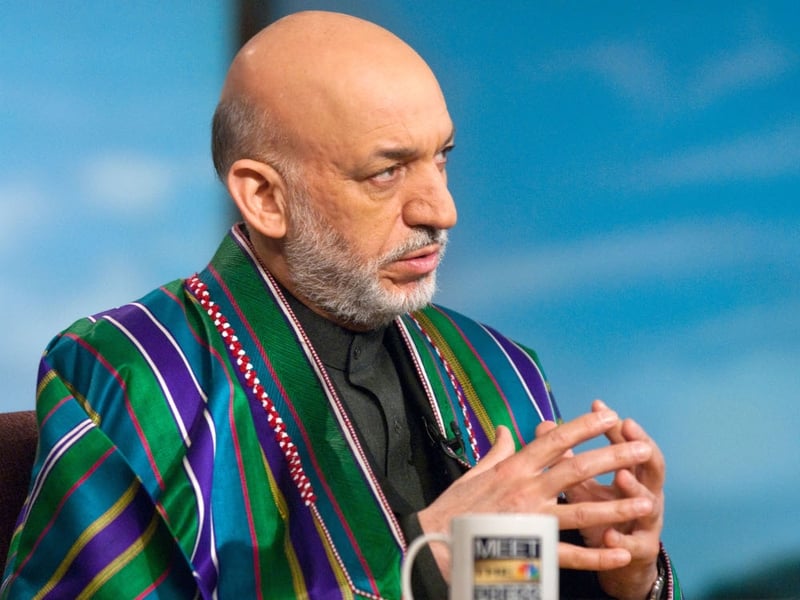
The Afghan President has met a senior delegation from one of the main insurgent groups fighting against his government and foreign troops.
Hamid Karzai's first confirmed direct contact with the Hezb-e-Islami group could signal prospects for a separate peace with a group that rivals the Taliban.
‘I can confirm that a delegation of Hezb-e-Islami ... is in Kabul with a plan and has met with the president,’ Mr Karzai's spokesman, Waheed Omer, said.
A spokesman for Hezb-e-Islami said it was the first time the group had sent senior envoys to Kabul for peace talks.
They had brought a 15-point peace plan, which includes a demand for withdrawal of foreign troops, said Haroun Zarghoun, spokesman for the group's fugitive leader, Gulbuddin Hekmatyar.
Mr Hekmatyar's Hezb-e-Islami has shared some of the aims of the Taliban, but has led a separate insurgency mainly in the east and pockets of the north of the country.
In recent months Taliban fighters have pushed into Hezb-e-Islami strongholds, leading to clashes between fighters from the two groups.
The delegation is led by Qutbuddin Hilal, a former prime minister and deputy to Mr Hekmatyar, and also includes Mr Hekmatyar's son-in-law.
‘The main point of the plan is the withdrawal of all foreign forces from July this year, and that this is to be completed within six months,’ Mr Zarghoun told Reuters.
‘The current government and parliament are to function until a provisional administration is formed after six months, and presidential and parliamentary polls are held in March 2011,’ he said, adding that details of the plan were negotiable.
Mr Karzai has launched a high-profile effort to reach out to insurgents this year, and included a former Hezb-e-Islami member as the economy minister in his new cabinet in January.
Mr Zarghoun said the delegation might also meet US officials to discuss the plan, however US embassy spokeswoman Caitlin Hayden said the US had no plans to meet them.
‘The US does support the Afghan government's interest in reaching out to members of insurgent groups that cease support to the insurgency, live in accordance with the Afghan constitution, renounce violence and have no ties to al-Qaeda or terrorist groups that share its objectives,’ she said.
Washington, which has the bulk of the 120,000 international troops in Afghanistan, has been cautious about President Karzai's efforts to reach out to senior militants.
The US is in the process of increasing its forces in Afghanistan this year but has already announced plans to begin withdrawing in mid-2011.
Western governments and Mr Karzai hope an outreach programme combined with a year of stepped-up military pressure will persuade insurgents to lay down their arms.
The former head of the UN mission in Afghanistan, Kai Eide, confirmed last week that he had held talks with Taliban representatives over the past year.
He said those talks ended in recent weeks after Pakistan arrested the Afghan Taliban's number two leader, Abdul Ghani Baradar.
Hezb-e-Islami is one of the three groups that NATO forces recognise as the main insurgent factions, led by Hekmatyar, a veteran anti-Soviet guerrilla commander, civil war faction leader and former prime minister.
Hekmatyar's Islamist fighters have long fought NATO and Afghan government forces in the east and in pockets in the north.
