


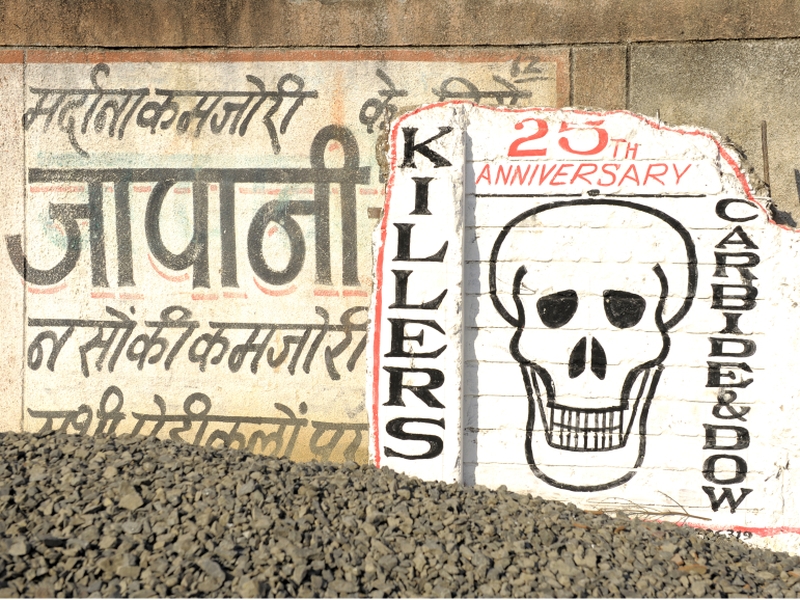
Indian activists have marked the 25th anniversary of the Bhopal gas leak disaster with protests and demands that those responsible for thousands of deaths finally be held to account.
Demonstrators and survivors capped a week of commemorations with a march to the Union Carbide pesticide plant in Bhopal, where on 3 December 1984 a cloud of methyl isocyanate gas killed up to 10,000 people within three days.
Studies released earlier this week showed the shanty towns surrounding the site are still laced with lethal chemicals that pollute groundwater and soil, causing birth defects and a range of chronic illnesses.
'The survivors of the tragedy, through these protests, are venting their ire against the state government for its inaction in clearing the toxic waste,' said Satinath Sarangi of the Bhopal Group of Information and Action.
Research by the Indian Council for Medical Research (ICMR) showed 25,000 people have died from the consequences of exposure since 1984.
After those studies concluded, government statistics said 100,000 people were chronically sick, with more than 30,000 people living in water-contaminated areas around the factory.
The state government of Madhya Pradesh, of which Bhopal is capital, assumed responsibility for the site in 1998, and has only partially cleared the hundreds of tonnes of toxic materials scattered around the plant.
Thousands more tonnes lie just yards away from the plant in man-made 'solar evaporation ponds' where Union Carbide was dumping waste for years before the accident.
State authorities say the material is not harmful and, to prove this, last month said they planned to open the site to visitors. Officials later reversed the decision.
Company statement
In a statement released to coincide with the anniversary, Dow Chemical, which purchased Union Carbide in 1999, said a $470m settlement reached in 1989 with the Indian government 'resolved all existing and future claims' against the company.
Union Carbide 'did all it could to help the victims and their families' until the settlement and said the Indian government should be responsible for providing clean drinking water and health services to residents.
It continues to insist that sabotage was behind the leak.
Most of the settlement money was used to pay compensation of $1,000-$2,000 to victims who were left unable to work or to those with long-term ailments, but many received nothing at all.
'People came and told us we could apply for compensation,' Laxmi Narayan, whose wife suffers severe eye complaints apparently caused by the industrial accident, told AFP. 'They took our name down, but we never saw a penny.'
Prime Minister Manmohan Singh issued a statement describing Bhopal as a tragedy that 'still gnaws at our collective conscience' and he vowed continued efforts to tackle the issues of drinking water and site decontamination.
Criminal cases against former Union Carbide executives are pending in various Indian and US courts which hold them and Dow liable for the catastrophe.
Amnesty International called on Dow to 'cooperate fully in the ongoing legal proceedings in order to ensure that those responsible are held accountable.'
