


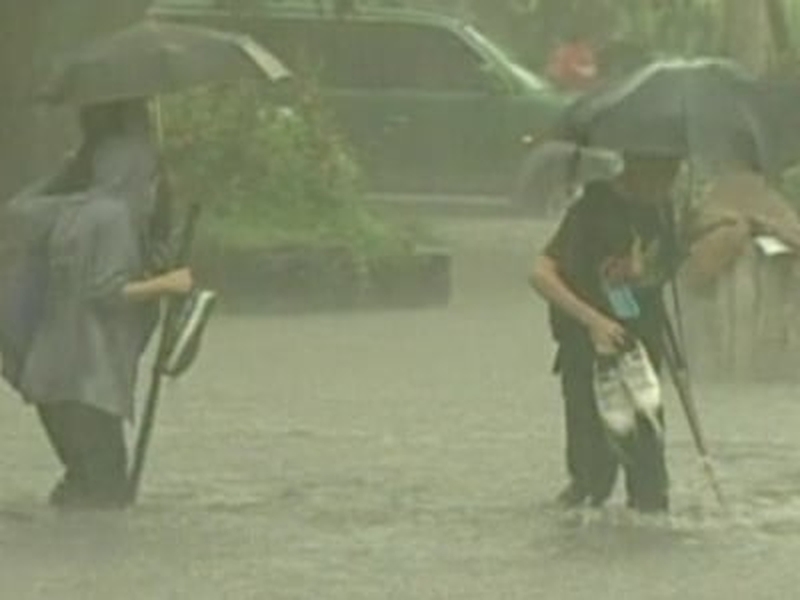
President Gloria Arroyo has placed the entire Philippines under a 'state of calamity', as a powerful typhoon threatens more devastation in the region.
Presidential spokesman Cerge Remonde said the move would help the nation prepare for Typhoon Parma, expected to hit the north of the country tomorrow afternoon.
Typhoon Parma has slowed while approaching the Philippines but continues to pack extremely dangerous winds and remains unpredictable, government weather forecasters say.
The typhoon was originally moving northwest at 19km/h, but is now slowing.
Under a 'state of calamity', local authorities can use emergency funds and the national government has expanded powers such as price controls.
Large areas of the Philippines, including the capital Manila, are still recovering from tropical storm Ketsana last weekend.
The typhoon claimed more than 400 lives and affected more than 3m people in the Philippines, Cambodia, Laos, Thailand and Vietnam.
'It is much better if the whole country (is under this state) so that local governments are prepared,' the spokesperson said.
The president has already ordered the evacuation of residents from riverside and low-lying areas in the provinces that are in the path of Parma.
Parma, packing gusts of 230km/h, is forecast to hit rural areas in the north of the Philippines' main island of Luzon tomorrow morning.
Meteorologists consider a super typhoon to be one with sustained winds of about 241km/h.
The water level rose by 1.2m in Laguna de Bay when Typhoon Ketsana dumped record-high rainfall last Saturday and submerged the capital region and two nearby provinces, said Edgar Manda, head of Laguna Lake Development Authority.
'We have to effect the removal of those in the danger zones', Mr Manda said, adding prolonged flooding in these areas posed potential health hazards.
He said waters could rise further when tomorrow's expected typhoon is due to hit northeastern provinces.
Tens of thousands of people around the 90,000-hectare lake are marooned in their houses due to flooding.
Electricity, communications and potable water services in some of these areas are cut and many people are still waiting for relief goods.
Lake authority official Jun Mystica said the clogged drainage system in the capital, heavy siltation of river systems, destruction of watershed areas and construction of houses on wetlands around the lake contributed to the flooding.
