


The G8 leaders have agreed to try to limit global warming to two degrees Celsius and cut greenhouse gas emissions by 80%.
However, they failed to persuade China and India to join an attempt to halve world emissions by 2050.
In a joint statement this afternoon, they urged other nations also to agree to join the fight against global warming.
'We intend to secure our present and future prosperity by taking the lead in the fight against climate change,' the statement read.
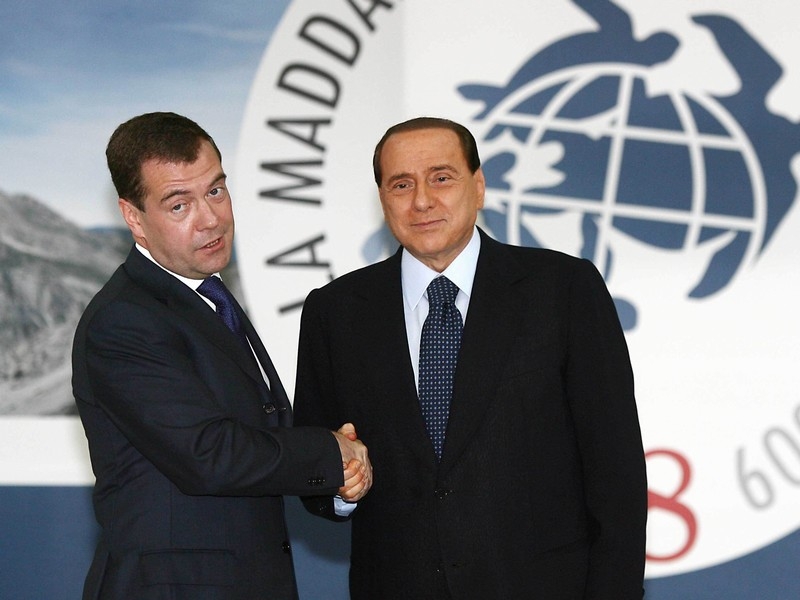
The three-day summit is taking place in L'Aquila in Italy, which was the site of a major earthquake in April that killed 299 people.
With only five months until a new UN climate pact is due to be agreed in Copenhagen, climate change organisations said the G8 had left much work to be done and ducked key issues.
Developing economies have demanded that rich nations commit to steeper short-term reductions.
And while the two Celsius goal was adopted for the first time by the US, Russia, Japan and Canada, it had already been agreed in 1996 by the EU and its G8 members Germany, Britain, France and Italy.
The G8 statement also failed to pinpoint a base year for the 80% reduction.
Separately this evening, the G8 unanimously expressed ‘serious concern’ about Iran’s post-election crackdown and its suspect nuclear program.
Other issues expected to dominate the summit are the global economic crisis and assistance for Africa.
Britain is seeking progress on the agreements reached at the G20 summit hosted by Gordon Brown in London in April to reform the international financial system.
At a foreign policy discussion over dinner this evening, leaders looked at the prospects for nuclear weapons reductions following this week's talks between Mr Obama and Russian President Dmitry Medvedev.
The G8 nations will be joined tomorrow by the group of emerging economies India, Brazil, Mexico and South Africa to discuss climate change and development.
On Friday, the summit will be joined by leaders from Algeria, Egypt, Nigeria, Senegal, Ethiopia, Libya and Angola, as the focus switches to action to tackle hunger by making Africa self-sufficient in food production.
