


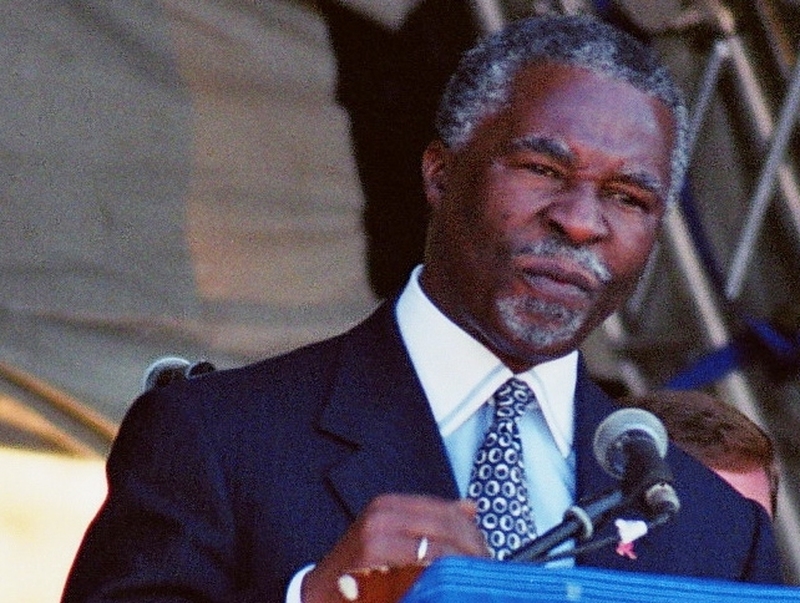
Thabo Mbeki has told the South African nation that he has resigned as head of state, deepening the country's worst political crisis since apartheid.
Mbeki, who took over from Nelson Mandela as president in 1999, agreed yesterday to accept the ruling ANC's request that he resign before the end of his term next year.
The National Executive Committee of the governing African National Congress called on Mr Mbeki to resign after a High Court judge said there was evidence of political involvement in a decision to prosecute his rival, Jakob Zuma, on corruption charges.
The 66-year-old, who succeeded Nelson Mandela as president in June 1999, has been under fire over allegations that he influenced the pressing of corruption charges against Mr Zuma.
'The ANC has decided to recall the president of the republic before his mandate has expired,' the ANC's secretary general Gwede Mantashe told journalists after a meeting of the party leadership.
'Our decision has been concluded, the formalities are now subject to the parliamentary process,' Mr Mantashe said, adding that Mr Mbeki didn't express shock, but welcomed the news.
'We have communicated our decision (to Mbeki) and that we will be going through parliamentary process. He has agreed to participate in that process.'
Government spokesman Themba Maseko said a cabinet meeting had been called for this afternoon, and afterwards Mbeki would speak to the nation in a live broadcast on radio and television.
Pressure after Zuma charges dropped
It will be Mr Mbeki's first direct speech to the public since he took to television screens across the country in the wake of violent anti-foreigner killings which rocked the country in May.
Under the South African constitution, the president is appointed by parliament, which has been dominated by the ANC since the end of apartheid and the start of majority rule in May 1994.
Mr Mbeki's term formally expires in mid-2009. The decision now rests with parliament whether to appoint an interim president and call an early election, or install a full acting president to complete the second term.
Senior ANC officials had gathered Friday to discuss Mbeki's future after a 12 September court ruling that cleared Mr Zuma of corruption charges and hinted that Mr Mbeki's government had interfered in the decision to prosecute him - an allegation that the president's office denied.
Fierce debate followed the judgment, along with speculation as to whether the ANC would force Mr Mbeki out in a vote of no confidence, ask him to resign, or allow him to serve out his term.
The dismissal of the charges on a technicality cleared the way for Mr Zuma to become South Africa's president in elections next year.
The main allegation against him had been that he received bribes for protecting French arms company Thint in an investigation into a controversial weapons deal.
Judge Chris Nicholson said the decision to throw out the case was not a reflection of Mr Zuma's guilt or innocence, but a technical decision based on his right to make representations before being recharged.
Mr Mbeki fired Mr Zuma as deputy president in 2005 after his financial advisor was jailed for corruption.
Mr Mantashe said the decision to ask Mr Mbeki to stand down was taken in the interests of party unity.
'This is not a punishment,' he said. 'We decided to take this decision in an effort to heal and reunite the ANC.'
