


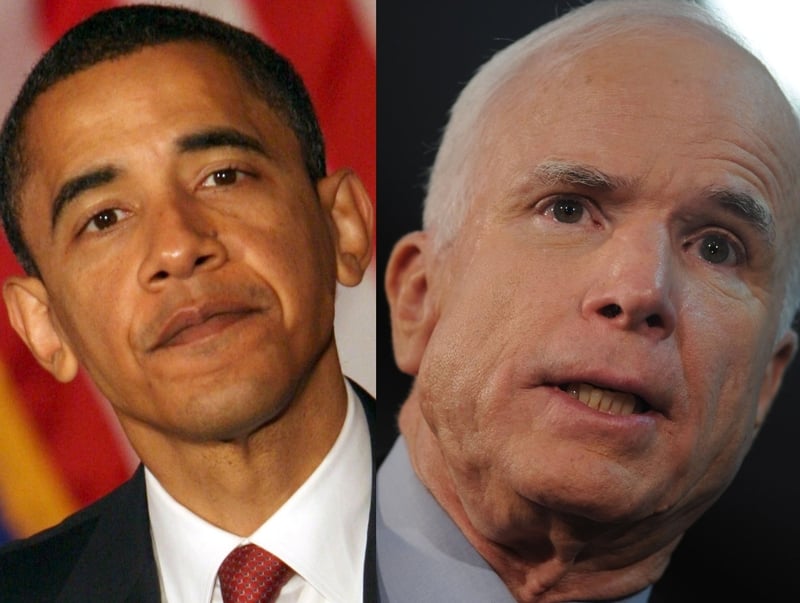
US presidential candidates have spent some $50m (€32m) and aired more than 100,000 TV ads since the start of the US election campaign in early June, far outpacing the rate of the 2004 campaign.
Democratic candidate Barack Obama spent $27m between 4 June and 26 July, while Republican John McCain spent just over $21m.
The University of Wisconsin Advertising Project, which monitors political ad spending, revealed the figures in a new report.
The Republican National Committee aired another 6,005 ads during the same time frame, spending $3.6m, while the Democratic National Committee did not air any presidential election ads, the ad project said.
By comparison, it said, the presidential candidates in 2004 had aired only 77,000 advertisements during the June-to-July period.
Senator Obama aired the largest number of ads, 55,312, nearly 9,000 more than Senator McCain, who aired 46,453.
When the RNC ads are added to Senator McCain's tally, Barack Obama's advertising lead drops to 2,744 ads.
More than 90% of the aids aired by Barack Obama are positive in nature and do not mention Senator McCain, the ad project said.
In contrast, about a third of John McCain's ads are negative, contrasting the two presidential candidates.
John McCain's advertising effort is focused on four key battlegrounds states - Michigan, Ohio, Pennsylvania and Wisconsin - where he is advertising more heavily than Obama, the ad project said.
So far the two sides have spent $10.3m in Pennsylvania, nearly $6.4m in Ohio, $6m in Michigan and $3m in Wisconsin.
While Barack Obama is advertising heavily in the same four battleground states as John McCain, he also is chasing votes in states where Democrats have not fared as well as Republicans in recent elections.
He spent more than $5m in Florida, the state that gave George W Bush the presidency in 2000, while John McCain did not air a single ad there between 3 June and 27 July, the ad project said.
Barack Obama also is alone in advertising in Republican-leaning states like Georgia, North Carolina, Indiana, Montana and Arkansas, hoping to pull them into the Democratic orbit in the November general election.
