

A team from the UN's nuclear watchdog is in Syria to investigate allegations that the country has been developing a secret nuclear weapons programme.
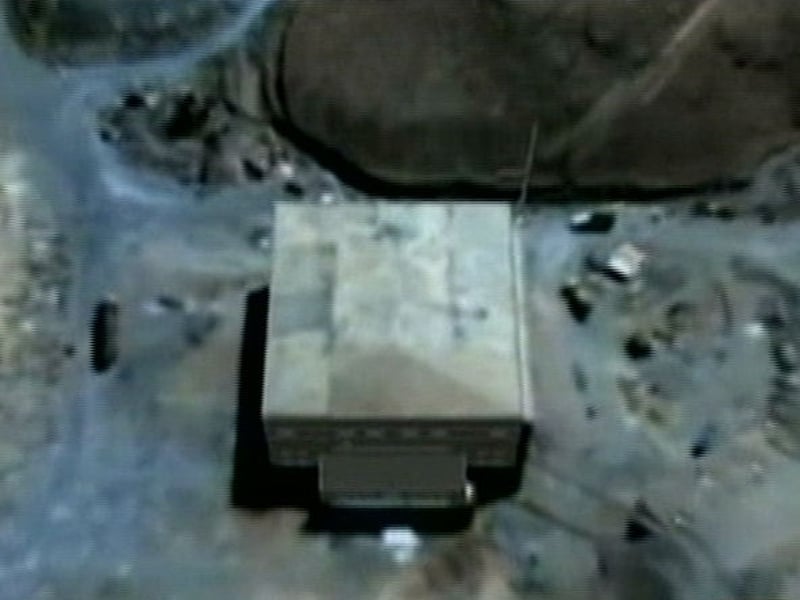
Israel claims that a building it had bombed in a remote desert area last year was a partially constructed nuclear reactor. Syria says the installation, which was bulldozed after the attack, was an empty military building.
The team led by International Atomic Energy Agency deputy chief Olli Heinonen left Vienna yesterday morning.
'We are now travelling to Damascus, we will meet tonight our counterparts and then we start to gather facts,' Mr Heinonen told journalists at Vienna Airport before boarding a plane to Syria for the unprecedented visit.
'What will be waiting there, we will see when we get there,' he added.
The team is due to visit al-Kibar site in a remote desert area of northeastern Syria on the Euphrates River during its three-day trip.
The US allegations, which it says are based on intelligence and photographic evidence, are that the site attacked by Israel in September was a nuclear facility built with North Korean help and close to becoming operational.
But Syria has denied the claims and said al-Kibar was a disused military building, although Damascus has fed suspicion by wiping clean the site in a move certain to make the IAEA inspection more difficult.
Mr Heinonen said he would return to IAEA headquarters in the Austrian capital on Wednesday evening. The team is to submit its findings to the watchdog's next regular board meeting in September.
Damascus has welcomed the inspection but insists that it will be limited to al-Kibar site. US news reports and diplomats close to the IAEA have said that the nuclear watchdog was also interested in two or three other facilities.
'Syria invited the IAEA and will cooperate with it,' President Bashar al-Assad has said, but he insisted that 'talking about other sites is not within the purview of the agreement' with the nuclear watchdog.
Mr Assad also charged that the US evidence was 'fabricated 100%' as part of a campaign to ratchet pressure on Damascus, which Washington accuses of supporting terrorism along with its key regional ally Tehran.
Meanwhile, the German magazine Der Spiegel, in its latest edition, said Damascus and Pyongyang had been trying to help Iran to develop its controversial nuclear programme through the construction of Al-Kibar.
But Mr Assad is now considering withdrawing his support for the Iranian programme, said the German weekly, which quoted German secret service reports.
The reports cited by Der Speigel claimed that al-Kibar was to have been used as a temporary site for Iran to develop a nuclear bomb until it was able to do so on its own territory.
'No evidence of Syria foul play'
IAEA chief Mohamed ElBaradei stressed in an interview with an Arab news channel ahead of the visit to Damascus that there was no evidence of Syrian nuclear foul play.
'We have no evidence that Syria has the human resources that would allow it to carry out a large nuclear programme. We do not see Syria having nuclear fuel,' he told Dubai-based Al-Arabiya television.
Washington levelled its accusations against Syria in April, seven months after the Israeli attack. The timing and the cloak of secrecy Israel kept for days after the attack have added to the lingering mystery about Al-Kibar, while Syria has refused to define the facility's military use.
On 10 June, Syrian analyst Ibrahim Darraji wrote in Al-Watan newspaper, which is close to the government, that Damascus fully supported the IAEA visit 'to prove the erroneous character of the US and Israeli allegations'.
Syria, a party to the nuclear Non-Proliferation Treaty which Israel refuses to sign, has 'limited nuclear resources and capabilities' focused on civilian research, according to the authoritative Nuclear Threat Initiative website.
