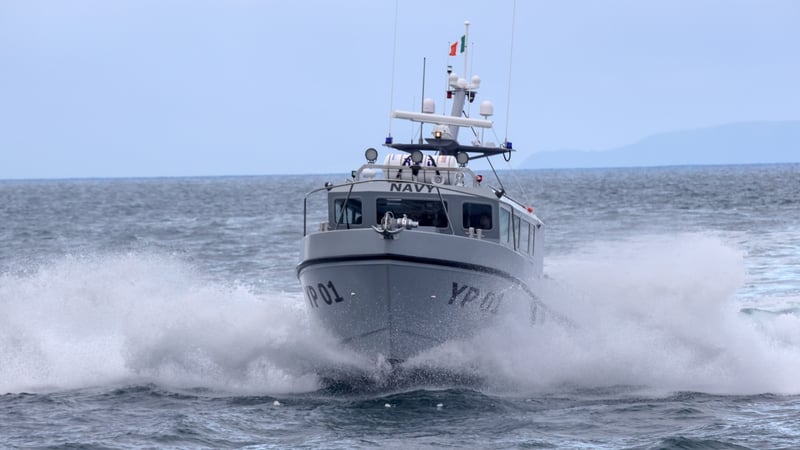

The Naval Service has launched a new recruitment campaign involving interactive online videos.
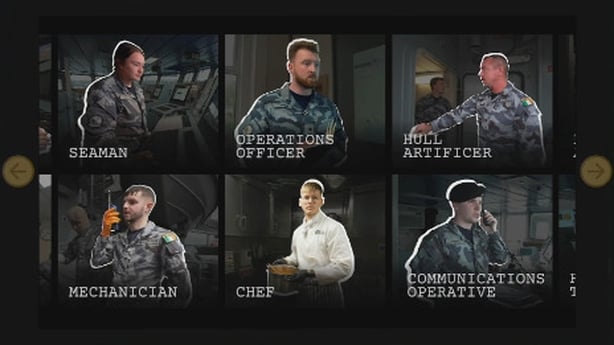
The 'Navy Career Explorer Videos' were developed with Irish company Trainify and are designed to give people a behind-the-scenes look at life in the navy.
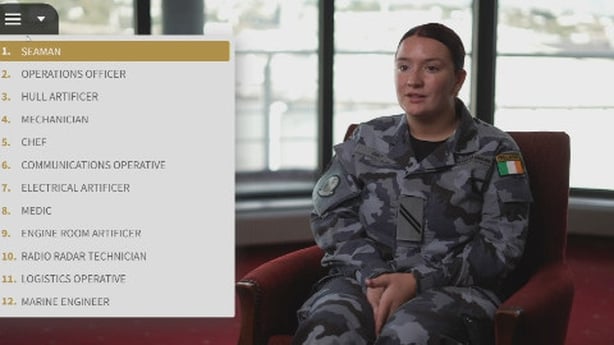
The videos let viewers explore 12 different roles that are required to make a naval vessel operate and carry out its duties.
"Each role is brought to life by the people who do the job every day," the Naval Service said.
"Through real conversations and real-world footage, viewers see the work, the responsibilities, the teamwork, and the opportunities on offer, helping them decide where they might fit and what a Naval Service career could mean for them," it added.
Staffing levels at the navy have increased in recent years to around 850 but that is still below the minimum requirement of 1,094.
Defence analysts say shortages of key personnel mean the navy has difficulty putting its full fleet to sea.
"There are eight naval ships in the Irish navy at the moment," said Cathal Berry, ex-Independent TD and former member of the Defence Forces.
"On a good day you could probably put three or four to sea, so there is a big issue for sure."
"The entire cost of all those ships is about a quarter of a billion euro so we do have quite a lot of money, State assets, lying fairly idle in Cork at the moment and it is primarily down to people that we don't have like key specialists and technicians to actually put a ship to sea," Mr Berry said.
"You need radar operators, you need mechanics, you need communications specialists, and if you don't have them you can't legally put to sea," he added.

A Defence Forces spokesperson said that Naval Service staffing levels have significantly improved in the past 12 months.
"Challenges in the recruitment and retention of personnel in the Naval Service are well-documented and a wide range of recruitment and retention initiatives have been introduced to address these," the spokesperson said.
The Defence Forces said that of the navy's eight vessels, two are in operational reserve, and one is completing fitout requirements and will commence patrolling later this year.
"All remaining ships are regularly deployed on maritime defence and security operations," the spokesperson said.
Concerns have been expressed in recent months about the navy's equipment and resources when it comes to counteracting drones and defending undersea cables.
Minister for Defence Helen McEntee said earlier this week that counter-drone technology will be in place before Ireland's Presidency of the European Council begins in July.
"We do need to invest in our equipment and our capabilities," Ms McEntee told RTÉ's Morning Ireland on Monday.
"That’s why the financial plan, the capital plan that I published just before the end of the year, very clearly focuses and refocuses our attention to our investment in radar, in sonar and in counter-drone technology," she added.
From car garage to ship engine room
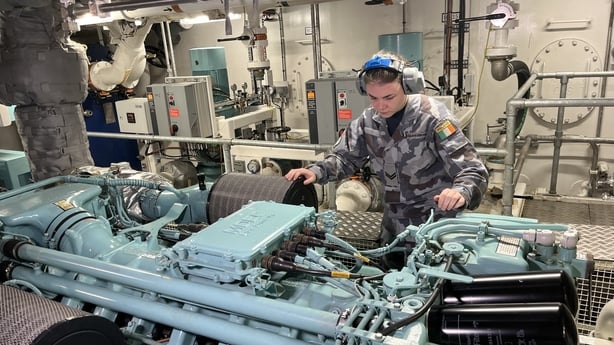
Geri Cairns used to work as a car mechanic but in August last year she decided to join the navy.
She has swapped the car garage for the ship's engine room.
"I always just loved engines, ever since I was young," Ms Cairns said.
"When I saw the option for direct entry into the navy, to come and work as an engine room artificer, I thought it sounded like everything I wanted to do, and it was something completely different, so I'm glad I chose it.
"Basically, we make sure the engines are running when you're at sea, making sure they're maintained and the services are all up to date," she said.
"I like that every day is a new learning day, you learn something new and you're doing something different every day.
"We have a good laugh on board and the crew is great.
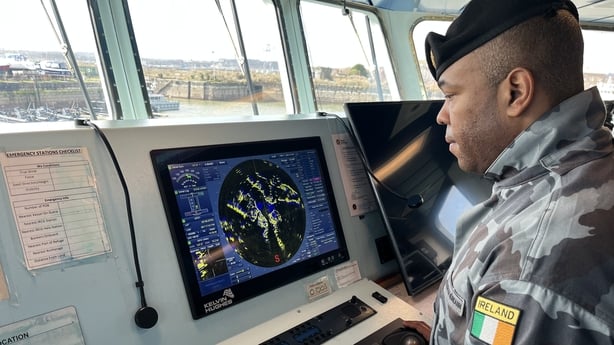
"It is a male-dominated workplace but there are more women joining now," Ms Cairns added.
"Everyone treats you the same, you are not seen as weaker or different or anything like that, everyone just gets on," she saod.
Ms Cairns said she would definitely recommend the navy as a career.
"There are great opportunities for progression, you are really well looked after," she said.
'At 39, I'm probably the oldest cadet ever'
Bruno Salatiel is originally from Brazil and has been in Ireland for almost 20 years.
At 39 years old, he is probably the oldest ever Navy cadet.
He has benefited from a recent rule change that raised the age limits for entry in the defence forces cadetships.
"I started working in a bank many moons ago, I worked in hospitality for many years, I worked in a social media company, I am also a musician, then I decided to join the navy," Mr Salatiel said.
"I think I have set a record here, I am 39, probably the oldest cadet ever.
"It feels great to be here working with a lot of younger people. You share experiences and get to work with the next generation," he added.