
The number of people who were unemployed increased on an annual basis by 17,600, or just over 14%, to 141,800 in the first three months of the year.
This led to an unemployment rate of 4.9%, according to the latest Labour Force Survey from the Central Statistics Office.
The largest decrease in employment by economic sector in the first quarter of the year occurred in the information & communication sector which fell by 20,300 or 10.7%.
The fall in employment in the sector was driven by a decrease in computer programming and consultancy roles which fell by 16,200.
According to the CSO, there were 41,300 people in long-term unemployment - unemployed for 12 months or longer - in the first quarter of the year, 15,500 more than a year earlier.
The number of people in employment rose by 400 to 2,794,500 with no percentage change recorded from the first quarter of last year.
On a quarterly basis, the number of people in employment has fallen from the figure of 2,833,100 which was recorded in the final three months of 2025.
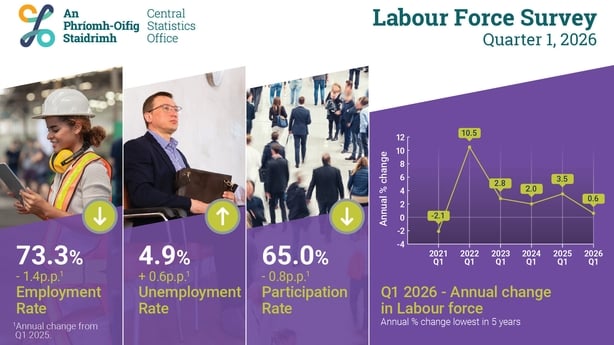
Today's CSO figures show that the number of people in the labour force increased by 18,000 or 0.6% to 2,936,300, the lowest annual increase in five years.
The estimated total number of hours worked per week was 86.3 million hours, a decrease of 0.2% when compared with the previous year.
The largest sectoral decreases in hours worked were in professional, scientific & technical activities, which fell by 800,000 hours, and the information & communication sector, which was down 700,000 hours.
According to the Labour Force Survey, the number of people who work from home fell by 44,800, or 4.3% to 990,100 in the first three months of year compared to the first quarter of 2025.
Those that never worked from home rose by 46,600, or 2.7% to 1,796,200, exceeding the pre-pandemic level for the first time.
We need your consent to load this rte-player contentWe use rte-player to manage extra content that can set cookies on your device and collect data about your activity. Please review their details and accept them to load the content.Manage Preferences
Kate English, chief economist at Deloitte Ireland, said that an "incredibly rare statistic" in Irish economic data is clear in the Labour Force figures today, with the CSO data showing practically no change in the volume of people employed compared to the same time last year.
The economist noted that excluding the quarters of Covid-19 volatility, Irish employment numbers have grown consistently since early 2012.
"While a slow-down in employment is expected this year, a return of zero growth is noteworthy. It is important to remember that one quarter never makes a trend, so this may well be a blip, but it must be monitored closely," she stated.
"It is still too soon to say if this is evidence of an impact from AI, and now there is the added layers of the energy shock and wider economic uncertainty," she added.
'Labour market data likely affected by volatility'
Bank of Ireland's group chief economist Conall Mac Coille said at face value, the CSO Labour Force Survey is very concerning, with employment falling by 0.6% to 2.8 million, annual job creation flattening off to zero and the unemployment rate rising to 5%.
But he added that volatility looks to be at play.
He said today's suggest full-time employment has increased by 1.5% over the past year to 2.23 million, but part-time work has declined sharply by 5% to 561,500.
The economist said that Bank of Ireland had forecast that Irish employment would expand by 1.8% in calendar year 2026, with the unemployment rate rising to 4.8%.
"There appears to be too much noise in today's LFS survey for it to warrant a change in our forecasts at this stage," he stated.
"Nonetheless, peering through the statistical fog, there still appears to be a gradual slowdown in job creation -now driven more by construction, manufacturing, and the public sector," he said.
"We will also be watching for any signs that recent uncertainty related to events in the Middle East is weighing on hiring," he added.