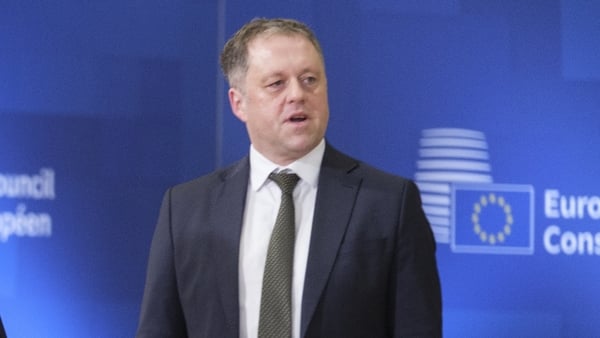

The Minister of State for European Affairs Thomas Byrne has said there is growing support at EU level for a ban on goods from occupied territories in the West Bank.
Yesterday, EU foreign ministers unanimously backed sanctions against violent settlers in the West Bank, with the EU's foreign policy chief Kaja Kallas saying further restrictions on goods from Jewish settlements could happen once a proposal from the European Commission was forthcoming.
Such a move would require a weighted majority of EU member states, as opposed to unanimity.
Speaking ahead of a meeting of EU defence ministers this morning, Mr Byrne said: "We now have sanctions agreed for violent settlers. I think that's a really important signal of the European Union at work, doing the right thing, responding to the demands of the people, and implementing this by unanimous decision.
"In relation to settler goods, obviously that's something that we have a policy at home on in terms of bringing forward the Occupied Territories Bill.
"But clearly it would be preferable if this were done at European Union level. We will await a [European] Commission proposal on this. But it looks to me like the support for this is increasing, but we have to wait until there is a Commission proposal in relation to it."
He told reporters that a European response would be more effective than Ireland going it alone with an Occupied Territories Bill: "That goes without saying. So if a commission proposal comes forward, it's likely that Ireland will support it, and I would say an increasing number of member states [will] as well."
Mr Byrne said Ireland wanted a complete end to the Iran war and a "complete resolution" to the issues between the US, Israel and Iran, "because all of us around the world are feeling the effects of increased energy prices, shortages of supplies of various goods, which then feeds into consumer prices and feeds into economic declines".
EU ministers are today discussing how Ukraine might make use of the €90bn EU loan, which was recently approved after Hungary dropped its veto, and will be joined by Ukraine’s defence minister Mykhailo Fedorov.
They will also discuss providing further support to the Lebanese Armed Forces and the potential for a European replacement in south Lebanon for UNIFIL.
Member states have been discussing a possible civilian and military mission to Lebanon under the EU’s Common Foreign and Security Policy (CFSP), a move which Ireland and other countries support.
Arriving at today’s meeting, Ms Kallas said the EU had been in contact with the parties to the conflict in the Gulf, as well as regional countries.
"The biggest challenge is how we can actually push the diplomatic track. We are in constant contact with the parties and also the regional actors that are pushing for the first phase of these peace talks: that would be [about] ending the war, also all the attacks by proxies, and also… opening the Strait of Hormuz, and then using the time for negotiating all the difficult topics that are still on the table."
She said the EU would be engaged in discussion with Gulf countries about what the post-war security architecture would be.
"It is in everybody's interests [to work out] how to achieve that, and the Gulf countries have said to us that they clearly see Europe's role there, because it's our neighbourhood," she told reporters.
"We have been in close contact, we are very much working together, also on security and defence issues - if you just look at what kind of help Ukraine has given to the Gulf countries. But in the long term, there is definitely a role for us," added Ms Kallas.