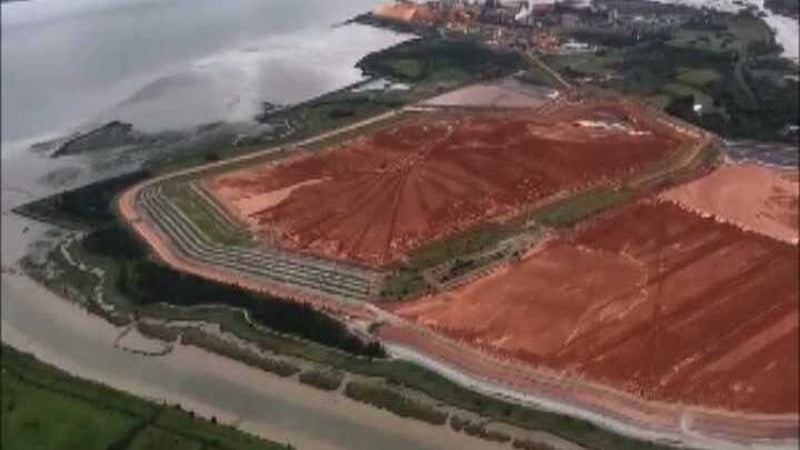

The European Commission has decided not to propose sanctions at this time on Aughinish Alumina, the Shannon-based plant owned by a Russian company, which has been accused of exporting alumina that has ended up in Russian weapons and armaments used against civilian targets in Ukraine.
RTÉ News understands that during discussions today between the European Commission and member states, on the next round of sanctions against Russia, a number of capitals raised the question of whether either the company itself or the product should be subject to sanctions.
However, two well-placed sources have said that the European Commission has decided not to recommend sanctions at this stage.
One source said the reason was due to the potential disruption to the European aluminium market, given that Aughinish is the main supplier of alumina to a number of EU smelting companies.
Alumina is one of the main ingredients of aluminium, which is a vital component for hundreds of industrial, commercial and military goods.
Separately, Aughinish Alumina has written to the Government warning of "unintended consequences" should the EU proceed with any effort to sanction the company.
The draft letter, seen by RTÉ News, suggests that any restrictions on the sale of alumina to Russia would lead to the closure of the plant in Co Limerick, "have no material impact on Russia and potentially stoke inflation in commodity markets in Europe".
The company has been under scrutiny after an investigation by a consortium of European investigative media outlets, including the Irish Times, which claimed that customs and trade data had shown that the majority of alumina exported by the Limerick plant had been sent to Russia.
Following the conversion of the raw material into alumina at a number of Russian smelting plants, owned by Aughinish's parent company Rusal, the Organised Crime and Corruption Reporting Project (OCCRP) alleged that the aluminium was then sold on via a Moscow-based trader to Russian weapons manufacturers, which are under EU sanction.
These companies provide the Russian military with aluminium-based short-range ballistic missiles and other weaponry.
The report claimed that sales of alumina to Russia from the Limerick plant had increased by 55% between 2022 and 2024. Russia invaded Ukraine in 2022.
Following the revelations, published in March, Taoiseach Micheál Martin ordered the Department of Enterprise, Tourism and Employment and the Department of Foreign Affairs to "review" the company’s operations.
However, the Government has pointed out that alumina was not a sanctioned product and that Aughinish Alumina employed 475 staff and supported over 1,000 jobs in the area.
In May, 39 MEPs from 12 member states wrote to the European Commission calling for a ban on alumina exports from the EU to Russia, while the Vice President of the European Parliament Pina Picierno called on the Commission to add alumina to the next sanctions package.
Aughinish Alumina responded to the OCCRP claims by saying that it was "in strict compliance with all applicable European Union laws, including sanctions, export control measures and trade regulations" and that it had implemented "robust sanctions compliance and due diligence framework covering its entire supply chain".
The company has denied that the majority of its alumina is exported to Russia, telling the Government that alumina from the plant is "a critical component" of the EU aluminium supply chain, with 55% of exports in 2025 going to European and global industries, and 45% exported to Russia.
Aughinish has also warned the government that if the plant closed due to sanctions on alumina exports to Russia, then a number of aluminium smelting companies in Europe, including in France and Sweden, would have to severely restrict their operations.
European Commission officials and diplomats from 27 member states held confidential discussions in Brussels today as a first step in preparing a 21st sanctions package against Russia.
Following these initial discussions, member states then reflect on the entities and individuals targeted for sanctions, as recommended by the European Commission, with a view to finding consensus on the issue.
The Commission is expected to conclude a draft legal text on the 21st sanctions package on 15 June, with foreign ministers then endorsing it at a meeting in Luxembourg.
Each member state has a veto on any sanctions measure.
It is understood that the European Commission has decided that, at this time, imposing sanctions on either the company or imposing trade restrictions on alumina exports to Russia would be disruptive to the vital aluminium supply chain in Europe.