
Ireland has declined an invitation to attend a meeting of ministers from EU net contributor countries - the so-called frugals - ahead of a key ministerial meeting today on the next seven year EU budget.
Frictions are emerging between net contributors countries - of which Ireland is a member - and those member states pushing for a bigger EU budget.
The current proposal is for the seven year budget , known as the Multiannual Financial Framework (MFF),- to be €1.8 trillion.
A group of net contributor countries is pushing for that amount to be scaled back.
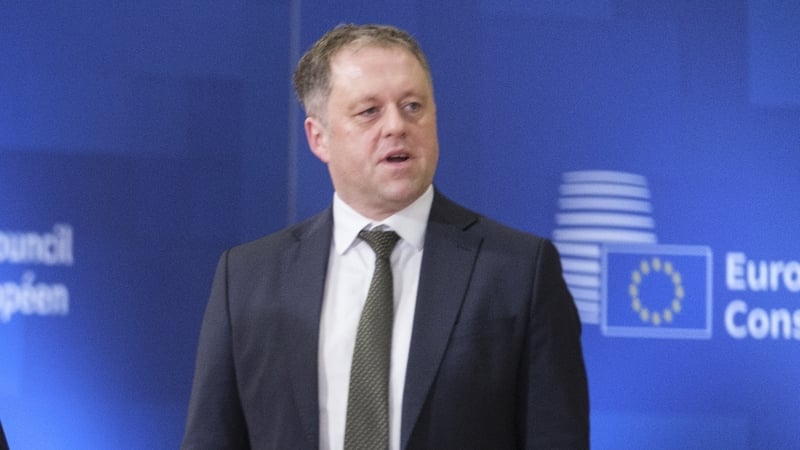
Despite reports that Ireland would join the group for a breakfast meeting ahead of the ministerial meeting this morning, Minister for State for European Affairs Thomas Byrne said he had been invited, but had declined the invitation because of Ireland's upcoming presidency of the EU.
Speaking to RTÉ News in Brussels, Minister Byrne said: "There was a meeting this morning, which I was invited to. I didn't attend. My permanent representative, Aingeal [O'Donoghue], went as an observer only to that meeting because we're in pre-presidency mode.
"I'm very, very conscious that there are different views around the table for the MFF. We, as presidency, when we start in July, will need to be the honest broker in the MFF [negotiations], and we take that role very, very seriously.
"So, I don't want to start falling into camps on the MFF at this particular point."
Negotiating a common position by member states on the seven year budget will be a key challenge for the Irish presidency ahead of an EU summit in December.
While Sweden, Denmark, Finland, Austria, the Netherlands, Germany, France and Belgium were expected to attend the net contributors club, a rival group of 16 countries - including Italy, Spain and Poland - have pushed back against any cuts to the budget.
"Ireland has never described itself as a frugal [member state]. I’m not sure I've ever heard anybody describe us as frugal on EU policy", said Mr Byrne.
"We want an efficient budget that works for European taxpayers, but we also see the value in having a strong European budget.
"We very deliberately last summer published our priorities for the MFF at an early point, so that we would have our priorities out there, and they're well known, because we knew that when we take the presidency, we cannot continue to advance a national interest.
"That is starting to happen now as we get into this pre-presidency mode," he added.
It is understood Minister Byrne declined an invitation to a previous gathering of ministers from net contributor member states.
'Negotiating box'
Arriving at the meeting, Sweden's Europe Minister Jessica Rosencrantz said: "Sweden’s position is clear, we need a better budget, not a bigger budget. That is why I hosted a meeting this morning with like-minded countries and we agree on many aspects of the budget, one being more modernisation in the budget and for a stronger rule-of-law conditionality.
"There is limited room for increased contributions [to the EU budget] from us as a member state."
The Cyprus Presidency of the EU will bring forward a so-called "negotiating box" containing broad amounts of money that could make up the seven year budget.
EU leaders will have a first substantive discussion on the budget when the meet at a summit in Brussels on 18 June. Ireland will then take over the process when the presidency begins in July.
"Our objective is to bring everyone together," said Minister Byrne. "We've achieved that so many times, and there's no reason why we can't do it again this time."
Arriving a short time later for a meeting of farm ministers, Minister for Agriculture, Food and the Marine Martin Heydon was asked if Ireland supported a bigger EU budget.
He said: "Yes, and obviously, during our presidency, the MFF will be a key part of the negotiations that Ireland will be looking to progress.
"From the perspective of the overall CAP budget, I'm acutely aware of the importance that many member states are putting on the area of defence, and I would say at the heart of the Common Agricultural Policy is food security, and it should be discussed in that context of defence and beyond, building our resilience around food security, the same as energy security [which] is a key part of that."
Minister Heydon said Ireland still supported a single EU candidate to be the next director-general of the UN’s Food and Agriculture Organisation (FAO), which will be voted on by UN member states next year.
So far, Ireland, Spain and Italy have put forward candidates, with neither country appearing willing to withdraw their candidate in order for a single EU contestant to emerge.
He told reporters in Brussels: "It is something we have a big ambition for in Europe, and Ireland supports the selection of an individual candidate.
"Obviously, we have a strong candidate in Phil Hogan, and Ireland's position has always been really clear. We agreed back in February that the best approach here is for all member states to agree one European candidate, and that would still be Ireland's position."