Ireland is going to significantly exceed its greenhouse gas emission targets for 2030, the Environmental Protection Agency has said.
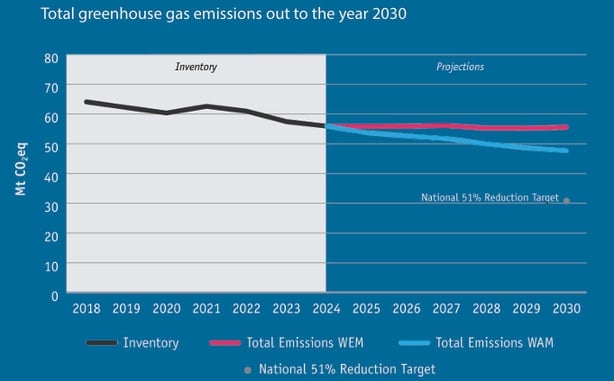
Its latest projections show that fully implementing the wide range of additional climate measures currently under discussion, would only deliver half the reduction in emissions the country is obliged to achieve by 2030.
The EPA said there must be a strong focus on implementation of policies and measures that will deliver wide-ranging benefits.
These include environmental protection, supporting public health and wellbeing, and reducing Ireland's dependence on fossil fuels.
Ireland has two separate legally binding targets for greenhouse gas emissions.
One is dictated by Ireland's own Climate Act. It is to ensure emissions fall to 51% below 2018 levels by the year 2030.
The other, from the EU Effort Sharing Regulation, is to ensure emissions are 42% below 2005 levels by that same year, 2030.
The EPA report says Ireland is way off achieving either of these targets.
Read the report in full here
The Government has promised additional climate-related measures are in the pipeline - things such as more electric cars, more heat pumps, fewer cattle and more imported and renewable electricity.
However, the report states that even if all of these promised additional measures are delivered on time, the best Ireland can achieve is a 25% emissions cut under the Climate Act definition, and a 23% reduction under the EU definition.
Both projected outcomes suggest Ireland’s climate actions are not strong enough.
A recent joint report by the Fiscal Advisory Council and the Climate Change Advisory Council suggested that failure to achieve the 2030 emissions targets could cost the country between €8 and €26 billion in fines and carbon credits.
EPA Director General Dr Eimear Cotter said that while greenhouse gas emissions are declining, European and national emission reduction targets are projected to be missed.
"There must be a renewed focus on delivering the actions to meet Ireland’s climate targets which will be a significant challenge given the short timeframe to 2030," she said.
The EPA emphasises that, apart from saving billions in potential fines, meeting Ireland’s emissions targets will deliver multiple other benefits.
These include reducing Ireland’s reliance on fossil fuels in electricity, transport and heating and strengthening national energy security and resilience.
It will also improve public health, provide green employment and protect Ireland's environment.
Dr Cotter said that overall, the emissions trends outlined in the EPA report demonstrate that progress is achievable but accelerating delivery of promised climate policy measures is critical.
"Renewable energy is now expected to provide nearly 60% of Ireland’s electricity by 2030. It is imperative given the increasing demand for electricity across several sectors, that renewables are delivered at the pace and scale required to meet this demand," she added.
Gaps widening and narrowing
The EPA greenhouse gas projections report is based on the latest information provided by governmental bodies and sector representatives.
It indicates that the gap to the targets is widening in some sectors of the economy, while narrowing in others.
Transport, industry and the commercial and public buildings sectors are projected to be the furthest from achieving their sectoral emission ceilings in 2030.
Meanwhile, agriculture emissions are projected to reduce by up to 19% - depending on the level of implementation of measures outlined in Government policies and plans.
These include changes in nitrogen fertiliser usage, switching to different fertilisers and lower anticipated livestock numbers.

Emissions from transport are projected to reduce by up to 28% over the period from 2018 to 2030, if the measures set out in plans and policies are implemented.
These include at least 751,000 electric vehicles on the road by 2030, increased biofuel blend rates and measures to support more sustainable transport.
In the energy sector, the continued rollout of renewable electricity generation to provide up to 59% of Ireland’s electricity by 2030, as well as increased importation of electricity from interconnectors, are contributing to reductions in Ireland’s emissions.
However, the EPA says delayed delivery of planned renewable energy projects such as offshore wind has lowered the potential for emissions savings by 2030.
EPA Programme Manager Dr Conor Quinlan said the shortfall to the 2030 targets is narrowing in some sectors.
"For example, emissions in the transport sector are now projected to reduce by up to 28% compared with 21% projected last year.
"Encouragingly, projections for electric vehicle uptake have improved, reflecting growing confidence in the transition to cleaner transport."
In contrast, the emissions gap is widening in other sectors such as the residential sector where emissions are now projected to go down by up to 18%, compared with a 22% fall projected a year ago.
This deterioration is the result of a lowering in the uptake of home energy improvement measures, including planned heat pump installation in existing dwellings.
The EPA said it is imperative that ambition and action is maintained across all sectors if Ireland is to meet its targets and realise the benefits of decarbonisation for society.