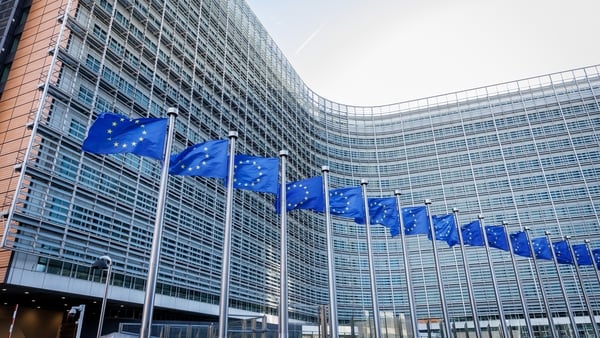
The European Commission has called on member states and the European Parliament to finally reach an agreement on ratifying the EU-US trade agreement announced last August.
The deal requires the EU to pass legislation in order to end tariffs on most US industrial goods.
As part of the ratification process, agreement must be reached between the member states and the European Parliament, based on a legal proposal from the Commission.
After six hours of negotiation on 6 May, talks between MEPs on the parliament's trade committee and Cypriot officials, representing member states under the Cyprus presidency, broke down without a breakthrough.
US President Donald Trump has threatened to slap tariffs of 25% on European car makers if the EU does not ratify the agreement reached at his golf club in Turnberry, Scotland last July.
Under the deal in principle, the EU agreed to scrap tariffs on most US industrial goods, while Washington would cap tariffs on most European goods at 15%.
The ratification process was thrown into doubt after President Trump threatened to seize Greenland by force and the US Supreme Court issued its ruling that the White House’s so-called Liberation Day tariffs on EU and global imports to the US were unlawful.
MEPs have also sought extra conditions, including that the EU would pause the trade agreement until the Trump administration drops tariffs on European steel.
Member states and MEPs will resume negotiations tomorrow.
Last week, following the failed negotiations, the chair of the European Parliament trade committee Bernd Lange said: "We have just concluded a constructive second trilogue [three way negotiation] during which we made good progress on the issue of the safeguard mechanism and the review and evaluation of the main regulation, but there is still some way to go".
A number of capitals want swift agreement in order to prevent the threat of higher tariffs.
European Commission spokesperson Paulo Pinho said it "absolutely makes sense" to strengthen and grow the transatlantic trade relationship.
"We struck a deal last August with the United States for fair, stable, balanced, and mutually beneficial trade. We are committed to delivering on it.
"A deal is a deal, so we are ready to deliver on our part of the deal, and we are now really at the very final stages of implementing our remaining joint statement commitments with the European Parliament, with the member states in the Council [of the European Union].
"We've made very good progress at the last trilogue on 6 May, and we are now confident that we will make progress towards the final deal at the next trilogue, which is taking place tomorrow," Mr Pinho said.
'US remains one of our most important trading partners'
Speaking in Brussels following a meeting of EU development ministers, Minister of State Neale Richmond said: "The US remains one of our most important trading partners, as well as a political ally, even when we don't always see eye to eye. But what was agreed in Turnberry now needs to be put into a legislative basis. We believe that there have been good negotiations and good progress, and we very much hope that Cyprus, on behalf of the other EU member states, as the Council presidency, will be able to push this along and maybe even get us towards the next [European Parliament] Strasbourg plenary session for a vote."
He said EU development ministers had discussed ways to ensure humanitarian support was extended to countries like Sudan to ensure that fertilizer and food systems remained in place despite the closure of the Strait of Hormuz, due to the Iran War.
"One of the biggest issues is negotiating as one bloc to make sure humanitarian workers can actually get the food and the emergency supplies into the people that need it, equally, in the more developed countries that we actually work together to use the scant resources that are in-country to make sure they're distributed evenly to the people who need them most. It's all about Europeans actually talking together, working with the European Union itself, and crucially not cutting our humanitarian or development budgets."
He said that one of the key priorities of Ireland's EU presidency was to ensure that humanitarian and development aid was ringfenced in the seven-year EU budget, known as the Multiannual Financial Framework (MFF). The MFF negotiations between member states and the European Parliament will likely dominate the Irish presidency, which begins on July 1.
"We want to make sure that our values come across in that this isn't a transactional thing," he told reporters. "We're not looking to do what other Member States are doing and move certainly from and aid to a trade basis or somehow make this on a quid pro quo basis. We believe in development because it's the right thing to do and because it is an investment in our own betterment at home.
"We'll be pushing very hard to move negotiations along to make sure that we can bring together like minded member states who perhaps have been a bit quiet over the last year or two to ultimately save the development, save the development cooperation infrastructure. We're at a period of time where the EU and its member states are now over 50% of the global development infrastructure. We can't have EU member states cutting their budgets and then trying to cut the EU's development budget at the same time."