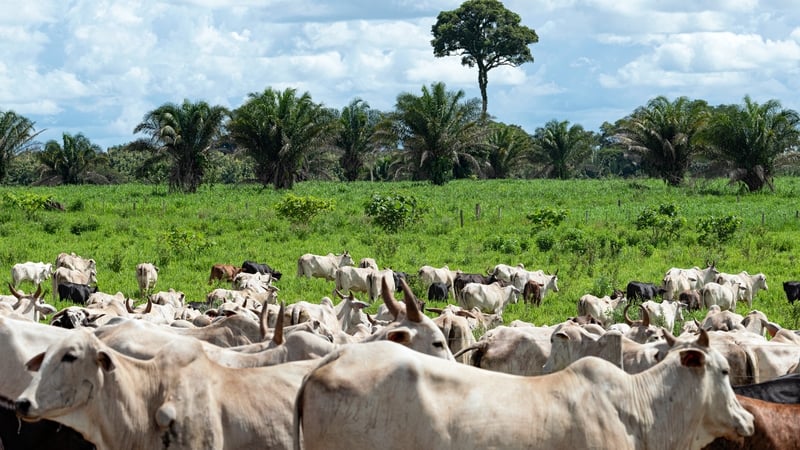

The European Commission has confirmed that Brazilian beef and other products will be banned from the EU from 3 September unless Brazil complies with EU rules on antibiotic use in animals throughout their lifetime.
Commission spokesperson Eva Hrncrova said in a statement: "The Commission confirms that Brazil is not included in the list [of countries complying with EU rules], meaning that it can no longer export to the EU commodities (both food producing live animals and derived products) such as bovine, equine, poultry, eggs, aquaculture, honey and casings, with effect as from 3 September 2026."
The IFA has welcomed the move as "an important first step."
Francie Gorman, the IFA's president, said: "The commission is finally taking the Antibiotic/Anti-Microbial Resistance (AMR) threat posed by Brazilian beef production somewhat seriously.
"This follows the IFA/Irish Farmers Journal investigation of the unregulated use of all levels of antibiotics in Brazil late last year," he said.
Mr Gorman said that across four Brazilian states controls of antibiotic use on farms were extremely lax, with investigators able to purchase an unlimited amount of antibiotics with few checks or queries.

Tonight, the European Commission said that under EU rules, which have applied within the bloc since 2022, the use of antimicrobials to promote growth or increase yield in livestock is not allowed, "nor should antimicrobials that are reserved for human infections be used to treat animals".
The statement added: "These rules are an essential part of the EU’s "One Health" agenda to fight antimicrobial resistance (AMR) - the biggest public health threats of our time."
The Commission said that from 3 September, all imports to the EU of animals or animal products for human consumption must also comply with these rules and that only third countries that provided guarantees of compliance were to be allowed to export such products to the EU.
Today, member state officials who make up the Standing Committee on Plants, Animals, Food and Feed agreed an updated list of countries which the Commission deems are compliant.
The list includes 21 new countries and five previously listed countries. Brazil has been excluded from the list.
"To be included in the list of third countries authorised to export to the [European] Union, Brazil must ensure compliance with the Union requirements on the use of antimicrobials for the entire lifetime of the animals that the exported products originate from," said Ms Hrncirova.
"We have closely engaged with the Brazilian authorities on this issue and will continue contact to work towards their compliance with these requirements. Once compliance is demonstrated, the EU will be able to authorise the exports."
The issue of the use of antibiotics in beef farming was a key part of the IFA’s - and the Irish government’s - resistance to the EU-Mercosur trade agreement, which came into provisional effect on 1 May.
Brazil is the only Mercosur country which is not on the list of approved exporting countries.
In his statement, Mr Gorman said: "The Brazilian authorities do not have a good track record of compliance with EU auditors and trade requirements as evidenced by the finding of the DG Sante [a division of the European Commission] inspections.
"There can be no fudging of this issue by the Commission; there can be no short cuts taken with an issue this serious for human and animal health."
He added: "The starting point has to be a comprehensive database of all bovine animals in the country to allow prescribing of antibiotics for farm animals and the infrastructure must then be built around that to incorporate prescribing, dispensing and treatment records similar to what we have in this country."
Mr Gorman said it would take years for such systems to be developed and put in place.
"Until this happens, not one ounce of Brazilian beef should be allowed enter the EU if the Commission are serious about AMR and if today's announcement is to have any credibility," he said.