


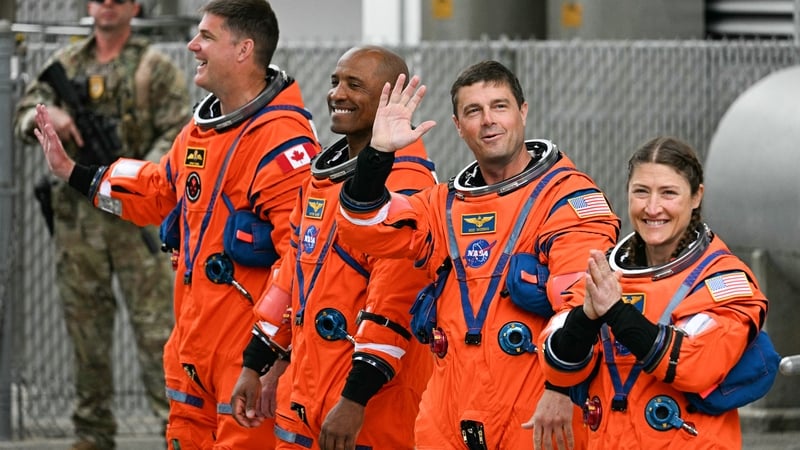
Four astronauts are strapped into their seats and sealed inside their space capsule, ready to blast off aboard a massive rocket on a historic odyssey around the Moon for the first time in more than 50 years.
The mission dubbed Artemis II has been years in the making and faced repeated setbacks and massive cost overruns, but is finally scheduled to take off from Florida as early as 6:24pm (11.24pm Irish time).
The weather was expected to be favourable, with a 90% chance of conditions suitable for launch.
Anxiety briefly spiked when less than two hours before the launch window was to open, NASA said engineers identified a technical issue related to the rocket's flight termination system, a key safety mechanism.
But cheers rang out among spectators gathered around a live broadcast when a US space agency official said the problem was resolved.
The team, clad in bright orange suits with blue trim, includes Americans Reid Wiseman, Victor Glover and Christina Koch along with Canadian Jeremy Hansen.
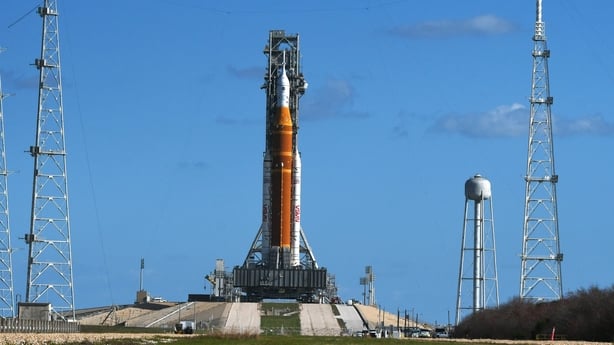
Their approximately 10-day mission will see them hurtle around Earth's natural satellite without landing, much like Apollo 8 did in 1968.
The journey marks a series of historic accomplishments: it will send the first person of colour, the first woman and the first non-American on a lunar mission.
If the mission proceeds as planned, the astronauts will set a record by venturing farther from Earth than any human before.
It is also the inaugural crewed flight of NASA's new lunar rocket, dubbed the Space Launch System (SLS).
The mammoth orange-and-white rocket is designed to allow the United States to repeatedly return to the Moon, with the goal of establishing a permanent base that will offer a platform for further exploration.
Even with all the potential records on the line, Mark Kelly, a US senator from Arizona and a retired astronaut, emphasised that the mission was about something much bigger.
"They're not doing it for themselves," he said of the astronauts. "They're doing it for the country.
"When you make a decision to climb into a rocket ship and lift off with over eight million pounds of thrust on your back, you don't take the decision very lightly," Mr Kelly added.
"But for our nation, there's a tremendous upside."
Repeated setbacks
Under bright Florida sunshine, four giant tanks on the rocket were filled with liquid hydrogen and oxygen.
A full load of fuel boosts the rocket's weight by 1,000 tons, for a total of more than 2,600 tons.
The mission was originally due to launch as early as February. But repeated setbacks stalled the mission and even necessitated rolling the rocket back to its hangar for analysis and repairs.
If this launch is cancelled or delayed, there are more liftoff opportunities through Monday, though forecasts show slightly less favourable weather later in the week.
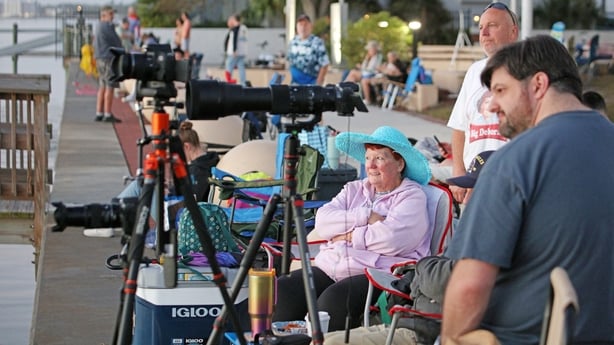
Local police authorities said they expected around 400,000 people to gather near the so-called Space Coast to watch history in the making.
"We're looking forward to it, we've never seen anything like this," 76-year-old retiree Melinda Schuerfranz of Ohio said.
'Beyond the stars'
Artemis is facing pressure from US President Donald Trump, who has pushed the pace of a programme that aims to see boots hit the lunar surface before his second term ends in early 2029.
Artemis II's objectives include verifying that both the rocket and the spacecraft are in working order to pave the way for a Moon landing in 2028.
That deadline has raised eyebrows among experts, in part because Washington is relying on the private sector's technological headway.
The current era of American lunar investment has frequently been portrayed as an effort to compete with China, which is aiming to land humans on the Moon by 2030.
Mr Trump will be tied up this evening addressing the nation in his first such speech since US and Israeli forces began strikes on Iran on 28 February, igniting a regional war and a global energy crisis.
But he took a moment to drop a line on social media ahead of the planned launch.
"We are WINNING, in Space, on Earth, and everywhere in between - Economically, Militarily, and now, BEYOND THE STARS," Mr Trump posted on Truth Social.
"Nobody comes close! America doesn't just compete, we DOMINATE, and the whole World is watching," he added.
