


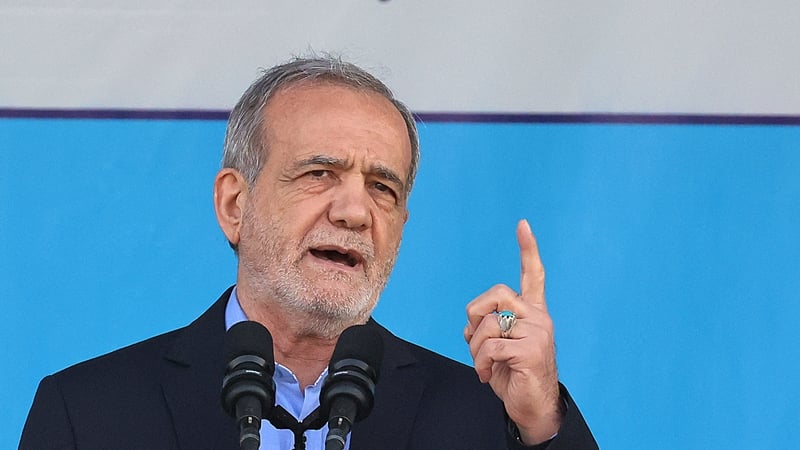
Iran's president asked the people of the United States if the Middle East conflict was truly putting "America First", accusing the US of war crimes and being influenced by Israel ahead of a much-anticipated address by Donald Trump.
Sparked by a US-Israeli offensive launched against Iran on 28 February, the war has rippled across the Middle East, creating global economic turmoil.
More than a month in, President Trump claimed Iranian President Masoud Pezeshkian was seeking a ceasefire, a claim Tehran has denied.
"Attacking Iran's vital infrastructure - including energy and industrial facilities - directly targets the Iranian people," Mr Pezeshkian said in an open letter, published to his website.
"Beyond constituting a war crime, such actions carry consequences that extend far beyond Iran's borders."
They sow "instability, increase human and economic costs", and plant "seeds of resentment that will endure for years", he continued.
"Exactly which of the American people's interests are truly being served by this war?"
Casting the conflict as costly for both sides, Mr Pezeshkian asked if there had been "any objective threat from Iran to justify such behaviour".
He also questioned whether Washington entered the war "as a proxy for Israel, influenced and manipulated by that regime".
"Is 'America First' truly among the priorities of the US government today?" Mr Pezeshkian asked.
He also said ordinary Americans were not Iran's enemy, "even in the face of repeated foreign interventions and pressures".
His letter comes ahead of US President Donald Trump's prime-time address to Americans at 9pm (2am Irish Time) on the Iran war in the face of plunging approval rates, economic jitters and spiralling diplomatic fallout.
Mr Trump said he would consider a ceasefire only when the Strait of Hormuz was reopened, with Tehran's effective closure of the vital oil corridor sending shockwaves through the global economy.
But in his address later, Mr Trump is expected to try and reassure the nation that US goals are being met and that he has a plan for completing the war, which has roiled the US economy and helped drive the 79-year-old Republican's polls into deeply negative territory.
Recent polling shows Mr Trump's overall approval rating slipping below 40%, with disapproval climbing above the mid-50s as voters sour on both the war and its economic fallout.
Support for the Iran campaign itself is underwater, with majorities opposing the offensive and independents turning sharply against it.
The economic picture has compounded the problem.
Gasoline prices have surged above $4 a gallon (over $1 a litre) for the first time in years, while consumer confidence has weakened, dragging down Mr Trump's already fragile standing on the economy.
A White House official said the president's speech would highlight the success of the military campaign in achieving the goals sketched out "prior to the operation."
Although Mr Trump's messaging has been inconsistent, the administration says these goals are to:
- destroy Iran's navy.
- destroy its missiles and production facilities.
- neutralize its militia proxies across the region.
- guarantee that Tehran can never obtain a nuclear weapon.
"He is expected to reiterate the two-to-three-week timetable for concluding the operation that he stated yesterday," the White House official said.
See-sawing between combative and conciliatory
President Donald Trump has said Iran had asked for a ceasefire, but ruled out any truce until the vital Strait of Hormuz was reopened for crucial energy shipments.
Tehran has insisted there are no ongoing negotiations, and has launched fresh missile strikes on Israel and US-allied Gulf nations, as AFP journalists reported massive explosions in the Iranian capital.
Mr Trump's statements have see-sawed between combative and conciliatory since US-Israeli strikes on February sparked the regional war and a global energy crisis after Iran choked off shipping through the narrow Strait of Hormuz.
Iranian President Masoud Pezeshkian had said the Islamic republic had the "necessary will" for a ceasefire, but only if its foes guaranteed that hostilities would not return.
President Pezeshkian said in a letter addressed to the American people that his country harbors no enmity towards ordinary Americans, Press TV has reported.
He said in his letter that portraying Iran as a threat was "neither consistent with historical reality nor with present-day observable facts".
We need your consent to load this rte-player contentWe use rte-player to manage extra content that can set cookies on your device and collect data about your activity. Please review their details and accept them to load the content.Manage Preferences
In a post on his Truth Social platform, Mr Trump said Mr Pezeshkian "has just asked the United States of America for a CEASEFIRE!"
"We will consider when Hormuz Strait is open, free, and clear. Until then, we are blasting Iran into oblivion or, as they say, back to the Stone Ages!!!"
Iran's Revolutionary Guards said the strait, through which one-fifth of the world's oil normally passes, would remain closed to the country's "enemies".
The guards also confirmed they hit an oil tanker in the Gulf they said belonged to Israel. A British maritime security agency said the vessel was struck off Qatar, reporting damage but no casualties.
'Every day we hear drones'
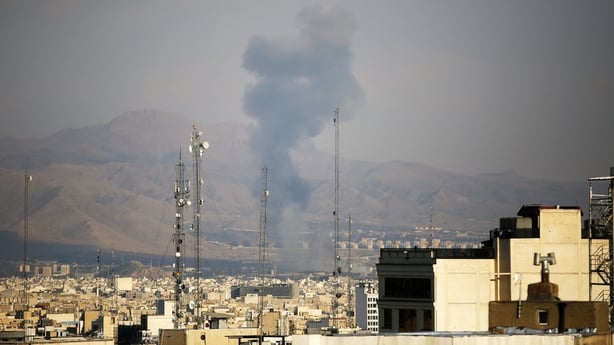
An AFP journalist reported huge explosions in Tehran this afternoon and earlier strikes near the former US embassy, now a symbol of decades of US-Iranian tensions.
Iranian media also said steel complexes in central and southwest Iran were hit, causing "significant damage and destruction".
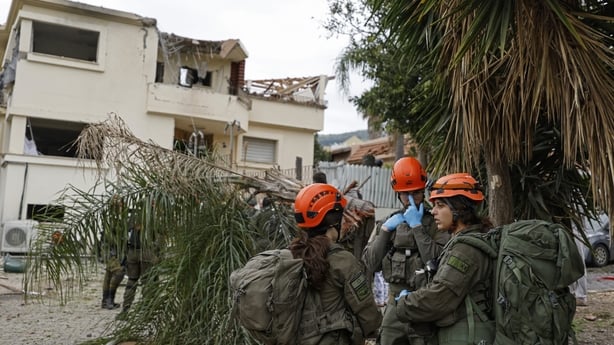
The Israeli military confirmed it struck Tehran, while emergency services in Israel said an Iranian missile attack wounded 14 people, including an 11-year-old girl.
Israel also said its air defences had responded to a missile fired from Yemen - the third attack by the Iran-backed Houthi rebels since they entered the war over the weekend.
In Lebanon, seven people were killed in strikes around south Beirut, the health ministry said, with the Israeli military saying it had struck a senior Hezbollah commander.
A Lebanese security source and a Hezbollah source both told AFP that the strike had killed Hezbollah's top commander for Iraq military affairs.
AFP correspondents at the scene saw a blackened, debris-strewn street.
Israel launched broad strikes and a ground offensive against Lebanon after attacks on 2 March by the Tehran-backed militant group Hezbollah.
The Lebanese health ministry said that Israeli attacks had killed more than 1,300, among the thousands reported killed across the region since the war began, mostly in Iran.
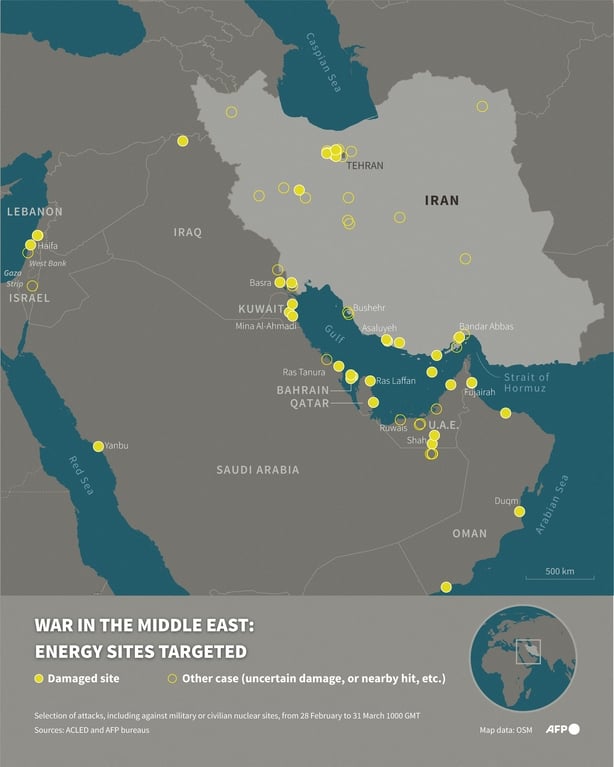
Iran has also carried out retaliatory attacks on nations in the Gulf it says have been launchpads for strikes.
A Bangladeshi national was killed by falling shrapnel from an intercepted drone in the United Arab Emirates.
Strikes in Kuwait caused a large fire in fuel tanks at its international airport, Bahrain's interior ministry said a fire broke out at a business facility, and Saudi Arabia said several drones were intercepted.
Meanwhile, a drone strike caused a massive fire at the storage facilities of an engine oil firm in Iraq's autonomous Kurdistan.
"Every day, we hear the sound of drones," Waad Abdulrazaq, a 31-year-old truck driver, near Iraq's Erbil international airport said.
"We hear them in the morning, and we hear them at night. We can no longer sleep or live in peace."
Energy crisis
Optimism sparked by Mr Trump's comments on the timeline for the end of the war pushed oil prices down and stock markets rallied in Europe and Asia.
But Iran's chokehold on critical oil and gas shipments through the Hormuz has sent energy prices soaring and unleashed global economic turmoil.
Average US gasoline prices topped $4 a gallon for the first time in four years this week, while European inflation spiked and governments around the world started to unveil support measures.
"We're a small outfit," driver Nicolas Barthes said at a protest against soaring fuel prices in the French city of Toulouse. "The additional diesel cost for me this month is €15,000, and we're not managing to pass all of that on."
Susannah Streeter, chief investment strategist at Wealth Club, said prices were still about 50% above pre-war levels, showing "scepticism still remains about Trump's claims of progress".
Mr Trump has criticised allies for not helping in the war, and President Emmanuel Macron repeated that France would not take part.
Britain said it would host a meeting of about 35 countries this week to discuss how to reopen the strait.
Washington has not said who it is speaking with in Iran, which has denied it is in talks. Iranian Foreign Minister Abbas Araghchi told Al Jazeera he still receives messages from US envoy Steve Witkoff, "directly, as before, and this does not mean that we are in negotiations".
Mr Trump threatened earlier this week to "obliterate" Iran's oil wells, its main Kharg Island export terminal, and possibly water desalination plants if the Islamic republic didn't make a deal.
Mr Trump has also rattled allies, saying he is "beyond reconsideration" on US membership in NATO after European countries declined to back the Iran campaign - a stance that risks widening a transatlantic rift at a moment of crisis.
