European Union member states have approved the EU-Mercosur trade agreement through a weighted majority vote.
Ireland was one of five countries, including France, Austria, Hungary and Poland, to vote against the agreement with Argentina, Brazil, Paraguay and Uruguay at a meeting in Brussels.
Twenty member states voted in favour, with Belgium abstaining, allowing for a qualified majority of at least 15 member states, representing at least 65% of the EU population.
Suggestions that France had tried to convince Romania to join the No camp appeared ill-founded.
Italy had earlier joined the Yes camp, thus preventing a blocking minority.
In the end it was a comfortable majority, with 20 out of 27 member states supporting the deal.
The agreement must now be ratified by the European Parliament.
European Commission president Ursula von der Leyen said she looked forward to signing the accord "soon".
"This historic trade deal is further proof that Europe charts its own course and stands as a reliable partner," she said.
Ms von der Leyen also confirmed she would travel to Paraguay for the signing, without specifying a date.
Although the trade provisions can be applied provisionally, the agreement cannot come into force formally until the European Parliament has given its consent. That vote is expected in April or May.
The chair of the Parliament's trade committee Bernd Lange said he was confident the vote would pass.
However, in the meantime, intense lobbying by farming organisations is expected.
'It's not a done deal'
Tánaiste Simon Harris has said the EU "can't take for granted" that the deal will go ahead.
Speaking to reporters at the Stripe Young Scientist exhibition, Mr Harris said: "No officials, at any level, including the European Commission, should ever take for granted the decisions that the democratically elected representatives right across the European Union may decide to make in the European Parliament."
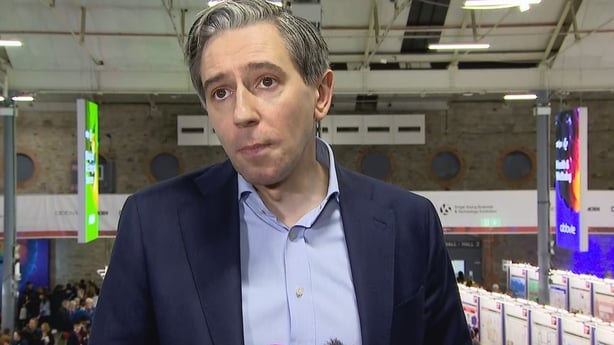
Mr Harris conceded: "It looks more likely than not that it will pass the parliament."
But he added "it's not a done deal" and said "there's still a window of time" to "outline the concerns that we have in relation to the agreement".
He said the Government had not ruled out supporting the deal "if changes and improvements" are made around food safety and "parity" with environmental standards.
Mr Harris said Ireland "benefits from free trade" but that "it has to be free trade that doesn't expect our farmers or our consumers to adopt a different set of standards".
Speaking on Limerick's Live 95 radio, Minister for Culture Patrick O'Donovan said Fianna Fail and Fine Gael MEPs will oppose the EU-Mercosur agreement when it is brought to the European Parliament.
He said government party MEPs are "bound" by the programme for government and the decision by the Minister for Agriculture Martin Heydon not to support the deal.
However, the Members Statute, which has been part of EU law since 2005, says members "shall vote on an individual and personal basis", "shall not be bound by any instructions" and "shall not receive a binding mandate".
Doherty and Andrews to vote for Mercosur
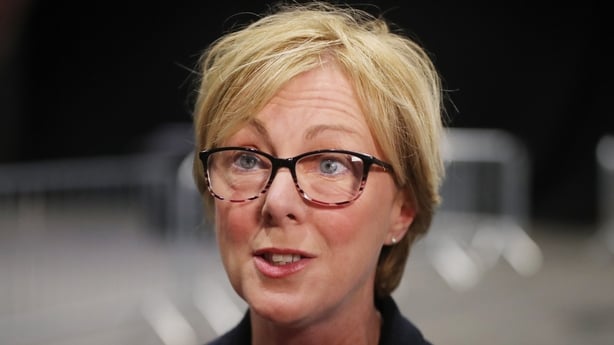
Fine Gael MEP for Dublin Regina Doherty said she would be voting for the agreement, rejecting the suggestion she was obliged to follow her party's lead.
"I don't think we’re bound by any Programme for Government," she told RTÉ News. "That’s never happened before.
"If there was a conversation to be had, I think it should have been had before Patrick went on the radio to make decisions for us.
"I don't know how to answer policy without being pedantic, but I make decisions in the best interest of my constituents, not just in Dublin, but also from a wider perspective.
"[Taoiseach] Micheal Martin spent the last week in China trying to diversify our trade markets. We need desperately to do the same in Europe. We can't say one thing on one hand and do something on the other hand."
"I understand pragmatically the decision from government. They have to represent the whole of the island.
"The view in Dublin has different perspectives, maybe, than some other communities. On that basis, I will be supporting the jobs of our pharmaceuticals, our tech industry, and our agri food [industry]."
Yesterday, Fianna Fáil MEP for Dublin, Barry Andrews said he would also be voting in support of the agreement.
In a statement he said: "When this deal comes before the European Parliament, as it must in the coming weeks, I will be voting to support the huge number of Irish jobs which are so reliant on international trade."
IFA president Francie Gorman described the news the EU had provisionally approved the deal as "very disappointing".
He said: "This morning's outcome shows that the Irish Government was not alone in expressing deep reservations about the deal and what it means for farmers and public health.
"The Commission cannot ignore the scale of the opposition to the deal."
Ireland's EU Commissoner McGrath welcomes deal approval
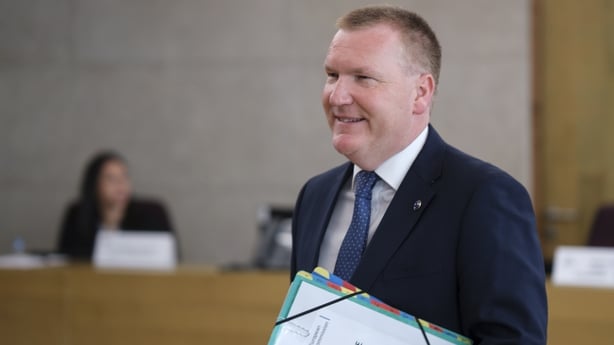
Ireland's EU Commissioner Michael McGrath welcomed the approval by member states of the EU Mercosur trade deal,
He said it showed Europe was intent on "deepening and diversifying its global network of trade relationships at a time of global uncertainty".
In a statement, he said the deal would open up significant export opportunities for multiple sectors, with the removal of tariffs on over 90% of EU exports.
This "gives EU businesses a valuable opportunity to gain a stronger foothold in a market of 270 million people, helping to create jobs and generate wealth in the EU," he said.
"This agreement reaffirms the EU's position as a champion of rules-based international trade, with minimal barriers," he added.
Mr McGrath said the Commission had heard the concerns of farmers and had "worked hard with member states and others in recent months to strengthen the safeguards and develop robust protective measures for this important sector".
He said: "Subject to the ratification by the European Parliament, we will work with all stakeholders to implement these safeguards in full.
"However, there also needs to be a recognition that this agreement opens up vast opportunities for the EU’s agri food sector and we will lend our full support to the sector in exploiting these opportunities over the years ahead.
"EU agri-food exports to Mercosur were worth €3.3 billion in 2024. The EU - Mercosur agreement will open unprecedented access to the countries of Mercosur for European farmers and food producers and we believe Europe’s agri food sector is well placed to take advantage of these opportunities."
Follow live: EU countries approve Mercosur deal
Green Party leader Roderic O'Gorman said the agreement was "not fair".
A protest against the deal is scheduled to take place in Athlone on Saturday.
Earlier, European Union sources expressed disappointment at the Irish Government's rejection of the agreement, given what they described as Ireland’s traditional image as an export-oriented economy.
Germany said that a trade deal between the European Union and the South American Mercosur bloc "sends an important signal".
"While others are closing themselves off and pursuing increasingly aggressive trade policies, we are focusing on new partnerships," Germany's Finance Minister Lars Klingbeil said in a statement.
The endorsement of the agreement marks a key milestone in a long process to forge the world’s largest free-trade deal, bringing together two of the globe’s biggest markets in terms of population size and trade volume.
The determination to finally get it over the line was accelerated by US President Donald Trump’s return to the White House and his upending of global trading norms.
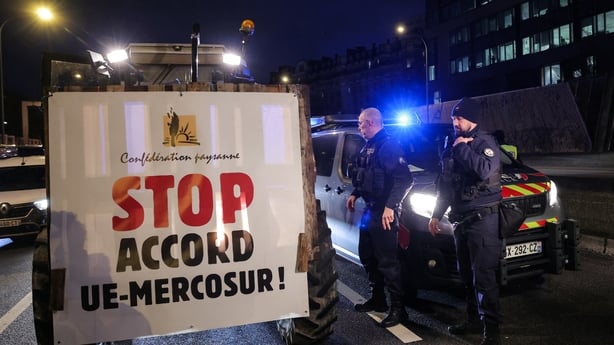
For the European Commission, this was about creating a platform upon which a rules-based trading system could prevail, and about building a bridge to Brazil, Argentina, Paraguay and Uruguay who were signalling their desire to diversify trade away from the United States.
Yet, environmental groups and farmers have railed against the prospect of more cheaply produced beef and poultry imports hitting sensitive markets at home, with further fears about hormone beef and products tainted with antibiotics.
We need your consent to load this rte-player contentWe use rte-player to manage extra content that can set cookies on your device and collect data about your activity. Please review their details and accept them to load the content.Manage Preferences
The European Commission has insisted such goods remain banned in the EU, and that audits within Mercosur will be increased, as will sanitary and phytosanitary controls at points of entry into the EU.
There was disappointment last night in some EU quarters at Ireland’s decision to reject the trade deal, with one senior source suggesting the Government had been unwilling to endorse concessions made to farmers and had failed to present the potential positives of the deal in other sectors of the Irish economy.
Read more: What will the impact of Mercosur be on Irish shoppers?
Professor of European Agricultural Policy at Trinity College Dublin Alan Matthews said the benefits of the deal are clear, with the economic assessments showing there will be small but positive benefits for Ireland and the EU as a whole.
Speaking to RTÉ's Six One, Prof Matthews said: "We need to think about the global situation at the moment. Irish exports to the United States face tariffs, the dairy sector for example. China is also imposing tariffs on Irish exports of dairy products and pork.
"While Russia has closed its market for obvious reasons."
He said the Mercosur region in South America has high tariffs, but they are offering to reduce those tariffs to zero on nearly all European and Irish exports to that region.
He described this as a "great opportunity", adding that it would be remiss of Ireland not to take advantage of this.
Prof Matthews said the impact is small in overall terms, but it is "positive".
"It will help us to create more jobs in the country; we will be able to export more. We are an open trading economy, that is how we earn our living in the world.
"That is why it is an important agreement for us to ratify."