


Taoiseach Micheál Martin has said Ireland is ready to move ahead with the EU's proposed Savings and Investments Union (SIU) despite the Government's concerns over how a single EU supervisor might impact Ireland's financial services sector.
He was speaking on arrival at an informal EU summit in Limburg, Belgium, devoted to boosting Europe's economy and competitiveness.
Leaders are expected to push for a completion of the SIU, which aims to forge a greater investing culture at EU level through more accessible retail investment products that would be available across 27 member states.
Diplomats say some €11 trillion are kept in bank or savings accounts by EU savers, rather than invested in European companies.
The lack of venture and risk capital has long been seen as an impediment to the EU scaling up tech champions and competing with the US and China.
"Our position on the Savings and Investment Union is more positive now. Obviously, there are issues around the harmonisation of supervision, and from our perspective, we support a more harmonized approach. But that said, we're largely in favour of securitisation," Mr Martin said.
"We've put our hands up and said we're willing to progress this issue, because the broader issue of European competitiveness is at stake here," he added.
The Taoiseach said the SIU held promise for Irish SMEs in terms of accessing venture capital.
"The whole area of availability of capital for entrepreneurs and for SMEs in Europe is a very serious issue. Many of our own SMEs pivot in terms of US venture capital. We have some of our own venture capital through Enterprise Ireland funds. But, in the overall scale of things, that's limited enough," he stated.
The Taoiseach said there were concerns around a central supervisor within the framework of the SIU.
"We would have concerns about one single authority in terms of the impact on the respective financial services [sectors] in member state countries, including our own, because we are a big player".
"That's something we would be watching out for. But we believe, in the context of the [European] Commission's proposals, that there's a landing zone there to scale up," he added.
The Taoiseach also said Ireland had nothing to fear from the European Commission's suggestions that, in order to boost the EU economy, certain member states could forge ahead in policy areas where there was a lack of consensus or unanimity.
Such an approach - known as enhanced cooperation - is enshrined in the Lisbon Treaty and has been used in several recent iterations, such as support for Ukraine.
"Fundamentally, Ireland believes in a more competitive Europe, a more expanded single market, a deeper savings and investment union," he said.
"That ultimately benefits Ireland as well, and we've benefited enormously from the single market, so we've nothing to fear from enhanced cooperation," he stated.
Mr Martin expressed reservations about the concept of "European Preference", championed by France and others, in which member states would prioritise EU products and components when spending public money.
We need your consent to load this rte-player contentWe use rte-player to manage extra content that can set cookies on your device and collect data about your activity. Please review their details and accept them to load the content.Manage Preferences
"We're concluding trade deals all over the world, [including] with India, and it's somewhat counter to that to say that you have to have a more protectionist approach within Europe," he said.
"There’s a balance to be struck here. Certainly we need more self-reliance in core areas, [and] you do need to reduce risk in terms of over-dependencies," he stated.
"But we must protect the open, free-trade ethos of the European Union. There will be debates around that, and that whole European preference issue is one that we need to explore far more deeply," he added.
Tánaiste and Minister for Finance Simon Harris is to bring a memo to Government in the coming weeks setting out "a roadmap" for the introduction of a new savings and investment strategy.
Mr Harris said officials in the Department of Finance are working on proposals for the scheme, which is "designed to create better financial opportunities for citizens who wish to invest".
Mr Harris said there is an estimated €170 billion currently on deposit in Ireland and that one in five Irish adults are saving more than €120 per month, according to recent data.
"Hard working people must get better returns on their savings and that Ireland should follow other EU countries in introducing a savings and investment model,the Tánaiste said.
A spokesperson for Mr Harris said he is due to update the Government in the coming weeks on a new strategy "to help people get a greater return on their savings".
BPFI urges Government to set up domestic Savings and Investment Account
The Taoiseach's comments come after the banking sector urged the Government to introduce a domestic Savings and Investment Account (SIA) to encourage long-term investment and strengthen household financial resilience.
The Banking & Payments Federation Ireland (BPFI) said the move would also help to "channel more Irish capital into productive investment".
BPFI said the EU level debate on competitiveness and the future of the Savings & Investment Union (SIU), "highlights the growing need" for the Irish Government to introduce a domestic SIA.
The group, which represents the banking, payments and fintech sector, said there "low levels of participation" in EU capital markets by Irish consumers.
"Incentivising simple, long-term investing in line with the SIU, will enable the Government to boost participation in capital markets and increase the flow of domestic savings into Irish and European enterprises," it said.
The chief executive of the BPFI, Brian Hayes, said it is "vital that Ireland also examines what we can do at home" to strengthen long-term savings, investment and financial resilience.
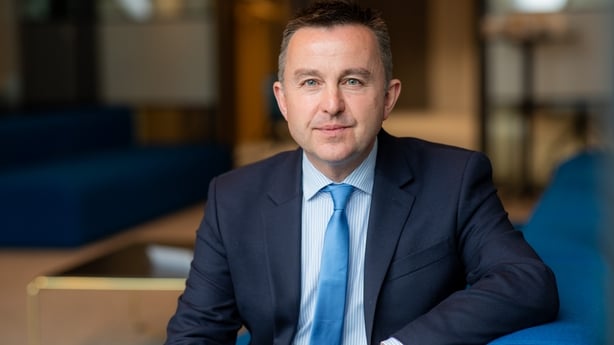
He believes a domestic SIA would give Irish households "a simple, internationally competitive way to build assets over time while ensuring more domestic capital is available for Irish businesses and the wider European economy".
Mr Hayes said an Irish SIA, modelled on successful systems in other EU countries, "would give savers a straightforward and tax efficient way to invest for the long term, while helping to mobilise more domestic capital for future Irish enterprises".
"Even a partial replication of such participation in Ireland would materially expand the pool of long-term domestic savings and support investment in strategic growth sectors."
As an example, he said Sweden’s investment account system has "seen assets rise to the equivalent of 31% of GDP by the end of 2024".
According to Mr Hayes, the current features of the Irish tax system, including the 33% capital gains tax rate and the deemed disposal regime on Exchange Traded Funds (ETFs), "act as strong disincentives, despite the clear benefits of diversified, long-term investing".
"A well-designed SIA based on international best practice would remove these barriers by including a simple and predictable tax structure, no withdrawal restrictions and no limits on geographic investment options," he added.
In advance of Ireland assuming the Presidency of the Council of the European Union from Cyprus in July until the end of the year, the BPFI renewed its call on the Taoiseach Micheál Martin to support "the broader agenda to deepen the Single Market and champion a renewed drive for regulatory simplification and the advancement of the Savings and Investment Union".
