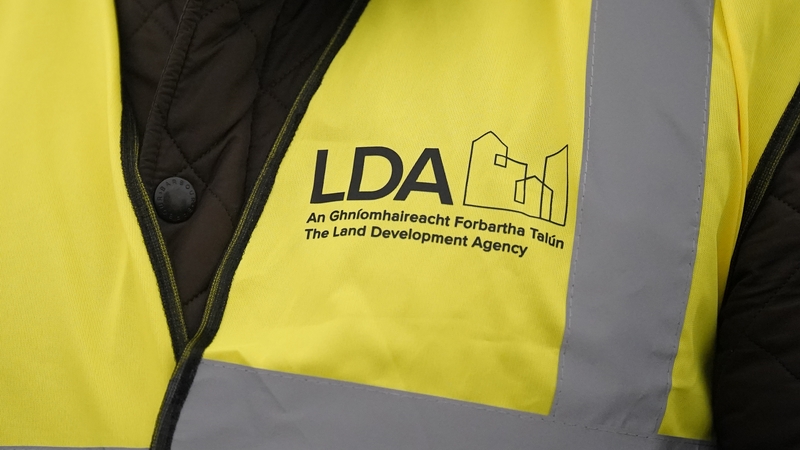

The Land Development Agency (LDA), the body responsible for coordinating the use of State land for housing, has been given the green light by Cabinet to use up to €5bn.
The organisation is mandated to provide 12,900 affordable cost rental homes between next year and 2028.
The Government has agreed to commit a further €1.25bn from the Ireland Strategic Investment Fund for the LDA and also give the agency permission to secure additional funding of €1.25bn.
The new money combined with an existing €2.5bn which has been already allowed under legislation means the LDA has access to a total of €5bn
Last week, the agency announced that it had started on the development of almost 220 affordable and social homes at the former Devoy Barracks in Naas, Co Kildare.
This week the LDA is said it has bought lands in Clongriffin in north Dublin with planning permission for over 1,800 homes and the potential to deliver a total of over 2,300 affordable and social units.
Minister for Housing Darragh O'Brien said: "Today's decision will give the agency the reassurance it needs to maintain this momentum."
Road Traffic Bill
Earlier, the Cabinet approved the publication of the new Road Traffic Bill which aims to reduce speed limits.
The bill also seeks to reduce road deaths by targeting four high risk, dangerous driving behaviours - speeding, intoxicated driving, not wearing a seatbelt and distracted driving.
Minister of State at the Department of Transport Jack Chambers brought the proposed law to Government and outlined to ministers that after a successful period reducing the number of road deaths, there had been a worrying increase in recent years with 180 road deaths and more than 900 serious injuries sustained so far in 2023.
This compares with 155 fatalities in all of 2022.
The Road Safety Strategy 2021-2030 sets the target of reducing road deaths and serious injuries by 50% by 2030.
The bill legislates for the safer default speed limits recommended by the Speed Limit Review published in September.
The review recommended default speed limit changes of 50km/h to 30km/h for "built-up areas", from 100km/h to 80km/h for national secondary roads, and from 80km/h to 60km/h on rural and local roads where three quarters of all road fatalities occurred last year.
The setting of speed limits for Irish roads is a devolved power of local authorities.
The bill will also address two anomalies within existing road traffic legislation which have emerged.
This concerns gardaí being able to detain motorists during the period after they have provided a sample for drug testing and before a result is processed.
The other anomaly relates to Section 2.8 of the Road Traffic Act whereby motorists avoid penalty points which would disqualify them from driving for six months and instead serve much shorter, ancillary disqualifications.
Measures will be introduced as part of this legislation as it progresses through the Oireachtas to address these matters.
Speaking after the Cabinet meeting, Minister for Transport Eamon Ryan said: "Tragically, we have seen an increase in the number of deaths in three out of the last four years.
"To turn this terrible trend around, we will need a variety of responses, including the implementation and enforcement of robust legislation that closes anomalies and helps ensure that our roads are as safe as they can be."
Climate action plan set to be approved
Minister for the Environment Eamon Ryan also sought Cabinet approval for Climate Action Plan 2024 (CAP24).
This is the second statutory climate plan since the Climate Action and Low Carbon Development (Amendment) Act 2021 was signed into law committing Ireland to 2030 and 2050 targets for reducing greenhouse gas emissions.
It will go out for public consultation.
Meanwhile, Minister for Further and Higher Education Simon Harris sought Government approval to establish a new research and innovation funding agency, Taighde Éireann - Research Ireland.
The new body will be an amalgamation of Science Foundation Ireland and the Irish Research Council.
Road Safety Authority chairperson Liz O'Donnell has welcomed the progression of the Road Traffic Bill.
She said statistics shows that more than 70% of fatal road crashes occur on rural roads, and that 43 pedestrians have also lost their lives this year.
Speaking on RTÉ's Today with Claire Byrne, Ms O'Donnell said this "means that ordinary men and women and children are being knocked down by cars that are going too fast and if they were going slower, people would survive those crashes. So reducing the speed in urban and built up areas is extremely important."
She said there were no pedestrian deaths in Helsinki and Oslo last year, where 30km/h limits apply in built up areas.
She added that local councils are best placed to decide which roads should be given lower speed limits and where the worst black spots are.
Additional reporting: Sandra Hurley