
The Health Service Executive has said that today's strike by SIPTU and Unite members in the National Ambulance Service is having "a significant impact" on ambulance services, resulting in longer than usual response times.
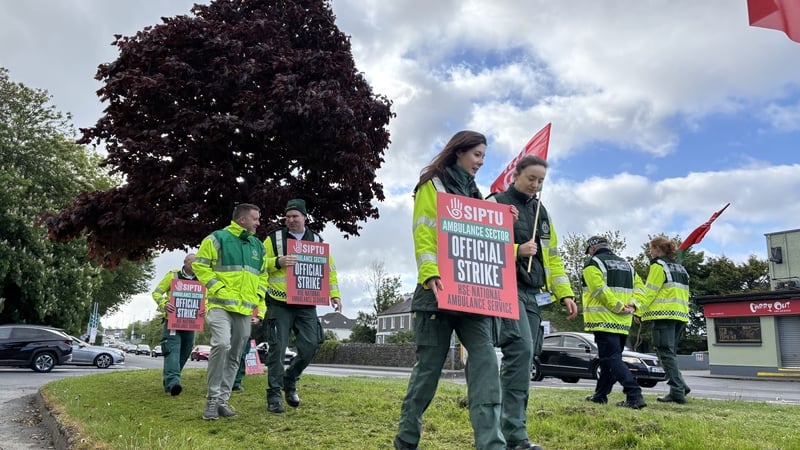
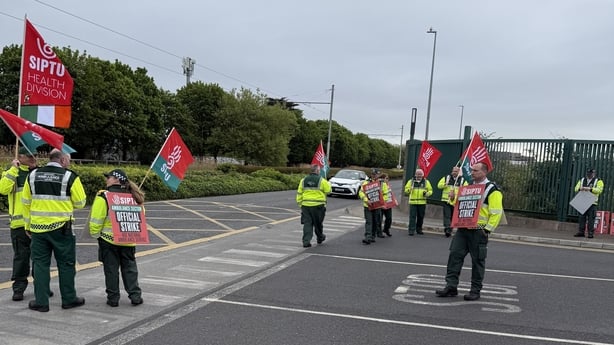
Around 2,000 workers at the National Ambulance Service, who are members of SIPTU and Unite, began a 24-hour strike in a dispute over pay at 8am today.
Pickets have been placed at ambulance bases around the country as part of the action.
In a statement to RTÉ News, the HSE said that "there are indications that the additional pressure on services today is having a significant impact, with longer than usual ambulance response times, due to the reduced crews available to respond.
"We continue to prioritise patients facing emergencies such as cardiac or respiratory arrest, and those experiencing serious trauma such as that arising from road traffic accidents."
The statement added that HSE and NAS teams are closely monitoring the situation, and said that every effort was being made to try to minimise the impact on patients.
It had earlier warned of significant disruption to ambulance services and said there may be long delays in responding to non-life-threatening calls.
The HSE added that a contingency plan has been put in place to prioritise patient safety and minimise disruption.
The 999 phone service is fully operational and, under the contingency plan, priority will be given to patients facing emergencies such as cardiac or respiratory arrest and those experiencing serious trauma such as that arising from road traffic accidents.
Members of the public are being urged to consider alternative healthcare options such as injury units, GP surgeries, local pharmacies and mental health supports.
Clinical Director of the National Ambulance Service Professor Cathal O'Donnell said it will be a very challenging day for the service.
"People should consider other alternatives and people may need to think about whether they need to make their own way to hospital rather than contacting us," Professor O'Donnell said.
"They should contact us, but it may be the case that they will get there quicker if they make their own way," he added.
Dispute over salary scales
The dispute involves emergency medical technicians, paramedics, advanced paramedics, specialist paramedics and paramedic supervisors.
Unions have accused the HSE of failing to implement the recommendations of an independent report on updating staff salary scales to reflect changes in responsibilities and workload.
"SIPTU members have been left with no option but to issue a strike notice due to this long-running dispute," said SIPTU Ambulance Sector Organiser John McCamley.
"The overwhelming mandate from our members for industrial action up to and including strike action is an indication of the depth of feeling within the service and the belief that their sacrifice and commitment over the last 20 years to the professionalisation and modernisation of the service have been forgotten about by the HSE," Mr McCamley said.
The HSE said that it and the Government "accepts the need to both increase and modernise pay arrangements for our staff working in the NAS but is also obliged to ensure that in exchange for significant increases in pay, our services can continue to transform to meet the needs of the public.
"These reforms are important because they will deliver better care for patients in the right place - in some cases avoiding the need to go to hospital - faster response times, more ambulances on the road, better deployment of staff to safely treat more people, with the right training and ongoing professional development to support them.
Watch: Paramedic Paula Lawless says staff have upskilled, which has not been recognised
"The HSE remains firmly committed to addressing the current dispute through the process set out in Public Service Agreement 2024 – 2026 and calls upon both SIPTU and Unite to withdraw industrial and strike action and engage through the State's industrial relations mechanisms."
The workers commenced a work-to-rule yesterday and unions have warned that in addition to this week's action, there will be a 48-hour stoppage on 19 May, a 72-hour stoppage on 26 May, with further strike action planned for June.
Unite regional officer Eoin Drummey said: "The HSE can resolve this dispute by agreeing to implement the 2020 Review immediately and without preconditions."
"Our members would prefer to be on the frontline saving lives, but they have been forced on to the picket line to demand that the vital work they do serving communities across Ireland is finally recognised," Mr Drummey said.
Decision to strike regrettable - Department
It is "regrettable" that SIPTU and Unite members in the National Ambulance Service (NAS) have chosen to proceed with their strike, the Department of Health said.
In a statement, it said: "The State accepts that NAS pay structures need to be modernised and previous engagement at the WRC concluded with the State offering pay increases of 3-14%, on top of the 9.25% increase under the current public service agreement.
"These increases were linked to essential service reforms designed to improve patient care, response times and how services are delivered, by supporting better deployment and training and professional development of staff."
The department said the only way to resolve the issue is "through dialogue" as it urged unions to re-engage with HSE management.
The HSE said it regrets the decision of SIPTU and Unite to proceed with industrial action, adding that it has worked intensively with the unions to resolve the dispute over the past two years under the auspices of the Workplace Relations Commission (WRC).
"A set of independently brokered proposals aimed at resolving the dispute, and all other matters in dispute including pay and service transformation were agreed and recommended to their members by both SIPTU and Unite," a HSE spokesperson said.
Watch: EMT Domhnaill Joyce calls on Taoiseach Micheal Martin to intervene
"The implementation of the timing of the significant increases in pay was also the subject of a Labour Court recommendation.
"In July 2025, the HSE and Government accepted both the WRC proposals and the Labour Court Recommendation, demonstrating a clear resolve and determination to address the current dispute."
The HSE said the proposals included 3-14% pay improvements, on top of a 9.25% increase under the public sector pay agreement, linked to agreed reforms.
"In September 2025, SIPTU and Unite informed the HSE that the proposals independently brokered by the WRC, supported by a Labour Court recommendation, and recommended by both trade unions had been rejected by their members," the HSE said.
Unions have claimed that the proposals came with conditions, including changes to allowances, that were unacceptable to members.
The HSE said it remains firmly committed to addressing the current dispute through the process set out in the Public Service Agreement and "calls upon both SIPTU and Unite to withdraw the proposed industrial and strike action and engage through the State's industrial relations mechanisms".
We need your consent to load this rte-player contentWe use rte-player to manage extra content that can set cookies on your device and collect data about your activity. Please review their details and accept them to load the content.Manage Preferences
Read more:
Follow live updates
What do you need to know about the ambulance strike?