

Minister for Enterprise Peter Burke has defended data centre expansion, saying it is a "strategic opportunity for the Irish economy" and that carbon emissions will reduce from 2030.
Last week, a report commissioned by Friends of the Earth outlined the cost of data centres, claiming households were paying about €90 a year more for their electricity in recent years because demand from data centres is driving up wholesale prices.
This morning, the Government has published a report that it commissioned, at a cost of €100,000, in support of data centres.
It claims that since 2010, €22 billion has been added to the Irish economy, an additional 17,000 jobs have been created, and €2.8 billion in tax has been collected because of data centres.
Speaking on RTÉ's Morning Ireland, the minister said that "data centre activity is a strategic opportunity for the Irish economy to bring forward the green transition".
Mr Burke said said data centres employ about 19,500 people with a 60-40 split - "in terms of 60% of that employment is in relation to construction, 40% is in relation to direct jobs at the data centres".
He added that they do not compete with housing, as the technical nature of their construction is done by specific companies, and that "80% of the power for new data centre activity has to come from renewable energy".
"They're mission critical skills ... mechanical, electrical, critical engineering skills, they're not the same sub-set of skills that we're using in the construction sector."
The minister said the green transition will drive the "offshore renewable energy transition", which will be financed through the digital transition, and from 2030 and beyond, it will reduce carbon emissions as "we will be meeting our energy independence, we will have our renewables come in".
Data centres accounted for 22% of electricity usage in Ireland in 2024, up from just 5% in 2015.
It is estimated that the consumption level will grow to almost a third of the national electricity demand by 2030.
In January, the Government published a Large Energy Action Plan aimed at enabling the further development of energy-intensive facilities, including data centres.
It followed the lifting of an effective moratorium on new data centre connections.
In December, the Commission for the Regulation of Utilities announced that data centres could be built where they meet at least 80% of their annual energy demand through new renewable electricity sources.
Dublin data centre operators complete biomethane purchase
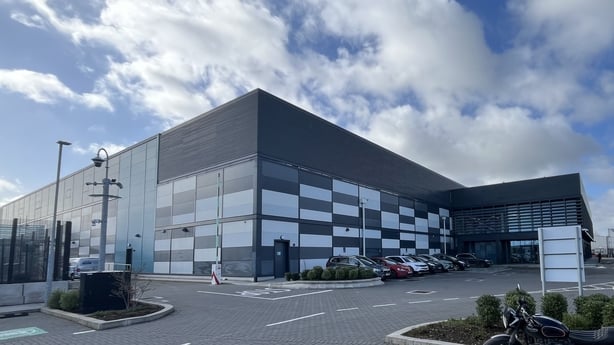
Meanwhile, the operators of an off-grid data centre in west Dublin have completed the purchase of biomethane to power the facility.
The data centre, which is operated by Pure Data Centres Group, is not connected to the national electricity grid and instead runs off its own on-site power plant.
When it launched earlier this year, the microgrid system was fuelled by natural gas but the company said this new purchase of biomethane is allowing it to decarbonise the site.
Biomethane is a renewable form of methane gas produced from organic waste through biological processes, and is seen as a sustainable alternative to natural gas.
Pure Data Centres Group said it has completed Europe's first large-scale cross-border biomethane purchase for a data centre, transferring 9GWh of certified German biomethane to the Irish gas network over a seven-day period.
The consignment was produced in 2025 at certified facilities in Germany using waste and residue feedstocks.
"This milestone is directly aligned with Ireland's Climate Action Plan and the 51% emissions reduction target," said Maria Jose Rivas Duarte, Director of Sustainability at Pure Data Centres Group.
"By demonstrating that cross-border biomethane can be procured, mass balanced, and registered at volume through existing infrastructure, we are helping to pave the way for broader data centre sector adoption as well as other industries seeking a credible route to decarbonise natural gas," she added.