

Parents of children born through surrogacy are calling on the Government to commence the Health (Assisted Human Reproduction) Act 2024 without delay.
The parent-led, voluntary advocacy and support group, Irish Families Through Surrogacy (IFTS), held a briefing for Oireachtas members this afternoon to highlight the need for Irish surrogacy law.
Under existing Irish law, children do not have full legal recognition of their relationship with both parents, which IFTS says is creating significant legal and practical challenges for families.
The Health (Assisted Human Reproduction) Act was signed into law by the previous government in July 2024 and a commitment to commence the Act is part of the current Programme for Government.
The primary purpose of the legislation is to regulate fertility clinics to ensure that assisted human reproduction and related areas of research are "consistent and standardised".
However, many of the provisions of the 2024 Act have not yet been brought into force, and certain surrogacy arrangements are not covered under the legislation.
Read More: Couple's story highlights concern over surrogacy loophole
Supplementary legislation has been drafted to ensure legal protection for all children born through surrogacy, mainly in relation to outstanding issues of parentage and citizenship.
This has required further consideration and consultation with the Office of the Attorney General.
The amending legislation is understood to be at an advanced stage, led by the Office of the Parliamentary Counsel, along with officials from the Departments of Health, Justice and Children.
The establishment of an Assisted Human Reproduction Regulatory Authority (AHRRA) is viewed as a vital component by the Government to ensure regulation of the sector and that process is under way.
'I'm recognised as her guardian, but I'm not her mother'
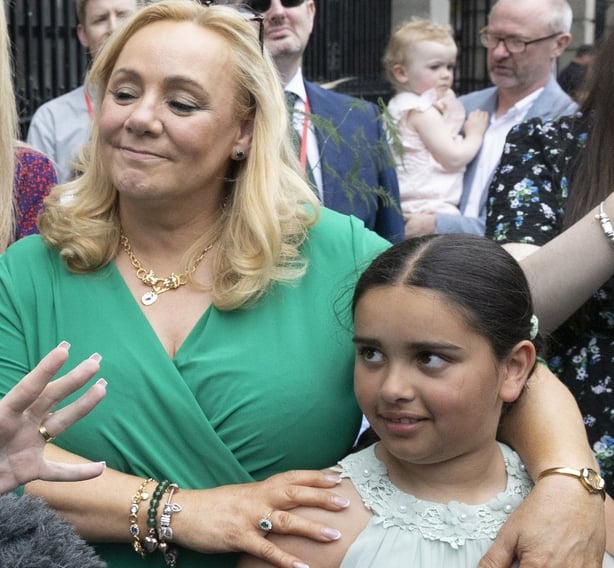
Former Fine Gael senator Mary Seery Kearney's daughter Scarlett was born via a surrogate.
She said that while she is legally her daughter's guardian, she is not legally recognised as her mother as she did not give birth to her.
Speaking on RTÉ’s Morning Ireland, Ms Seery Kearney said there is always the worry of something happening to her daughter’s biological father, because if that were to happen, her daughter would not have a legal parent in the State.
"I'm not recognised as her parent. I'm recognised as her guardian, but I'm not her mother," she said.
She said that when it comes to signing forms, she does so as her daughter’s guardian "even though I have always been her mother".
Ms Seery Kearney said her daughter says that she "is born from my heart because she couldn't be born from my tummy".
She added that in relation to issues around citizenship and residency for children born through surrogacy, legislation has been passed and signed by the President, but it needs to be commenced.
She said that Part 12 of that "would deal with the legal rights of our children to have recognition of both of their parents".
Ms Seery Kearney said she believes that the regulatory authority does need to be in place, but there seems to be no urgency in establishing it.
"The amending piece of legislation languished in the Department of Justice for months, months with very little action happening on it.
"Our daily lived lives are that our children are discriminated against in the rights to inheritance, in the rights to their parents. And that needs to be dealt with as a matter of urgency and can be if Part 12 has commenced."
We need your consent to load this rte-player contentWe use rte-player to manage extra content that can set cookies on your device and collect data about your activity. Please review their details and accept them to load the content.Manage Preferences
Lack of rights a 'huge concern to all parents'
Liam Aherne and his husband are the fathers of twin boys born through surrogacy, and he will be at today's meeting with Oireachtas members.
He said his sons will be starting creche shortly, and because their legal guardian is their biological father, the other father has no consent to sign anything and is not recognised as a legal guardian.
He added that if anything did happen to the biological father, despite being married and caring for the children, the other parent has no rights.
"That’s a huge concern to all parents that have children born through surrogacy," Mr Aherne said.
Amy White of Irish Families Through Surrogacy, who has two children born through surrogacy, said that the Health Act legislation needs to be enacted as two years have passed but nothing has changed.
She added that it needs to happen soon so families hoping to have children through surrogacy can have pathways so they know how they can go about it, while if anything was to happen to the sole parent of children already born, it leaves the other parent and the child very vulnerable.
She explained that she has an eight-month old daughter, whose father is recognised as her husband, but she has no legal connection to her. Meanwhile, her older daughter, who her sister gave birth to as a surrogate, is legally recognised as her niece, but she is her guardian until the age of 18.
She said that she can apply to be her second daughter's guardian when she turns two but, until then, if she wanted to travel with her outside of Ireland without her husband, she would have to have a letter of consent from her husband to take her daughter.
She said that the parentage aspect of the legislation needs to be corrected as soon as possible.
Read more: Couple's story highlights concern over surrogacy loophole
'Prospective' and 'past' provisions must be commenced concurrently - Dept of Health
The Department of Health has said that following discussions with the Office of the Attorney General it was decided that the "prospective" and "past" international surrogacy provisions in the complete Assisted Human Reproduction (AHR) legislation (as amended by the forthcoming second Bill) must be commenced concurrently to ensure the proper operation of what are comprehensive and complex provisions.
It said this had been communicated by Minister for Health Jennifer Carroll MacNeill both directly with relevant advocacy groups and in the Dáil.
In a statement, it added that a further concern is that a legal "lacuna" will be created in respect of surrogacy arrangements undertaken in any "interim" period between the time of the commencement of the "prospective" provisions and the time of the commencement of the "past" provisions, if the latter were to be commenced at an earlier point in time.
"Therefore, it is intended that the "past" international surrogacy provisions will not be commenced until such time as the Assisted Human Reproduction Regulatory Authority (AHRRA) is operational to the extent that it can begin accepting and processing applications for approval of "prospective" international surrogacy agreements," it said.
The statement went on to say that further progress of both the AHR legislation and the operationalisation of the AHRRA "are Government priorities and represent key commitments in the Programme for Government", and every effort would continue to be exerted to ensure that all outstanding work is concluded as soon as practicable.
The statement acknowledged the importance of ensuring that parentage can be recognised in a wide set of circumstances.
It described the area as very complex and that a cautious and legally robust approach is required.
"The three Departments (The Department of Health, the Department of Justice, Home Affairs and Migration, and the Department of Children, Disability and Equality) are not aware of any other State which has in place a similar bespoke regime for international surrogacy as the AHR legislation will introduce here," it said.