


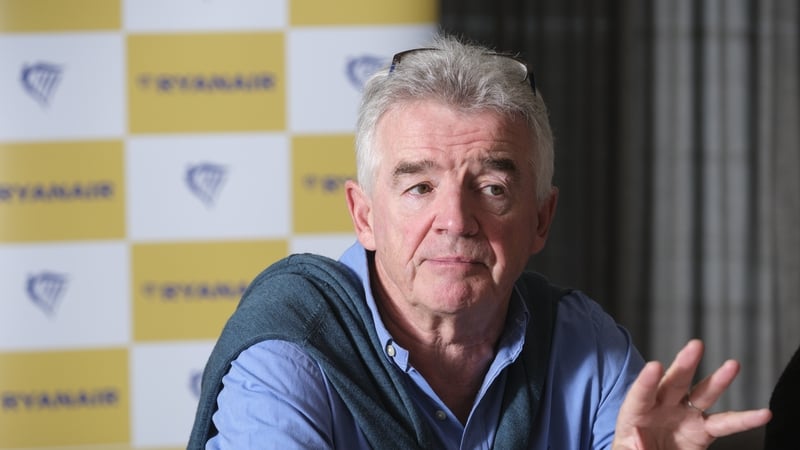
Disruption to jet fuel supplies may kick in during early May, according to Ryanair CEO Michael O'Leary, who warned that if the war in the Middle East continues, there is a risk of supply disruption in Europe in the early summer months.
Speaking on Sky News, Mr O'Leary said the airline and its fuel suppliers are "constantly looking at the marketplace".
"Hopefully, the war will finish sooner than that and the risk to supply will be eliminated," he said.
Mr O'Leary added that the airline is "reasonably well hedged" and has about 80% of its fuel bought forward until March 2027.
He said that if the war ends and the Strait of Hormuz reopens "by the middle or end of April, then there's no risk to [jet fuel] supply".
However, he said, if the war continues and "the disruption to supply continues", the airlines believe there is a "reasonable risk at some low level - maybe 10[%], 20[%], 25% of our supplies might be at risk through May and June".
Mr O'Leary said that "like everybody else in the [aviation] industry", Ryanair hopes that the war would end "sooner rather than later".
At the moment, he said, he was "reasonably certain" that there would be no disruption to supply "until about the middle of May, and obviously we would hope this war will finish before the end of April.
"Then, I think, the risk of disruption will go away.
"However, the risk of significantly higher prices will remain through May, April, June," he said.
He added that some of Ryanair's competitor airlines - Wizz and Easyjet - are already cancelling flights, adding that "they've reduced their capacity by about 5% ... through May and June".
But he said Ryanair has not cut any flights, adding that "we think our [fuel] supplies are secure... and we intend to continue to grow through this crisis".
Minister for Transport Darragh O'Brien said Ireland was being affected as the energy situation is volatile and changing daily, and that conservation was "really important".
He said that the country does have robust energy reserves.
"We will be bringing forward a public information campaign very shortly in that regard to assist people in making the right decisions," he said.
He said Government is not considering restrictions on supply saying, "we are not in that space right now."
He added Ministers are treating the situation very seriously.
The Minister added that measures taken in previous crises worked and Government "will be asking people to put their shoulders to the wheel. Many are doing that already within their households and managing their energy use".
The Minister also noted the temporary reduction in the NORA levy charged by the State on sales of fossil fuels comes into effect today after it was signed into law, reducing the cost by 2c per litre.
'Extremely difficult to be certain'
Meanwhile, Taoiseach Micheál Martin has warned that if the war in Iran continues and if the Strait of Hormuz remains closed, then an energy supply shock will hit the economy.
Mr Martin said that disruption to fuel supply and particularly the supply of aviation fuel due to conflict is leading to a "very serious" situation.
Speaking on his way into Cabinet this morning, Mr Martin said it is "extremely difficult to be certain as to what will unfold".
Addressing comments made by US President Donald Trump, the Taoiseach said that two or three weeks more of conflict in the Middle East is "too long".
Tánaiste Simon Harris said that "we are living through the largest energy crisis in the history of the world".
"I would just make this point that the war is currently ongoing for about 33 days," he said.
"Look at the scale of damage that has been done to the world's energy infrastructure in that period of time."
The EU has urged member states to try to push down domestic demand for fuel and prepare to secure oil supplies, warning of potentially prolonged effects of the Middle East war on energy prices.
"It is clear that the more you can do to save oil, especially diesel, especially jet fuel, the better we are off," EU energy commissioner Dan Jorgensen told a press conference in Brussels yesterday.
"We are in a situation that might worsen where indeed, demand reduction is necessary," he added, after video talks with energy ministers from the 27-nation bloc.
The European Commission has repeatedly said supplies are not an issue at this stage for the bloc, but high prices are a matter of concern.
To ease the impact of the war, EU countries have contributed to the release of about 400 million barrels of strategic reserves under the coordination of the International Energy Agency (IEA) - the biggest such release.
