Researchers in Cork have discovered a new way to treat oesophageal, colorectal and other gastrointestinal cancers that are resistant to traditional chemotherapy treatment.
Today is World Cancer Day, and one of the country's leading oncologists said the discovery will offer hope to thousands of people diagnosed with these cancers in Ireland and across the world.
The discovery is the result of a research collaboration between Breakthrough Cancer Research, University College Cork and Cork University Hospital.
The project has been ongoing for the past 15 years.
Scientists working on the project have now discovered why some cancers are drug resistant.
This has led to the development of a new lithium-enhanced chemotherapy treatment.
The researchers say the discovery could improve the outcomes for around 4,000 people who are diagnosed with these cancers in Ireland every year.
Oesophageal, colorectal and other gastrointestinal cancers are responsible for almost 1,750 deaths in Ireland each year.
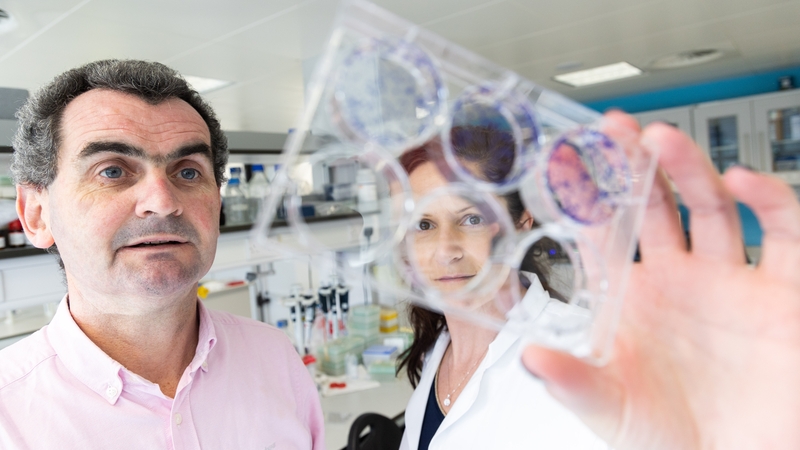
The research was funded by Breakthrough Cancer Research through public donations, and was led by Dr Sharon McKenna from University College Cork.
Her research team has found that adding lithium to the chemotherapy regime blocks the ability of cancer cells to repair the internal damage normally inflicted by chemotherapy.
This makes the chemotherapy more effective and reduces the risk of the cancer returning again.
Lithium is currently used as a mood stabiliser in the treatment of neurological disorders, but it has never been used in chemotherapy, so this is a novel concept, the researchers say.
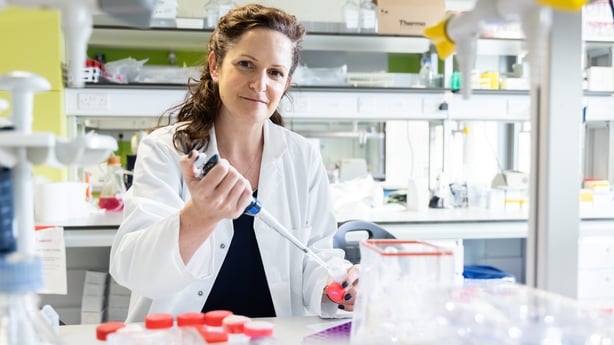
The research project has now moved from the laboratory to hospitals, where the doctors will treat patients using the combination of chemotherapy and lithium.
During the clinical trial, which has just enrolled its first patients in Cork, the research team will be monitoring the safety of combining lithium with standard chemotherapy over a range of doses.
It will also establish how well lithium works in combination with oxaliplatin and capecitabine, a traditional chemotherapy combination used in the treatment of colorectal and oesophago-gastric cancer.
This is referred to as a Phase 1 trial.
Because it is an alternative use of a known drug, lithium, researchers in Cork are hoping it will be adopted for treatment quicker, should it prove safe after completion of the initial trial phase.
However, the work of gaining licence approval for the new drug combination will take some time, possibly several years.
Colorectal cancer is the second most common cause of cancer-related death in Ireland, accounting for the deaths of more than 1,000 annually. There are more than 2,800 new cases of colorectal cancer in Ireland each year.
Oesophageal and stomach cancers have two of the lowest five-year survival rates, at just 24% and 30% respectively.
Because these types of cancers are rarely detected early enough for surgery -- as they are internal -- chemotherapy is the most common treatment. However, the cancer cells can be highly resistant to the chemotherapy drugs, so the cancer frequently comes back.
Recognising this challenge, Breakthrough Cancer Research invested over €1m in research at University College Cork, so that researchers there could explore how cancer cells that responded to chemotherapy were different from those that did not.
They identified a cell recycling process called autophagy that enabled the cells to repair themselves and recover. They then found that lithium blocks this ability to repair, which greatly enhances the effectiveness of the chemotherapy treatment.
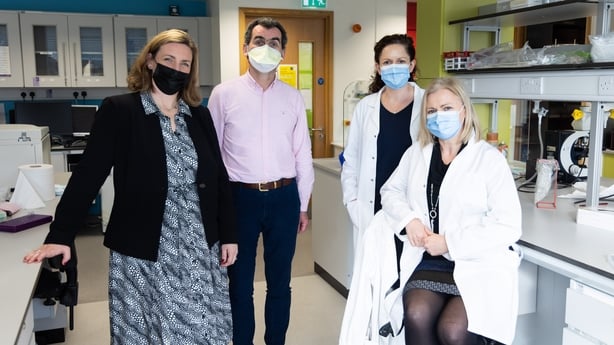
The discovery was made when Dr Tracey O'Donovan, one of the lead scientists working with Dr Sharon McKenna, Principal Investigator at Cancer Research at University College Cork, set up a series of tests with cells from oesophageal cancer patients.
The results were far more impressive than any combination they had seen before, as the combined chemo-lithium therapy killed off the chemo-resistant cancer cells and prevented them from returning.
"We were so thrilled to find a combination that could potentially make an impact on the effectiveness of treatment and improve survival. We tested this new chemo-lithium combination in several pre-clinical models and found that tumours were being cleared much more effectively than single agent treatments," Dr O'Donovan said.
Consultant Oncologist Professor Seamus O'Reilly, based at Cork University Hospital and Mercy University Hospital, is leading the clinical trials. He said new treatments are always urgently needed.
"The most difficult part of my job is seeing patients you think are going to respond well to treatment, do badly," he said.
"People whose lives should have been longer, whose cancer should have been cured, or whose suffering should have been less.
"More and more patients are being diagnosed with cancer in Ireland on a daily basis, and we need to extend their lives. Patients don't fail treatments, but treatments sadly do fail patients.
"We urgently need treatment advances to cure more people and to help those that can't be cured to live longer and better. That can only be found by investing in ground-breaking cancer research, so I hope people continue to support charities like Breakthrough Cancer Research who help make research like this happen."
He explained that one of the attractions of the chemo-lithium discovery is its affordability.
"Many new cancer drug treatments are expensive, limiting their impact as societies and patients struggle to afford them. Lithium is cheap, widely available and, as a result this study if positive, could be globally accessible," he said.
Researchers in Cork have discovered a new way to treat oesophageal, colorectal and other gastrointestinal cancers that are resistant to traditional chemotherapy treatment. | More: https://t.co/eOfrRwcivi pic.twitter.com/kB9P70LFh6
— RTÉ News (@rtenews) February 4, 2022
Bowel cancer survivor Ger Stanton, from Ballyvolane in Cork, said: "This new research sounds incredibly promising. I have heard it said that cancer changes your life and, believe me, it really does.
"I feel like every day is a blessing, and I truly live life to its fullest. I squeeze more time into each day. Cancer research helps so many people to live longer and better, and this announcement will bring so much hope to so many."
Breakthrough Cancer Research targets cancers that have particularly poor prognoses. The charity raised €1m from public donations and invested it in this research.
Its chief executive Orla Dolan said: "Resistance to chemotherapy is a major challenge for clinicians and devastating for patients.
"This discovery was fuelled by collaboration between researchers in the lab and doctors in the hospital working to overcome clinical challenges.
"This is a wonderful example of how patient focused research, supported by the generosity of the public, can translate from the lab into new treatments in the clinic."