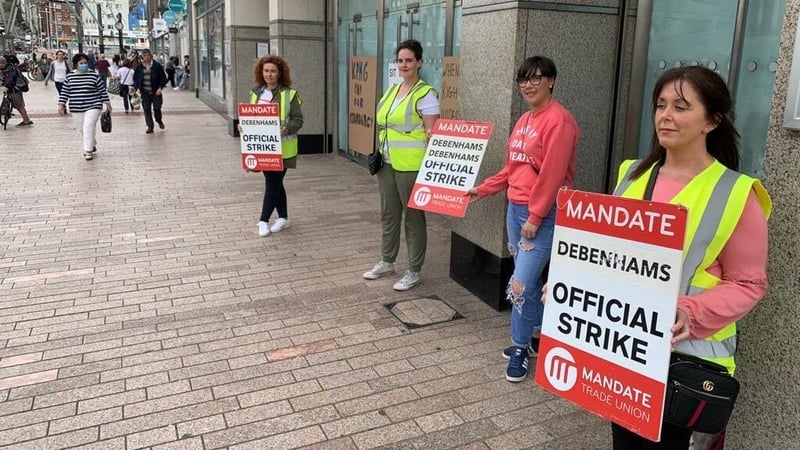

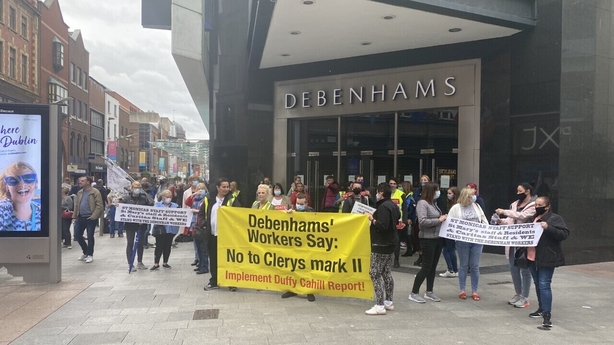
The liquidator of Debenhams, KPMG, has said that the pickets of former employees in pursuit of enhanced redundancy terms are reducing the assets for creditors by hundreds of thousands of euro per month.
Speaking exclusively to RTÉ News, joint liquidator Andrew O'Leary of KPMG also declined to rule out court action in a bid to remove stock, which has been blocked in stores by pickets since April.
Mr O'Leary acknowledged the plight of the 1,000 workers who lost their jobs when Debenhams Ireland went into liquidation in April.
However, he said that after over 150 days of protests, the costs the liquidators were incurring by keeping stock in stores and not progressing the realisation of assets was running into hundreds of thousands of euro per month.
He described this as a very difficult situation, "because the return to the taxpayer, which was already less than 100%, is being depleted every week."
Mr O'Leary noted that the main creditors were the Revenue Commissioners, local authorities, and the employees, and he stressed that other businesses were also at a loss due to the Debenhams collapse.
He said that Debenhams had been in a precarious situation since 2016 when it went through examinership, but that when the UK parent company – currently facing administration with debts exceeding £700m – withdrew its support, the Irish operation had no choice but to go into liquidation.
He estimated the cost of statutory redundancy for the workers at €13m, which would be paid by the taxpayer.
We need your consent to load this rte-player contentWe use rte-player to manage extra content that can set cookies on your device and collect data about your activity. Please review their details and accept them to load the content.Manage Preferences
Read more:
Treatment of Debenhams staff 'shabby and unacceptable' - Taoiseach
Debenhams shop stewards urge redundancy deal rejection
He estimated that the value of realised assets would be between to €6-8m, and confirmed that no creditors would receive all they are due.
Mr O'Leary noted that the workers' 2016 collective agreement for four weeks pay per year of service has no force in the current situation.
"Unfortunately when a business goes into liquidation, collective redundancy agreements like that simply don't apply", he said. "They rank as unsecured creditors and unless there are funds to pay it, they are not paid."
Workers have queried why the Irish Debenhams online service was transferred from Henry Street to Oxford Street in the UK, and why it could not have been used to fund enhanced redundancy.
Mr O'Leary said KPMG had taken legal advice, but the domain name was owned by the UK business.
He said the liquidators had withdrawn Friday's settlement offer when it became clear over the weekend that there was a number of former employees "... who were simply not going to abide by the terms of the settlement, in particular allowing the opening of stores to move stock to two trading stores".
He also stressed that Friday's deal was "the absolute limit of where we could go to in financial terms."
Mr O'Leary said that under insolvency law, the liquidators are not in a position to ring-fence funds to make them available to employees, but that if the law changed, they would operate in line with it.
Mr O'Leary said that while KPMG was extremely sensitive to people's plight, they could not rule out court action.
"The last thing we want to do is go to court and incur further cost, but there does come a point where we won't be able to wait any longer," he said.
He differentiated the Debenhams situation from Clerys, noting that in the Clerys liquidation, there was a valuable asset through which additional funds could be raised for the former employees.
However, in the case of Debenhams, he said there are "no assets, no business here, no large property portfolio, no purchaser" and he noted that the UK parent is itself insolvent.
Mr O'Leary also rejected suggestions that KPMG had blocked food supplies for former workers who had occupied the Patrick Street premises yesterday.
Those protestors have told the liquidators that they will leave the premises at lunchtime tomorrow.