
The Department of Finance has downgraded its growth forecasts but is projecting a big jump in the Government surplus.
In its Spring Economic Forecast, the department said that a general government surplus of €9.2 billion is in prospect, up from the €5.1bn surplus that was projected on budget day last year.
The increase is linked to factors including higher corporation tax receipts, more revenue in the social insurance fund and less spending by bodies outside of central government departments such as local authorities.
The department is forecasting an Exchequer deficit of €1.2bn for 2026 compared to a surplus of €7.1bn last year.
The deficit figure is linked to commitments of transfers into the Government's Future Ireland Fund and Infrastructure, Climate and Nature Fund.
According to the forecast, the economy, as measured by Modified Domestic Demand, will grow by 2.1% this year. That is a downgrade from a previous forecast of 2.3%.
The department said that if the Iran conflict had not happened, the figure would have been upgraded to between 2.5% and 3%.
The economic forecast is predicting inflation of 3.3% in 2026.
Read more: More money but more pressure on the Government to spend
The outlook analyses three scenarios linked to the depth and duration of the Iran conflict.
In the "severe" scenario, oil prices would hit $130 a barrel this year, inflation would rise to 4.6% this year and 5.3% next year, and modified domestic demand would fall to 1.5% in 2026.
In all scenarios, the Irish economy would continue to grow but at a slower pace.
Possible hard winter ahead

If there was an image to sum up the Government's Spring Economic Forecast, it might be Gene Kelly Singin' in the Rain in the 1952 film of the same name.
Yes, the downpour is here, and it could yet intensify with inflation possibly hitting 4.6% by the end of the year.
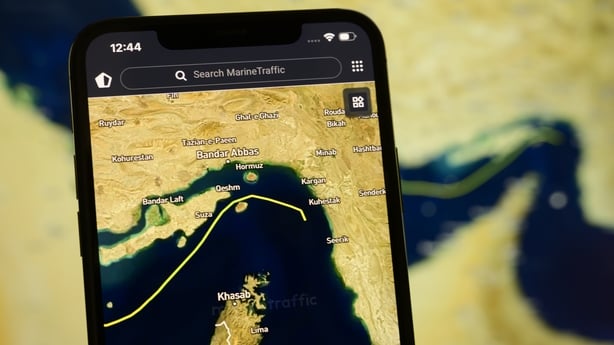
The winter could get very tough indeed and it is all because of the energy price shock triggered by the war in Iran.
Yet the economists at the Department of Finance are predicting a surplus of more than €9 billion this year.
This is due to larger corporation tax receipts; more cash in the social insurance fund, and less spending by local authorities.
The figure has immediately heightened calls on the Government to do more to help people with the cost of living.
"It is as though there are two different realities in this country. One in your forecast of growth, of surpluses, and another at kitchen tables across the land - cold homes, mounting bills, and real fear," was how Sinn Féin Leader Mary Lou McDonald viewed the latest economic update.
Already the Tánaiste has said it would be foolish to rule out the return of energy credits, and he is committed to a personal taxation package in the Budget.
And there appears to be a desire in Government to wait until October before taking any further action on energy supports.
The Taoiseach told the Dáil the Government would keep things under review, but it was now looking at permanent ways of easing pressure on families, and this will take time to finalise.
The Government remains committed to a strategy to address the risks of potentially fleeting high tax receipts.
Central to that is the running of surpluses and the regular transfer of substantial resources to long-term savings funds.
These funds should have around €24 billion in reserves by the end of this year.
If that trend continues, it might leave less scope for major cost of living measures to cushion people from the possible hard winter ahead.
'The situation remains volatile', says Tánaiste
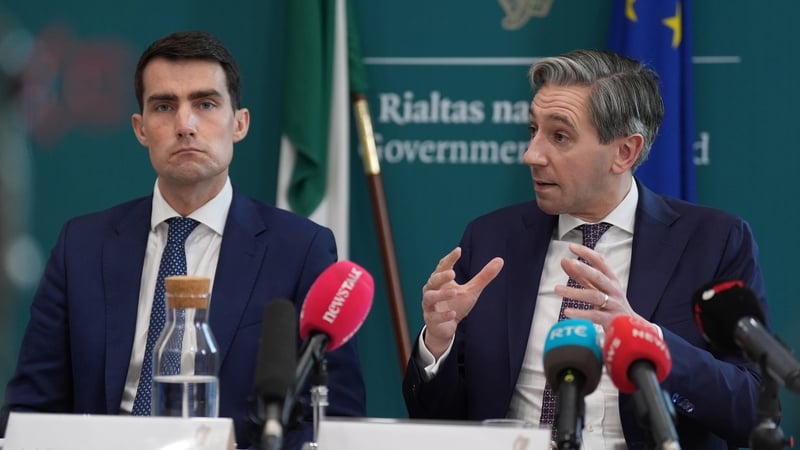
Tánaiste and Minister for Finance Simon Harris said this year's report is being published at a time of considerable global uncertainty as recent developments in the Gulf have resulted in significant disruption to global energy markets.
"While efforts towards de‑escalation are welcome, the situation remains volatile," the minister noted.
He also said it was important to stress that the latest forecasts were calibrated on the assumption of a short and relatively contained conflict, with limited lasting damage to energy infrastructure in the Gulf.
"The turbulence in the international environment is a reminder of the importance of keeping our approach to overall budgetary policy balanced and sustainable across the medium-term," Mr Harris said.
"It is because of this Government's careful management of the public finances that we have had the fiscal firepower to respond to help households and firms hit by rising energy prices," he said.
Mr Harris said that inflation in Ireland could rise to 4.5% this year "in a severe scenario".
Speaking at the Spring Economic Forecast briefing this afternoon, he said that scenario would have "real knock-on effects".
"We're now expecting under the baseline scenario for inflation to be 3.3% this year. But in a severe scenario, inflation could rise to 4.5% this year," Mr Harris said.
"That obviously has real knock-on effects on both economic growth and employment. I do want to say this is not what we're predicting, but it is what we must prepare for.
"This is a severe scenario, but we have to be prepared for all scenarios as well."
'Prolonged conflict in Middle East poses challenges for the Irish economy' - Chambers
Minister for Public Expenditure, Infrastructure, Public Service Reform and Digitalisation Jack Chambers said the report acknowledges the potential challenges posed by the current international environment.
"That said, Ireland has weathered several challenges over recent years and the economy continues to perform strongly with further growth projected across different scenarios.
"In a rapidly changing and increasingly uncertain world, we want to provide certainty on Government's plans to invest sustainably. Investment will continue to increase with expenditure reaching €125.5bn in 2027.
"This will provide for increased capital investment in critical infrastructure and enable continued enhancement of public services."
Mr Chambers also said that while the overall outlook is positive, a prolonged conflict in the Middle East poses challenges for the Irish economy, including high levels of inflation resulting in elevated costs in our economy.
"There is a need for strong cost controls across departments to enable continuing delivery of commitments in the Programme for Government," he said.
With a forecast €9bn surplus, nearly twice what was projected in the last budget, there have been calls from the opposition for the Government to increase spending.
Speaking on RTÉ'S Six One, Minister Chambers said: "We're still expanding public services, we're still making interventions of the €750m intervention and we'll have a package that's quite substantial in 2027, which will go to about €125bn in total expenditure planned for 2027.
"We cannot excessively narrow our tax base and massively increase expenditure. That presents huge risk for the Irish economy and for Ireland."
With forecasts showing consumer spending declining, Mr Chambers was asked whether there was scope to give workers a break.
"Well, a priority for the Tánaiste and myself around any tax package is to give workers and families a break from an income tax perspective. But that has to be carefully calibrated and balanced in the context of what's available to Government," he said.
In terms of energy support, Mr Chambers said that the Government's €750m package is the most substantial package per capita of any EU member state.
"Energy prices have massive volatility attached to them. But our real focus is on Budget 27, giving workers and families a break, trying to improve public services and most critically building more homes, and ensuring that we protect the long-term interests of the environment," he said.
'Macro projections are set against a highly uncertain backdrop'
Commenting on the publication of the Annual Progress Report, AIB Chief Economist David McNamara, said the Annual Progress Report is the mid-year check point on the health of the Irish economy ahead of the budget in October.
"As was the case last year with US tariffs, the macro projections are set against a highly uncertain backdrop with inflation expected to spike on the back of the war in the Middle East," Mr McNamara said.
He also said it should be noted that Ireland faces the current energy shock in a relatively robust position compared to European peers.
"While the current shock is not yet at the levels of what was experienced following the invasion of Ukraine in 2022, the Government is already using some of this fiscal space to offset the effects of higher fuel prices, spending c.€750m (c.0.2% of GNI*) on fuel subsidies," he added.
'The money is there' for cost-of-living package' - Sinn Féin
Sinn Féin has told the Government that the time for "refusing to bring forward a meaningful cost-of-living package" is over.
In a statement after a €9.2bn budget surplus was announced, Sinn Féin finance spokesperson Pearse Doherty said the amount shows that while there are significant financial difficulties in the wider economic world, Ireland in his view, has money available to help those in need.
"What today's announcement from the Department of Finance tells us is that the money is there. It is the duty of the Government to defend its people in times of crisis, and right now this Government is failing massively.
"Even a fraction of these surpluses could make a meaningful difference in people’s lives and protect them from this cost-of-living crisis.
"The time for excuses is over. We need to see excise completely cut on home heating oil and green diesel, and petrol and diesel made affordable. And that needs to be combined with a wider cost-of-living package that includes energy credits and targeted supports.
"The new economic projections go far beyond what was previously projected, making it crystal clear that the Government can act to support people, but they are choosing not to," he said.
'Resources need to be focused in a laser-like way' - Labour
Labour's finance spokesperson Ged Nash said increasing inflation predictions for the second half of this year means the Government must target available resources to low and middle-income households.
"Now is the time for a Government, that claims to be responsible, to front up with people and to admit that tax cuts beyond indexation for PAYE workers cannot be on the table ahead of Budget 2027.
"Instead, resources need to be focused in a laser-like way on targeted energy credits, fuel supports, accessible retro-fitting and forms of grant aid to some firms, as things are likely to worsen as a result of this energy shock and global volatility.
"This would make the country better prepared than it currently is, for an uncertain future over which we have little control," Mr Nash said.
Additional reporting: Fiachra Ó Cionnaith