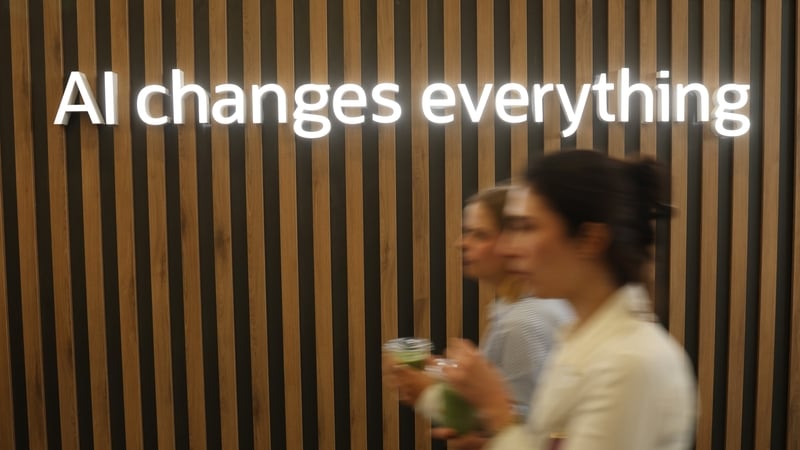

The termination emails from Meta management landed at 4am.
It may have been early but most workers were probably already awake, waiting to learn their fate.
Of Meta's 1,800 Irish-based staff, around 350 received emails outlining how they were "potential impacted" by global redundancies.
It was a high number of Irish layoffs, double the 10% cut that was being applied to the worldwide workforce.
The announcement has sparked concern in both business and political circles amid fears that the great AI job displacement is already under way.
Meta job cuts
In January, Meta CEO Mark Zuckerberg said that 2026 would be the year that AI starts to dramatically change the way the company works, with investments in AI tools that would involve "flattening teams".
"We're starting to see projects that used to require big teams now be accomplished by a single very talented person," Mr Zuckerberg said at the time.
Last month, news emerged that Meta would cut 8,000 jobs globally.
Workers were also told of plans to eliminate managerial roles and transfer 7,000 employees to new initiatives related to AI workflows.
If the full 350 job cuts are implemented, it will mean that Meta's Irish headcount will have halved from 3,000 just four years ago, to less than 1,500.
Minister for Enterprise Peter Burke said his message to Meta workers is that "the Government will have your back", offering support to gain employment again.
He spoke about the skills that the Meta workers have being in high demand in the wider economy.
But if Meta believes AI can replace the jobs, won't other companies feel the same?

Other tech job cuts
In recent months, a series of AI-related job cuts have hit the tech sector in Ireland.
In October, online retail giant Amazon announced 14,000 global redundancies saying at the time that artificial intelligence and concerns over shifting corporate culture were to blame.
The move was expected to impact 150 Irish-based roles.
In January, Amazon announced a further 16,000 global cuts putting an additional 300 roles at risk in Ireland.
Last month it was reported that cloud computing firm Oracle was laying off thousands of employees globally as it ramped up spending on AI in an effort to better compete with rivals.
The move led to 150 roles in Ireland being at risk of redundancy.
In February, financial technology firm Block announced plans to cut over 4,000 jobs, nearly half its global workforce, due to the adoption of AI across its operations.
Block was co-founded by Twitter co-founder Jack Dorsey.
"Intelligence tools have changed what it means to build and run a company," Mr Dorsey said in a statement at the time.
"A significantly smaller team using the tools can do more and do it better," he added.
It came just weeks after Block announced the opening of new offices in Dublin for its 300 Irish-based employees.
AI washing
There is a school of thought that tech companies could be "AI washing", blaming artificial intelligence for job losses that are not actually connected to the adoption of the technology.
In 2022 and 2023 there were waves of job cuts across the tech sector due to Covid-era over-hiring.
During the pandemic, everyone was stuck at home using technology to work and ordering products online, ramping up demand for internet services.
When the lockdowns were lifted and normal life resumed, many tech firms realised that they had too many staff and mass layoffs ensued.
Some analysts think that overstaffing from that era is still an issue for certain companies and that this could be the real reason for some of the job cuts we are currently seeing.
In a recent interview, Sam Altman, CEO of OpenAI, said that almost every company that does layoffs is blaming AI "whether or not it really is about AI".
"I don't know what the exact percentage is, but there's some AI washing where people are blaming AI for layoffs that they would otherwise do, and then there's some real displacement by AI of different kinds of jobs," Mr Altman said.
Whatever the reasons for the layoffs, official data shows that there has been a decline in tech jobs in Ireland over the last year.

Fall in tech employment
Figures released by the Central Statistics Office on Thursday showed a fall in employment levels in the tech sector.
According to the Labour Force Survey, the largest decrease in employment by economic sector in the first quarter of the year occurred in the information and communication sector which fell by 20,300 or 10.7%.
The fall in employment in the sector was driven by a decrease in computer programming and consultancy roles which fell by 16,200.
Overall, the number of people who were unemployed increased on an annual basis by 17,600, or just over 14%, to 141,800 in the first three months of the year.
This led to an increased unemployment rate of 4.9%.
The Financial Services Union (FSU), which represents workers in the tech industry, said the figures were a stark reminder of the effects of job losses in the sector.
"Unless we have a transparent and proactive approach to managing the effects of AI in the workplace we will continue to see the decline in employment in these sectors," a spokesperson said.
"We need full stakeholder engagement across the sector to ensure we have a robust policy that harnesses the advantages of AI while protecting employees, businesses, and consumers against negative outcomes," the FSU added.
Dermot O'Leary, Chief Economist at Goodbody, said that while there has been much focus on the role of AI in the jobs market, the fall in tech employment could also reflect a reversal of the boom in hiring during the Covid period.
"Employment in ICT in Ireland is still up by a third relative to its pre-Covid level," Mr O'Leary said.
"That said, the impact of AI on the labour market will have to be carefully monitored," he added.

Entry level jobs
Aside from the tech sector, there are growing concerns about the impact of AI on entry level and graduate roles across a range of industries.
The latest IrishJobs hiring trends report, which was released this week, showed that almost half of employers have reduced the number of entry and graduate level roles available in their organisations amid rising labour costs and increased AI adoption.
"Rising labour costs and advances in AI are reshaping workforce planning, prompting many employers to rebalance their hiring mix and focus on experienced talent with in-demand skills," said Christopher Paye, Country Director of The Stepstone Group Ireland with responsibility for IrishJobs.
Despite the recent high profile job cuts in the tech sector, 56% of employers in the IT and telecoms sector said they increased hiring over the last six months, according to the hiring trends report.
The study also found that more than a quarter of firms in Ireland are hiring for highly specialised roles in AI and machine learning.
200,000 jobs under threat from AI
Last month, a joint report from the Economic and Social Research Institute (ESRI) and the Department of Finance found that around 7% of jobs could be displaced by AI in the short-to-medium term.
Based on current employment figures, that would equate to almost 200,000 roles.
The study found that the job losses would likely be concentrated among highly educated workers.
According to the research, roles facing higher levels of job losses include information and communications technicians, customer service clerks and clerical support workers.
Jobs that are customer-facing or physically demanding face little risk of substitution.
Occupations facing lower levels of job losses include health professionals, agricultural workers, builders and refuse workers.
The report concludes that in the long term, the widespread adoption of AI will likely boost productivity, create new jobs and raise living standards.
In the short term however, there will be pain and many more sleepless nights for tech workers waiting for those dreaded early morning emails.