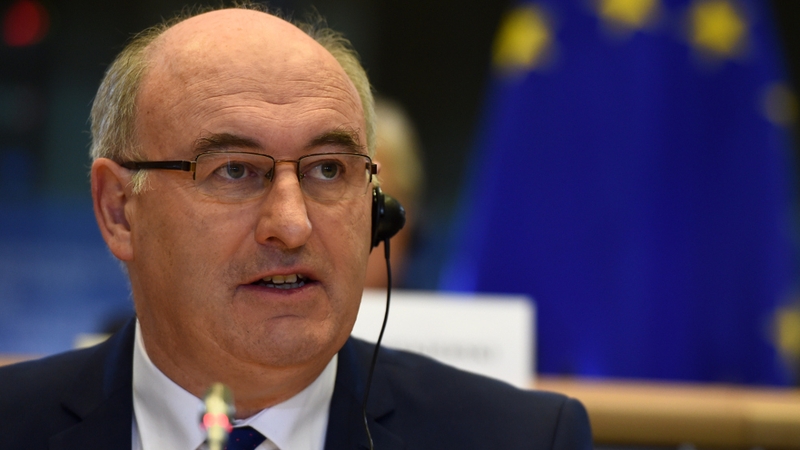

Phil Hogan’s bid to become the next head of the UN’s Food and Agriculture Organisation (FAO) is facing some strong headwinds.
Ireland’s former EU commissioner is still seen as the ideal candidate to become the first European director-general of the Rome-based organisation in 50 years.
However, securing a single agreed EU nominee is being frustrated by determined bids from both Italy and Spain.
Without an agreed candidate there is a risk that Europe will once again lose out when a new director-general is elected by 193 UN voting members in July 2027.
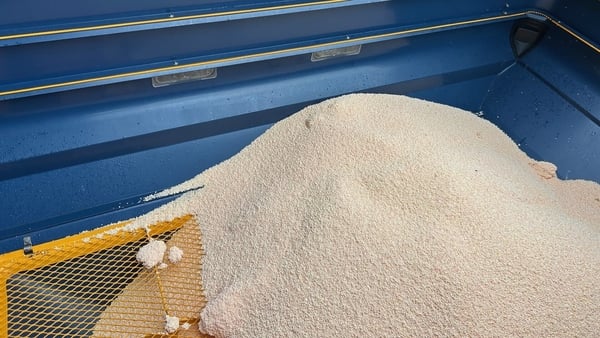
This matters to the EU. Brussels has expressed deep concern about global food shortages next year as a result of the Iran war and the closure of the Strait of Hormuz, through which one fifth of the world’s urea and ammonia, key fertiliser ingredients, transit.
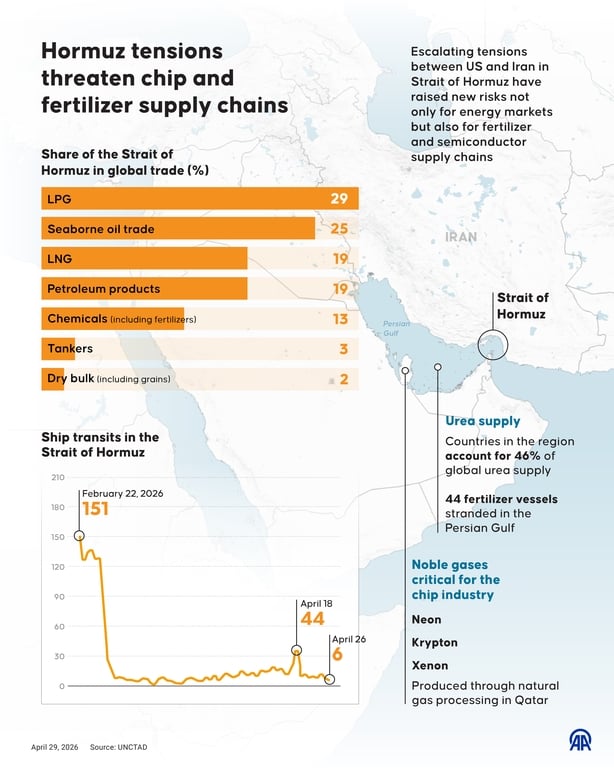
The EU has also had concerns about the FAO currently being "weaponised" to frustrate sanctions against Russia over its full-scale invasion of Ukraine.
The outgoing director-general Qu Dongyu will leave next year following his second four-year term, during which there have been accusations that the former Chinese vice minister for agriculture was inclined to bend the FAO towards Beijing’s geopolitical interests.
At a lunch on 23 February, the EU’s agriculture commissioner Christophe Hansen urged farm ministers to "consolidat[e] our support behind a single candidate", according to speaking notes seen by RTÉ News.
Hinting at undue Chinese and Russian influence, he said leadership of the FAO was "crucial", adding that "the concerns [over] the current top leadership are widely shared, as sometimes the organisation appears to be instrumentalised to specific interests. We are also concerned at attempts to instrumentalise FAO against Western sanctions on Russia in the context of food security".
The FAO was set up by the United Nations in 1945 to defeat hunger, malnutrition and food insecurity.
Its 2025 State of Food Security and Nutrition in the world report indicated that up to 720 million people are currently chronically food insecure, with 43 million children suffering from the most severe form of malnutrition.
The EU sees global hunger as a key issue in light of the Trump administration defunding multilateral institutions and abolishing its own international development arm, USAID, which, according to The Lancet, could lead to 14 million untimely deaths over the next five years.
Hogan is seen in Brussels as a strong candidate.
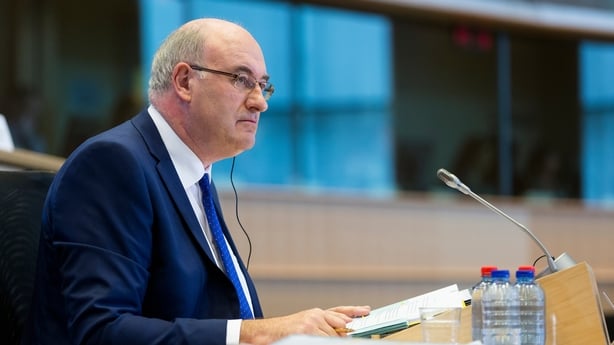
Following his resignation from the European Commission in September 2020, he launched Hogan Associates, a successful lobbying firm in Brussels that counted JP Morgan Chase, DLA Piper, Enfer Labs and Vodafone among its clients, with a turnover in 2024 of over €1 million, according to the EU’s transparency register.
Those close to him downplayed suggestions that he would run for a UN position, believing that he would be unlikely to turn his back on a lucrative lobbying career in Brussels.
Hogan himself privately poured cold water on the notion last November.
However, it seems clear the job was in his sights for some time. In May of last year he was spotted networking at a Brussels conference entitled Agroecological Transition of Food Systems in Africa, a topic not entirely in tune with his blue-chip lobbying portfolio.
In early January this year, Manfred Webber MEP, president of the European People’s Party (EPP), of which Fine Gael is a member, privately said the party would support a Hogan run to be head of the FAO.
On 23 February, during that informal lunch in Brussels, agriculture ministers unanimously agreed there should be a process to select a single EU candidate.
It’s understood that the Minister for Agriculture Martin Heydon floated Hogan’s name at the lunch, although it was not until 3 March that the Government formally put his name forward.
However, rival bids were then launched by Italy and Spain. Rome announced that Maurizio Martina, a former Italian agriculture minister and currently one of the FAO’s deputy director-generals, would also be a candidate, while on 16 March, Spanish prime minister Pedro Sanchez nominated his long-standing agriculture minister Luis Planas.
Sources suggest that the Cyprus presidency of the EU, which is managing the process, has until 25 May to decide if it can put the matter to a secret indicative vote by EU agriculture ministers, with a view to an agreed candidate being declared at a meeting in Luxembourg on 22 June.
The Cyprus presidency has confirmed that as yet no European candidate has been settled upon by national capitals, meaning the 22 June deadline is looking shaky.
"It doesn't look as though there will be an agreed European candidate by the end of the Cyprus presidency, unless there's a rush of blood to the head sometime in June," says a senior EU source.
There are some suspicions that, under pressure from Italy, Cyprus has slowed down the process towards getting an agreed EU candidate, a claim a presidency source strongly denies.
If agriculture ministers cannot decide on a single candidate by June, then the matter might be elevated to the level of foreign ministers, who meet in Luxembourg on 15 June.
France has told the Irish Government it supports Hogan’s candidacy, and it’s understood the Baltic States are on board as well.
Sources close to the former Fine Gael minister say all EU prime ministers from the EPP family - now 14 in all, when you count the incoming Hungarian prime minister Peter Magyar - will support his candidacy.
Depending on how vital the EU regards the FAO position, there could be pressure on Italy or Spain to pull out.
However, the fact that getting an agreed candidate is not written into any EU treaties, and that it is a process driven by UN member states, means that both Rome and Madrid could stick to their guns if they believe they are in with a chance.
"It’s more of an informal understanding that there will be an agreed EU candidate, and that everyone will get behind that agreed candidate," says one source familiar with the process.
"But there's no obligation on anyone to do that. The FAO [election] is an independent process, and any country can put forward a candidate."
'I think everybody knows he is the one with the better chance'
"My reading is that Spain and Italy are not minded to pull out and give Hogan a clear run," says a senior EU source, "even though I think everybody knows he is the one with the better chance of the three in terms of his experience".
Failure to agree a single candidate by the end of the Cyprus Presidency would, of course, make things awkward for Dublin, which takes up the presidency on 1 July. The Government would have to both push Hogan’s nomination while supposedly acting as a neutral chair within the agriculture council, the body representing 27 EU ministers.
There may be ulterior motives for Italy and Spain in running candidates.
There is a convention that the country hosting a UN agency should not nominate a candidate to become the head of that agency. As such, Maurizio Martina could be running to ensure that, as a consolation, he keeps the deputy director-general position.
Martina, who hails from the opposition Democratic Party, has been firmly backed by the centre-right foreign minister Antonio Tajani, a notable across-the-aisle endorsement in the fiercely tribal arena of Italian politics.
Likewise, Spain may be nominating Luis Planas in order to keep Alvaro Lario, another former Spanish official, as director-general of the International Fund of Agriculture Development (IFAD), another UN agency. His term ends in March next year, so Planas pulling out could nudge Lario into a second term.
Planas, unlike Hogan or Martina, regularly meets fellow EU agriculture ministers, meaning he is in a position to lobby directly.
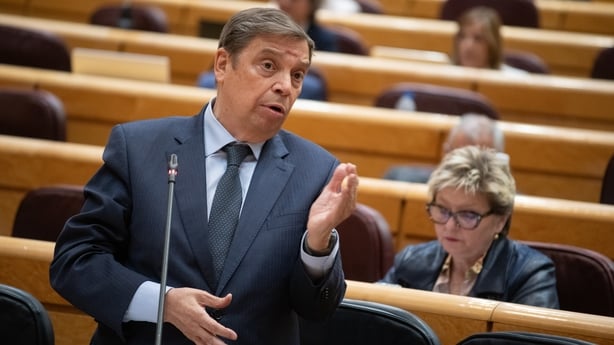
At the last ministerial meeting, he circulated a brochure describing himself as "committed to building consensus and making every voice count", adding that he would manage the FAO in an "efficient manner to effectively serve its core purpose of eradicating hunger and malnutrition".
Again, Madrid, which is a major voluntary donor to the FAO, could calculate that their candidate is in with a chance even if Ireland and Italy also stay in the race.
"Spain will be a strong candidate", says one source familiar with the election process, "especially considering that Planas is the longest standing minister of agriculture in the EU.
"Spain also has strong soft power, not just in Latin America. Given all the positions they've been taking towards the US and Israel on Palestine and Iran, that would definitely get their candidate support from the Global South. It could be said about Ireland too, but Spain has been very active in FAO for many years."
Ireland’s prominence on food security is an argument that Phil Hogan, and the Irish Government, will be making. In June 2024, the outgoing director-general Qu Dongyu presented President Michael D Higgins with the FAO’s Agricola Medal for his commitment to global food security, poverty reduction and sustainable development.
A number of Irish officials have risen to prominent jobs within the FAO. Charles Spillane, a professor of plant science at the University of Galway, was appointed the FAO’s chief scientist in December, the highest position any Irish person has attained in the organisation’s 80 year history.
In 2024, Irish microbiologist Sarah Cahill was appointed secretary of the Codex Alimentarius Commission, the FAO’s internal body which manages global food standards and codes of practice to ensure consumer health protection and facilitate fair practices in the food trade.
In announcing Hogan’s candidacy, the Government stressed its "strengthened" engagement on food security, nutrition, agriculture and humanitarian support across the spectrum of UN agencies, including "enhanced cooperation… with the FAO and the World Food Programme, two key UN organisations in the field of agriculture, food security and emergency food assistance".
Sources in Rome familiar with the contest suggest that Hogan’s departure as EU trade commissioner in 2020, following the Golfgate controversy, should not count against him.
"In Ireland it was a scandal, but in other countries it may not have meant that much. Every country is different," said one source. "Ireland enjoys soft power in FAO, it has an aura."
EU sources say there is a lot at stake and that after 50 years, it is in Europe’s self-interest for a strong, united candidate to run for the job.
"The effort is there for the EU to coordinate since it’s always stronger if there’s one clear candidate," says one senior official. "That’s how you get these [UN] jobs. If you look at how the Chinese do it, they put people in at all levels."
Hogan brings with him a wealth of experience that would be suited to the FAO job: a former environment minister and a former EU agriculture and trade commissioner.
Since his nomination was confirmed, Hogan has met officials and political figures in most EU capitals, and has attended key FAO regional meetings in Brazil, Mauritania and Rome. He will attend the FAO’s European regional conference in Tajikistan on 15 May.
He is understood to be in regular contact with current and former Trump administration officials, including those he dealt with in his time as EU trade commissioner.
Paul Kiernan, a former Irish deputy permanent representative to the UN’s food agencies in Rome, is helping to coordinate Hogan’s campaign, and the Government continues to press his candidacy.
The Cypriot agriculture minister Maria Panayiotou met the Minister for Agriculture Martin Heydon in Luxembourg on 27 April on the issue (she has separately met her Italian counterpart Francesco Lollobrigida as well as the Spanish candidate Luis Planas in recent weeks).
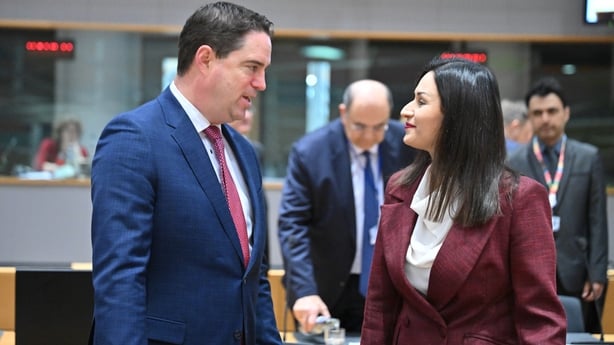
The Cyprus Presidency says it continues to push for an agreed EU candidate.
"It remains of strategic importance for the European Union to move towards a unified approach for the FAO Director General position in 2027, with the objective of [the first] successful candidature of an EU FAO Director General in over 50 years," said a Cyprus presidency spokesperson.
"Cyprus continues its efforts as an honest broker, including bilateral consultations, to facilitate coordination.
"In view of the EU’s leading role and contributions to FAO amid growing geopolitical and food security challenges, the presidency underlines the value of timely preparation and strategic coherence to strengthen EU–FAO cooperation and promote the Union’s priorities globally."
A spokesperson for the Department of Agriculture, Food and the Marine, said: "At the Informal [ministerial] lunch on 23 February, there was unanimous agreement amongst member states that a single unified EU candidate be identified for the post of FAO Director General for election at [the] FAO Conference in 2027.
"It was also unanimously agreed that the Cyprus Presidency undertake a process of bilateral discussions and outreach in an effort to identify a preferred EU candidate.
"Ireland fully supports this process which is still ongoing and thanks Cyprus for their leadership on this matter."
Whether EU capitals can rally round a single candidate for the €200,000 a year post of director-general remains to be seen.
Food security has rarely been so central to geopolitics, and Hogan is understood to have been arguing in his campaign that the FAO needs to take the political lead in warding off a hunger crisis next year triggered by the closure of the Strait of Hormuz.
Should his message resonate and deliver him to the FAO seat in Rome in the summer of 2027, it will be a startling political rebirth for the 66-year-old - and not the first.