
"For the first time since the Cold War, we must genuinely fear for our self-preservation and the reason for a unified response has never been so compelling."
Those were the words of Italian former prime minister and economist Mario Draghi launching his eponymous report into the failings of the European economy.
But that was September 2024. Donald Trump had yet to be re-elected, and transatlantic trade was still a source of economic reassurance.
"The situation is even more challenging now," says a senior EU source. "The speed of actually executing the report now is even more critical."
The Draghi Report depicted a Europe falling dangerously behind the US and China.
Global trade was slowing, cheap Russian oil and gas were being phased out. The EU needed to spend up to €800 billion per year to invest in competitiveness and innovation.
A year previously, another former Italian prime minister, Enrico Letta, reported that Europe needed to deepen and broaden the single market, lower the costs of decarbonisation, and boost investment in start-ups.

Despite the clarion calls of the Draghi and Letta reports, member states responded sluggishly.
Then came Trump II and the year of shock therapy, from tariffs to the US President's threat to invade Greenland. Europe was being squeezed from the west, and by Russia and China from the east.
The impact of Donald Trump’s 15% tariffs on EU goods provided prognosticators with a new angle on Europe’s malaise. Worried about tariffs? Well, persistent barriers within the single market actually correspond to intra-EU tariffs of up to 110% on services and 65% on goods.
'Terrible 10' barriers
In May, the European Commission identified the "Terrible 10" barriers holding back the internal market.
These were difficulties in setting up cross-border businesses; complex EU rules; non-compliance of rules by member states; limited recognition of professional qualifications; lack of common standards; fragmentated rules on packaging; a lack of product compliance; restrictive national services regulations; complicated rules for the posting of workers in low-risk sectors; unjustified territorial supply chain constraints leading to high prices.
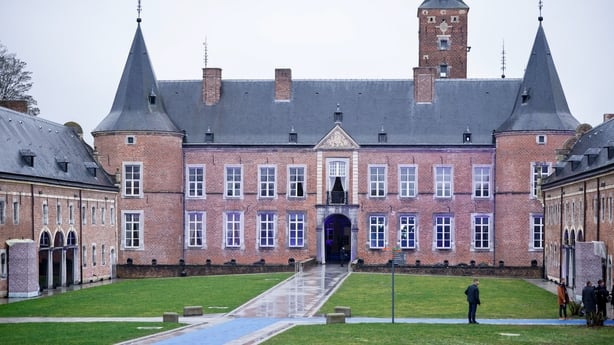
Arriving at the informal summit of EU leaders in Alden Biesen, a 13th century castle in Limburg Province, Danish Prime Minister Mette Frederiksen, fresh from the bruising MAGA attempt on Greenland, warned that Europe’s dependencies had to end.
"We have learned that trade can be used as a pressure tool, as when the US did not agree with the Kingdom of Denmark on the future of Greenland," she told reporters on arrival at Alden Biesen castle.
"We should not be, and should probably never have been, dependent on others, neither on Russian oil and gas, nor on China in the area of new technologies.
"Europe is in a rush, that is the most important conclusion. This means that along with military re-armament we must make our companies stronger, so there will be enough job opportunities in the future and Europe can be a strong player on the international scene."
So why has it taken so long?
"I'm the first to share the frustration that things don't move as fast as we would like," says a senior EU official. "But there is a real willingness to get to concrete measures. There is a feeling that the conditions are there to harvest the political will to move forward."
For its part, the European Commission introduced a Competitiveness Compass to speed up reforms, with a series of proposals to give effect to the Draghi and Letta reports.
These include simplifying EU regulation across a range of areas, introducing the Savings and Investment Union (SIU), new proposals on AI, quantum computing, cloud services and the digital economy and negotiating new trade agreements (India and Indonesia), while completing decades-old ones (EU-Mercosur).
Read more
Trump shook up global trade this year; some uncertainty may persist in 2026
EU launches Competitiveness Compass to boost productivity
EU Commission to focus on economy, security this year
In a submission paper, IBEC described the Competitiveness Compass as showing "strong intent, but insufficient speed and impact.
"The Irish Presidency [of the EU] must capitalise on the momentum generated by the [Draghi and Letta] reports and prioritise finding ways to urgently advance the development of the Single Market within the Council, and in collaboration with other EU institutions".
When it comes to removing barriers to the internal market the results are, indeed, mixed.
Senior officials say most of the low-hanging fruit have been picked. The most stubborn hold-ups are where national capitals do not comply with EU rules, or where vested interests resist cross-border trade.
With the former, the European Commission issues infringement proceedings, a laborious process in which letters are exchanged and legal action threatened. National capitals only tend to fall into line when they end up in the European Court of Justice or face daily fines.
"Fragmentation and uneven implementation throughout the EU continue to limit crossborder activity and investment," wrote Commission President Ursula von der Leyen in a letter to EU leaders, "in particular in key services sectors such as telecoms, energy, capital markets, company law, research and innovation - sectors that are the backbone of Europe's economic model and its future growth".
The problem is that legal action has been declining because the commission instinctively prefers to avoid a scrap with a member state in an era of increased euroscepticism.
Brussels is now considering toughening up enforcement and speeding up the legal process.
There are also constant complaints that member states "gold plate" EU regulations with their own rules, with the commission then getting the blame for increased red tape.
This comes on top of a surge in complaints by powerful industrial lobbies, particularly in energy-intensive sectors, about the costs of producing carbon in the EU, further increasing demands to reduce climate regulation.
"We have to be careful that the [member states do] not enter into a sort of war with the commission, where the commission gets all the blame," said Belgian Prime Minister Bart De Wever when he arrived at the summit.
While leaders at Alden Biesen echoed the call for broad simplification, NGOs worry that the commission's drive for deregulation gives companies an excuse to evade climate targets.
"Many civil society organisations, as well as businesses, worry that the push to simplify will come at a cost," says a WWF report on simplification last September, "weakening environmental, social, and public health protections, while rewarding companies that avoid sustainability efforts. Some also warn it could further delay urgent action on climate and nature".
There is also increasing talk of enhanced cooperation, a radical part of the Lisbon Treaty which would allow member states (at least nine) to forge ahead in policy areas, so long as others can join later and no-one is excluded.
Once regarded as an unsavoury option of last resort, it has become the default when getting around the objections of Hungary and Slovakia on supporting Ukraine.
On Thursday night, President von der Leyen proposed using enhanced cooperation to launch the first phase of the Savings and Investment Union (SIU) by June, if there is no consensus among the 27.
Formerly known as the Capital Markets Union (CMU), the SIU has been languishing in the preparatory phase for at least a decade. The idea is to unlock potentially trillions of euro in dormant savings accounts and invest them in the European economy.
A common explanation for the US supremacy in producing tech giants is the lack of an accessible, large-scale stock market culture in Europe that would be attractive to small-scale "retail" investors, and where start-ups could access the kind of risk capital not offered by high street banks.
Europeans do not have to invest in their pensions like their US counterparts, and investment opportunities are scattered across 27 stock markets, with different tax regimes, pensions and insolvency rules.
Ireland, Germany, the Netherlands, France, Sweden and Denmark have advanced financial service sectors, member states in eastern and central Europe don’t.
A harmonised capital markets union could replace the existing system so that savers could invest in European start ups - and not leave their money in deposit accounts, or invest it in the US stock market.
'We are a big player' - Taoiseach
However, the dream has been hobbled by friction over how it would all work. France wants a single supervisor (based in Paris, naturally), Ireland and others disagree.
"We would have concerns about one single authority in terms of the impact on the respective financial services [sectors] in member states, including our own, because we are a big player," said Taoiseach Micheál Martin on arrival at the summit.
"That’s something we would be watching out for. But we believe, in the context of the [European] commission's proposals, that there's a landing zone there."
Different insolvency regimes are also sources of friction - Ireland has a common law system meaning resolving a dispute over a cross-border contract could be tricky.
Tánaiste and Minister for Finance Simon Harris, who said €170 billion is sitting in savings accounts in Ireland, will bring forward a memo to Cabinet shortly setting out a new savings and investment strategy.
The Banking & Payments Federation Ireland (BPFI) argues that the real impediment is not Ireland’s insolvency laws but how it taxes retail investment products such as Exchange-Traded Funds (ETFs).
"It's not really the issue of insolvency," says the BFPI’s Brian Hayes.
"Some officials may have put that forward as a problem, but it’s tax: people are still being taxed too much. They’re being taxed at 41% on most of these products. We’re a leader in ETFs internationally, but no one can buy an ETF in Ireland because the tax regime is so bad," he said.
The Taoiseach said Ireland had "nothing to fear" from enhanced cooperation on the SIU.
One source said getting France and Germany aligned would be the first step, followed by getting Luxembourg and Ireland on board. After that, more member states could follow.
The Commission signalled that the so-called "28th Regime" could also be adopted through.
The proposal, which will be launched by Ireland’s EU Commissioner Michael McGrath and President von der Leyen in March, would create an EU-wide legal regime for setting up a company.
The system would be optional, but start-ups opting to establish a company under the 28th Regime would be able to operate in every member state, without having to comply with potentially 27 national sets of company law.
"Companies will be able to register online within 48 hours using a single, EU-wide company form," Ms von der Leyen wrote to EU leaders.
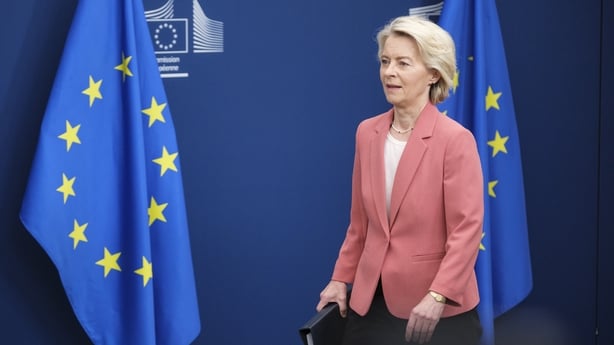
"EU Inc will ease access to finance in the start-up and scale-up phases, enable smooth cross-border operations, and allow rapid wind-down if a company fails," she added.
The 28th Regime will be ambitious and highly sensitive. The commission dropped an employment law component following alarm raised by trade unions that the 28th Regime could lead to a US-style, one-size-fits-all set of EU labour laws that might dilute hard-won work practices.
Much of the drive to boost Europe’s economy will land during the Irish EU presidency in the second half of this year.
Dublin prides itself on being a champion of the single market and has long campaigned to make it easier to provide cross-border services.
IBEC says Ireland should drive the so-called Single Market Roadmap in a way that removes barriers to the cross-border trade in goods and services and that "working constructively with the commission and parliament, [Ireland] will be well-situated to deliver impact on this agenda".
Yet, the Government removed itself from a position paper on European Strategic Competitiveness, circulated ahead of the summit by Estonia, Finland, Latvia, Lithuania, the Netherlands and Sweden - normally Irish allies on the competitiveness agenda.
The paper highlighted the need for the EU to boost the single market, increase simplification, remove barriers to cross-border services, support the 28th Regime and so on.
It’s understood Ireland declined to join the call because the paper contained the following sentence: "Open and rules-based trade is a cornerstone for European competitiveness. Under the lead of this commission, the EU has acted as the trade superpower it is. We have signed the Mercosur agreement - and must apply it provisionally as soon as possible."
Given that a key pillar of the clamour to boost Europe’s economy is the forging of new free trade deals, Ireland’s continued opposition to Mercosur - which may well be provisionally applied next month once Uruguay ratifies - could be a pebble in the shoe as the presidency approaches.
The Government might also be uncomfortable with the European Preference idea, pushed by French President Emmanuel Macron and President von der Leyen.
This envisages a Buy European approach in certain strategic sectors, where innovation and high-added value are key.
Under the draft Industrial Accelerator Act, due to be published by the European Commission in the coming weeks, there could be European content requirements for electric vehicles, renewables, low-carbon cement and steel if public money is being used, and limits to foreign investment in European companies in these sensitive sectors.
Germany had opposed the idea, while the Nordic Baltic paper said a European Preference risked "wiping out our simplification efforts, hindering companies’ access to world-leading technology, hampering exchange with other markets and pushing investments away from the EU".
On the eve of the summit, senior officials said the notion that this boiled down to a France vs Germany contest was a "caricature", and that discussions around the idea had "evolved".
Arriving at the summit, Micheál Martin said Ireland had "concerns".
He understood "the need for industrial resilience within Europe, but at the same time, we're concluding trade deals all over the world…and it's somewhat counter to that to say that you have to have a more protectionist approach.
"Certainly, we need more self-reliance in core areas. You need to reduce risk in terms of over-dependencies, but we must protect the open, free trade ethos of the European Union."
In the event, leaders agreed to task the European Commission to come up with an evidence-based list of critical sectors where European companies should be given preferential treatment, such as the automotive and pharma sectors.
It’s understood the Government is comfortable with that approach, but much will depend on what the Industrial Accelerator Act looks like, and what "evidence-based" actually means.
Officials say this week’s summit was a moderate success, focusing the minds of EU leaders in an informal setting with, it appears, genuine determination to tackle the outstanding obstacles to greater economic growth.
Yet, energy costs remain a major problem, with huge distortions in price depending on which member state you’re in. Fixing that will require major changes to grid and interconnectivity rules, not an overnight solution.
Asked about the European Preference on her way into the summit, the Danish Prime Minister Mette Frederiksen was quick to respond: "Buy more Danish, buy more European. The old world is gone, and we have to look with an open mind to the new one."