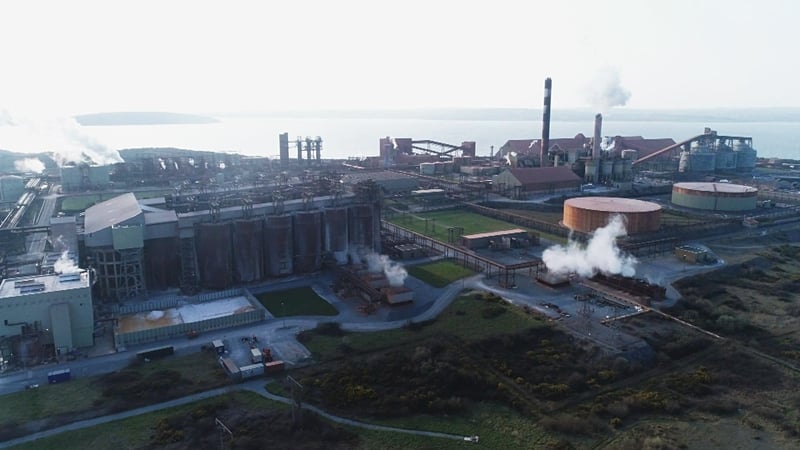

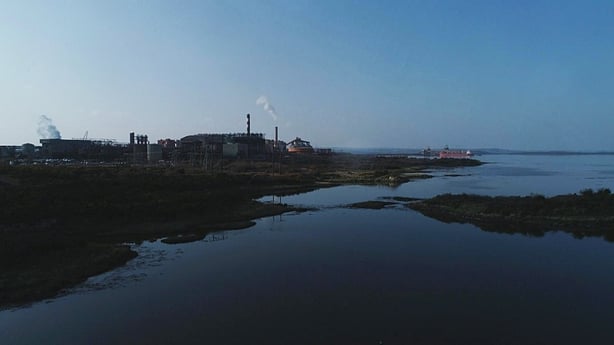
Aughinish Alumina, the refinery in Co Limerick at the centre of a controversy over its raw material allegedly ending up in Russian weapons, has warned the Government that any attempt to sanction its sale of alumina to Moscow would have implications for Ireland's national gas and electricity grids.
The warning comes in a briefing document provided by the Russian-owned plant to the Government and seen by RTÉ News.
The document states that Aughinish Alumina "exports excess electricity to the national grid, enough to power [circa] 200,000 Irish households".
The note also warns that Aughinish provides up to €25m each year for the maintenance of the natural gas grid.
Both the briefing document, and a letter from the company to the Government - also seen by RTÉ News - warn that any attempt to restrict the sale of alumina from the Limerick plant to Russia would mean that the "ongoing viability of the refinery at Aughinish would be severely in question with the potential loss of employment".
In such a scenario, the company warns, the Government would have to pick up the tab for what Aughinish currently provides towards the maintenance of the national gas grid.
The note states: "Aughinish plays a significant role contributing close to €25m per annum for the maintenance, upkeep and capital expenditure of the natural gas grid."
The briefing document adds that "these are fixed costs for Gas Networks Ireland" which would need to be "socialised if Aughinish were unable to continue in operation".
The warnings are part of a lobbying campaign by Aughinish Alumina, which is owned by the Russian aluminium conglomerate Rusal, to ensure that it is not subject to EU sanctions.
It follows an investigation by a consortium of European media outlets, including the Irish Times, which claimed that alumina shipments from the Limerick-based plant to Russia were converted into aluminium in a number of Rusal-owned smelting factories in Russia.
In turn, the aluminium was allegedly sold on by a Moscow-based aluminium trader ASK to a range of weapons manufacturers.
The report cited customs and trade data allegedly showing that the alumina ultimately ended up in weapons such as short-range ballistic missiles, which have been responsible for the deaths of hundreds of civilians in Ukraine.
In the briefing document, the company denies the claims by the Organised Crime and Corruption Reporting Project (OCCRP) that a majority of the alumina produced in Limerick is sold to Russia.
In the letter to Minister for Enterprise, Tourism and Employment Peter Burke, Aughinish Alumina Managing Director Ciaran Kelleher states: "In 2025, 55% of Aughinish's alumina was supplied to European and global industries, with 45% exported to Russia."
Neither the letter nor the briefing document address the central claim in the OCCRP report that the alumina shipped to Russia, which had increased 55% in volume between 2022 and 2024 - at the peak of Russia’s invasion of Ukraine - had ended up in Russian weapons.
However, the briefing document states that Aughinish Alumina "has received a warranty from Rusal that aluminium made from alumina from Aughinish is exported and not used in military applications".
The documents do not explicitly explain why any effort to stop alumina going to Russia would force the Aughinish plant to close, with the loss of 475 directly-employed staff.
The briefing document only suggests that restrictions on exports to Russia "would leave Aughinish in a position where a significant portion of its alumina production would need to be curtailed, reducing efficiency and increasing unit costs".
The document states that the "vertically integrated" nature of the plant "would be compromised" if there were restrictions on sales of alumina to Russia.
This would make its "viability as a standalone 3rd party operation unlikely".
The note states that while aluminium "is currently trading at high prices, alumina by contrast is not".
As such, to remain "viable through economic cycles, smelter grade alumina refineries, like Aughinish must be part of an integrated value chain to remain operational when the alumina refinery is not a cash generator (as it is currently)".
Both documents say that "recent media coverage mischaracterises its operations and the nature of global industrial supply chains".
The letter to the Government ultimately warns that, since Russia is a net exporter of aluminium, and that it only relies on Aughinish for 10% of its alumina needs, any EU sanctions would "have no material impact on Russia and potentially stoke inflation in commodity markets in Europe".
European Commission decision on sanctions
Last night, RTÉ News reported that the European Commission has decided not to propose sanctions at this time on Aughinish Alumina.
RTÉ News understands that during discussions yesterday between the European Commission and member states, on the next round of sanctions against Russia, a number of capitals raised the question of whether either the company itself, or the product, should be subject to sanctions.
However, three well-placed sources said that the European Commission has decided not to recommend sanctions at this stage.
One source said the reason was due to the potential disruption to the European aluminium market, given that Aughinish is the main supplier of alumina to a number of EU smelting companies.
Alumina is a compound of aluminium. Aluminium is a vital component for hundreds of industrial, commercial, and military goods.
Watch: Dutch MEP Bart Groothuis speals to Six One News about sanctions against Aughinish Alumina
We need your consent to load this rte-player contentWe use rte-player to manage extra content that can set cookies on your device and collect data about your activity. Please review their details and accept them to load the content.Manage Preferences
In May, 39 MEPs from 12 member states wrote to the European Commission calling for a ban on alumina exports from the EU to Russia, while the vice president of the European Parliament Pina Picierno called on the Commission to add alumina to the next sanctions package.
Aughinish Alumina responded to the OCCRP claims, published in March, by saying that it was "in strict compliance with all applicable European Union laws, including sanctions, export control measures and trade regulations" and that it had implemented "robust sanctions compliance and due diligence framework covering its entire supply chain".
Aughinish warned that if the plant closed due to sanctions on alumina exports to Russia, then a number of aluminium smelting companies in Europe, including in France and Sweden, would have to severely restrict their operations.
European Commission officials and diplomats from 27 member states held confidential discussions in Brussels yesterday as a first step in preparing a 21st sanctions package against Russia.
Following these initial discussions, member states then reflect on the entities and individuals targeted for sanctions - as recommended by the European Commission - with a view to finding consensus on the issue.
The Commission is expected to conclude a draft legal text on the 21st sanctions package on 15 June, with foreign ministers then endorsing it at a meeting in Luxembourg.
Each member state has a veto on any sanctions measure.
It is understood that the European Commission has decided that, at this time, imposing sanctions on either the company or imposing trade restrictions on alumina exports to Russia, would be disruptive to the vital aluminium supply chain in Europe.
We need your consent to load this rte-player contentWe use rte-player to manage extra content that can set cookies on your device and collect data about your activity. Please review their details and accept them to load the content.Manage Preferences