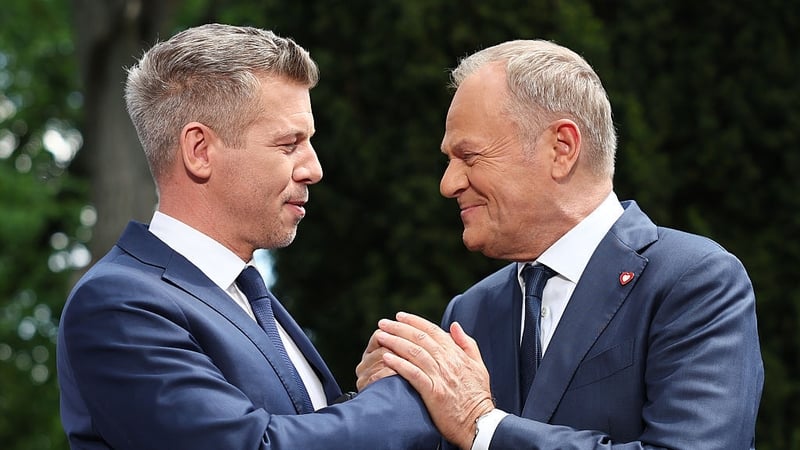

Hungary's new Prime Minister Péter Magyar has met his Polish counterpart Donald Tusk in Warsaw - his first official engagement abroad since his inauguration earlier this month.
The two-day visit to Poland by Mr Magyar marks a reset in relations between Budapest and Warsaw, which became strained during the final years of former Hungarian prime minister Viktor Orbán's government, particularly after it granted asylum to a former Polish justice minister and his deputy, sought by Polish courts for alleged misappropriation of public funds.
Mr Magyar’s centre-right Tisza party won a landslide victory in April’s Hungarian parliamentary election, ending 16 years of rule by Mr Orbán's eurosceptic Fidesz party.
Shared economic interests as well as defence and security issues were on the agenda for the meeting between the Polish and Hungarian leaders this morning.
The new Hungarian government views Poland as a key regional partner within the European Union and both governments have signalled an interest in cooperating more closely on energy security and on infrastructure projects to improve links between the two countries.
Mr Tusk, speaking alongside Mr Magyar during a press conference in Warsaw, said that both leaders would work towards establishing a common European position on Ukraine.
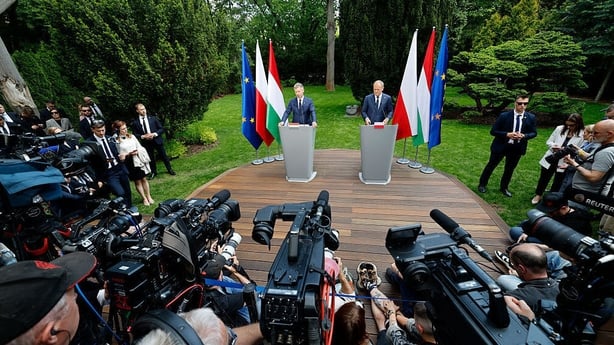
The previous Fidesz government opposed Ukraine’s ambitions to join the bloc but Hungarian and Ukrainian officials held discussions this morning, focusing on safeguarding the language rights of the Hungarian minority in western Ukraine and Ukraine's EU ambitions.
Securing those language rights would go a long way to Budapest supporting Ukraine's ambitions to join the bloc.
However, during the Hungarian election campaign, Tisza pledged to hold a referendum on the issue.
Mr Magyar said that he may meet Ukrainian President Volodymyr Zelensky next month.
He also said he planned to hold a meeting of Visegrad 4 leaders in Budapest next month, an informal political alliance comprising Poland, Hungary, Czechia and Slovakia.
The alliance lost much of its momentum over the past three years as relations between Warsaw and Budapest deteriorated.
Mr Magyar and Mr Tusk both lead political parties that are members of the centre-right European Peoples’ Party and hold similar pro-EU views as well as advocate for strict controls on immigration.
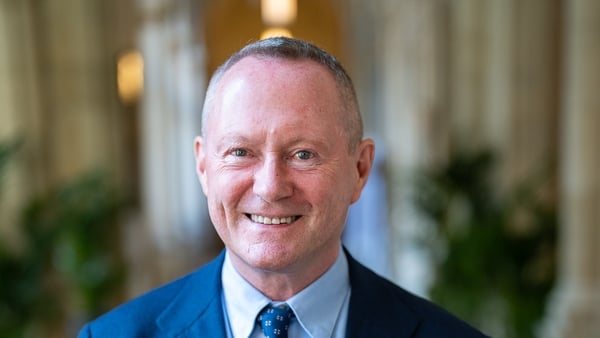
"Both capitals are under the same umbrella, so it's easier to align and build larger influence," Wojciech Przybylski, a Polish geopolitical analyst, told RTÉ News.
On the campaign trail, Mr Magyar pointed to the Tusk government’s success in unlocking frozen EU cohesion funds after its formation in December 2023.
Similarly, Mr Magyar wants to unlock some €18bn in blocked EU funding, frozen because of the former Fidesz government’s backsliding over the bloc’s rule-of-law norms.
Read more:
Why EU funding was the decisive factor in Hungary's election
The visit, said Mr Przybylski, editor in-chief of Warsaw-based think tank Visegrad Insight, is not only about EU funds, but also about "coordination between the two capitals on European and EU policy".
Hungary's new foreign minister Anita Orbán (no relation to the former prime minister), as well as Hungarian ministers for defence, economy and energy, and transport have accompanied Mr Magyar for intergovernmental meetings with their Polish counterparts.
Mr Magyar visited the southern Polish city of Kraków yesterday evening, meeting Cardinal Grzegorz Ryś, the Metropolitan Archbishop of Kraków, and also met with Polish President Karol Nawrocki this morning in Warsaw.
The Hungarian prime minister concludes his two-day visit this evening in the northern port city of Gdańsk where he will meet former Polish President Lech Wałęsa, who led Poland’s Solidarity trade union in the 1980s, a nationwide movement that led to the collapse of Communist rule in the country in 1989.
According to a report from Reuters, the Polish government is offering Hungary access to LNG imports from the a new terminal in Gdańsk that will become operational in 2028.
Mr Magyar has set 2035 as the date when Hungary will wean itself off Russian energy imports entirely.
Energy cooperation, said Mr Przybylski, is "the lowest hanging fruit" for the Polish and Hungarian governments.
"It's something Hungary needs. It's something that Poland offers, and it also builds into the narrative that Poland wants to see Hungary go north, aligning with the Polish direction," he added.