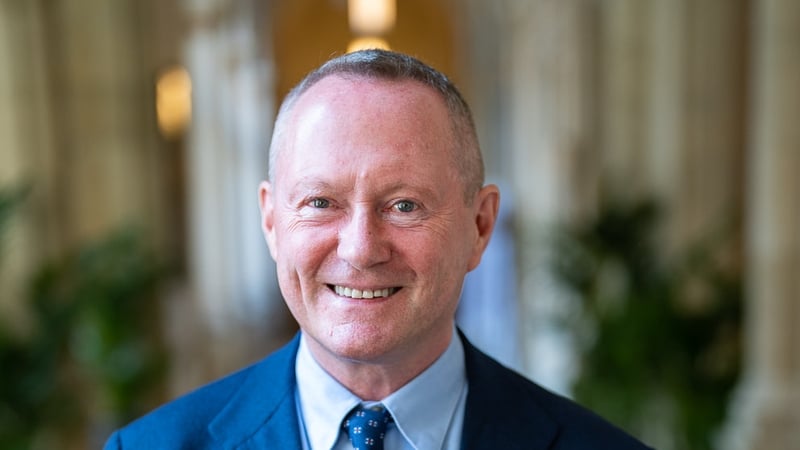

Council of Europe Commissioner for Human Rights Michael O'Flaherty has said that he is increasingly concerned about "growing fatigue and intensifying discussions" in the EU and across Europe over ending emergency protection measures for Ukrainian refugees.
Mr O'Flaherty, who held the role of Chief Commissioner of the Northern Ireland Human Rights Commission from 2011 to 2013, has warned in a statement that "a slow and fragmented phase-out" of the European Union’s Temporary Protection Directive (TPD) "risks leaving the most vulnerable exposed".
The EU has extended TPD measures for Ukrainian refugees until March 2027.
The mechanism has enabled Ukrainian citizens to reside, work and access healthcare systems in member states since March 2022, shortly after the start of Russia's full-scale invasion.
"I am increasingly concerned about the growing fatigue and intensifying discussions at EU and national levels about ending emergency arrangements," Mr O'Flaherty said in his statement.
"In some countries, policy changes have diminished protection and assistance. In addition, I see rising anti-Ukrainian sentiment, sometimes fuelled by populist politics."
The statement continues: "The stakes could not be higher: without robust national frameworks and a coordinated European approach, countless Ukrainians may be forced into impossible choices."
Mr O’Flaherty pointed to increased Russian attacks on Ukrainian civilian infrastructure over the past year and recommended that any future decisions over temporary protection must be "anchored in the principle that international protection is withdrawn only when return is safe and durable".
Those conditions, he said, "are manifestly not met today", adding that no region in Ukraine was currently safe.
According to data from the European Commission, 4.3 million Ukrainian citizens were residing in the EU under temporary protection at the end of March.
Starting in 2024, several EU member states including Ireland, Germany, Poland and the Netherlands began reducing financial support for Ukrainian refugees at various stages.
Many member states have pursued policies that help Ukrainian residents enter the labour market in tandem with phasing out financial support.
Last month, the Irish Government decided to withdraw state-contracted commercial accommodation for Ukrainian citizens who had arrived in the country prior to March 2024.
That process will begin in August on a phased basis over a six-month period.
Currently, up to 16,000 people from Ukraine living in Ireland are housed in tourist or commercial accommodation, funded by the State.
Last Sunday, Minister for Justice Jim O'Callaghan confirmed that the Government is considering a mechanism to help Ukrainian citizens return to Ukraine, though he has not made any announcement yet regarding the type of repatriation payment that may be offered.
The plan does not yet have full Government approval, according to Mr O'Callaghan.
More than 120,000 Ukrainian refugees have applied for temporary protection in Ireland since March 2022, though latest data from the CSO show that about 84,000 were residing in the State, as of last February.
In his statement, Mr O’Flaherty urged EU member states to avoid "a protection gap" after the current TPD mechanism expires in March 2027.
"Long-term solutions are also needed to allow Ukrainians to plan their futures. Millions live in uncertainty which exacerbates trauma," he wrote.
The Council of Europe comprises 46 member states and is based in Strasbourg.
Founded in 1949, the organisation is the seat of the European Court of Human Rights and oversees the European Convention on Human Rights.