


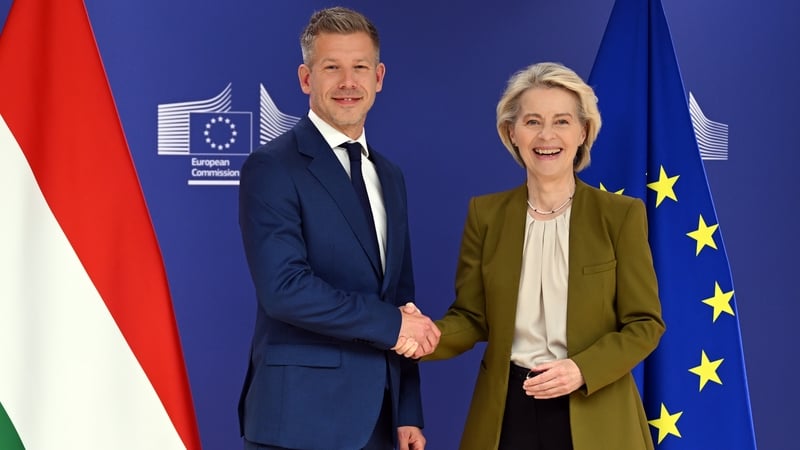


Analysis: One reason why EU relations matter so much in Hungary is how it's been a major source of investment money for roads, public projects, and development spending
Hungary's parliamentary election on 12 April 2026 produced a result that few observers expected in its scale: the opposition Tisza Party, led by Péter Magyar, won a two-thirds majority in parliament, while the long-ruling Fidesz–KDNP alliance of Prime Minister Viktor Orbán fell into opposition. The vote drew record-high participation for post-communist Hungary, with turnout reported around the high-70s percent range.
Elections rarely turn on one factor alone. But this vote is widely being read as a sign that many Hungarians wanted a change of direction, especially on the economy and on Hungary’s long-running standoff with the European Union. One reason EU relations matter so much in Hungary is simple: EU funding has been a major source of investment money for roads, public projects, and development spending for years.
Following the financial crisis, Hungary's gross domestic product (GDP) shrank by 6.8 per cent in 2009, and public debt stood at 77 per cent. After a difficult start, Orbán steered the economy onto a stable growth path from 2012 onward. Since he took office, GDP doubled, and poverty declined significantly. However, the economy has stagnated since 2022 – the moment the EU slowly closed the taps.
We need your consent to load this rte-player contentWe use rte-player to manage extra content that can set cookies on your device and collect data about your activity. Please review their details and accept them to load the content.Manage Preferences
From RTÉ Radio 1's World Report, Rob Cameron reports on the shockwaves in central Europe after Prime Minister Viktor Orban is swept from power
By the end of 2025, growth slowed to just 0.4 per cent compared to the previous year. The growth engine stalled. Also, Hungary's debt grew. After Orbán reduced the debt-to-GDP ratio from around 80 per cent to 65 per cent following his inauguration, it climbed back to almost its previous high during the pandemic. When that tap slows, it shows up in public finances and in day-to-day economic confidence of voters.
Why EU pressure shifted from politics to money
For years, the EU tried to address concerns about democracy and the rule of law in Hungary through a procedure described by former European Commission President Barroso as the "nuclear option": Article 7 of the EU Treaty (TEU). The European Parliament (EP) triggered the procedure in 2018. However, the EP repeatedly discussed and criticized the slow progress of those hearings. Civil society groups likewise argued that hearings happened but decisive follow-through was non-existent. Moreover, the option to sanction Hungary under the procedure was impossible due to the unanimity requirements under Article 7 TEU.
Alongside that political track, the EU also developed something more direct: a rule-of-law funding lever. In December 2022, EU member states decided, under the conditionality mechanism, to suspend €6.3 billion in EU money to Hungary, citing concerns linked to public procurement, prosecution effectiveness, and anti-corruption safeguards. This approach matters because it does not rely mainly on speeches or symbolic condemnation. It links EU money to concrete conditions and can therefore affect budgets, investment planning, and, eventually, economic mood.
We need your consent to load this rte-player contentWe use rte-player to manage extra content that can set cookies on your device and collect data about your activity. Please review their details and accept them to load the content.Manage Preferences
From RTÉ Radio 1's Morning Ireland, Hungary comes to terms with the two-thirds majority secured by Prime Minister elect Péter Magyar.
It is not just the stagnation that's draining the state coffers: Between 2014 and 2020, Hungary received €27.2 billion from Brussels. Measured against GDP, this amounted to approximately 3.2 per cent annually. Since 2022, the EU has withheld new funds, either partially or entirely, due to violations of the rule of law. Orban's attempt to close the gap with Chinese money increased the fiscal risks.
The majority of Hungarians support ending Orban's anti-EU policies, not particularly out of loyalty to Brussels, but so that funds from Brussels can flow again. Therefore, the EU's conditionality policy played a role in Orban's recent loss in Hungary.
Scholars disagree on how effective funding freezes are in the short term, but all accept they are among the EU’s strongest tools. The Centre for European Reform (CER) describes conditionality as powerful, while noting that early rounds produced only partial changes.
Academic work looking at 2022–2023 conditionality measures noted that Hungary’s response showed selective compliance shaped by political trade-offs, such as the vote on Ukraine’s candidate status to the EU. Along the same lines, my new book argues that conditionality has become the EU’s ultima ratio for dealing with rule of law backsliding Member States.
We need your consent to load this rte-player contentWe use rte-player to manage extra content that can set cookies on your device and collect data about your activity. Please review their details and accept them to load the content.Manage Preferences
From RTÉ News, Pro-EU Magyar vows 'new era' in Hungary after ousting Orbán
The economic backdrop: weak growth and rising fiscal strain
Against this institutional backdrop came a difficult economic period. The European Commission’s November 2025 forecast projected GDP growth of 0.4% in 2025 after two years of no or limited growth, with deficits expected to remain elevated. Debt is part of the story too. The Commission forecast shows gross public debt in the low-to-mid 70s percent of GDP range over 2025–2027. Trading Economics, citing Eurostat, reports Hungary’s government debt-to-GDP around the mid-70s in 2025.
Put plainly: Hungary was not collapsing, but it was not thriving either, and governments tend to suffer at the ballot box when voters feel the engine has stalled. As Bill Clinton’s advisor James Carville famously said: 'it’s the economy stupid'.
How funding freezes resonate with voters
The link between EU funding and domestic politics is not only about macroeconomics. It is also psychological. When you walk through Budapest, EU funds are visible: construction projects, municipal upgrades, and regional development. When funds are frozen, even partially, the absence becomes easier to argue about at kitchen tables.
We need your consent to load this rte-player contentWe use rte-player to manage extra content that can set cookies on your device and collect data about your activity. Please review their details and accept them to load the content.Manage Preferences
From RTÉ News, 'Disappointment' as Hungary blocks €50bn in EU funding for Ukraine
Reporting on the funding dispute has also highlighted the scale of the freeze. The Council decision in 2022 formalized the initial suspension of €6.3 billion under conditionality. In the campaign and immediate aftermath, several reports framed the election as a "turning point" and stressed that the winner intended to free frozen EU funds and rebuild institutional relationships. This shows that EU money and EU relations were part of the political weather and potentially turned the tide in Hungary.
What to watch next
A two-thirds majority in Hungary gives the new government wide legislative room to act. The immediate questions for Europeans will include: how quickly Budapest can rebuild trust with EU institutions; whether specific anti-corruption and procurement safeguards will satisfy the conditions linked to funding; and how Hungary’s position inside the EU shifts after years of high-profile disputes.
The Commission would be wise not to immediately release all funding and instead wait for meaningful reform to materialise before opening the taps again.
Follow RTÉ Brainstorm on WhatsApp and Instagram for more stories and updates
The views expressed here are those of the author and do not represent or reflect the views of RTÉ
