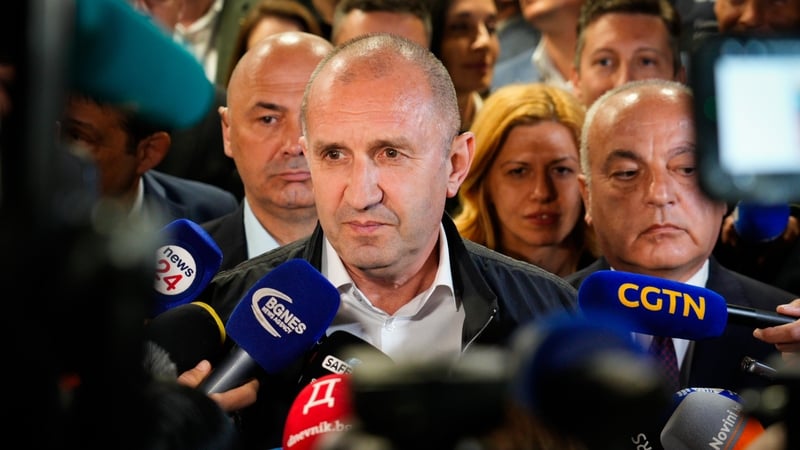

Just one week after Viktor Orbán’s Fidesz party was defeated in Hungary’s parliamentary election, more than 44% of voters in Bulgaria backed a centre-left coalition, led by Rumen Radev, in their country’s election last Sunday.
Mr Radev was Bulgaria’s president from 2017 until last January when he resigned to lead his new party in the election campaign.
He has been widely described as pro-Russian and there are concerns that he could disrupt future EU measures to support Ukraine, just as Mr Orbán had done.
His Progressive Bulgaria coalition won an absolute majority and looks set to put an end to a period of instability in Bulgarian politics after eight general elections in the past five years.
The previous centre-right government collapsed last December after tens of thousands of mostly young Bulgarians protested against budget plans to increase taxes. Those protests soon broadened into calls for the judiciary to tackle corruption.
Mr Radev tapped into that sense of public anger during the campaign and pledged to put an end to what he calls Bulgaria’s "oligarchic model", where a small group of the country’s oligarchs are said to assert control over political parties and the media.
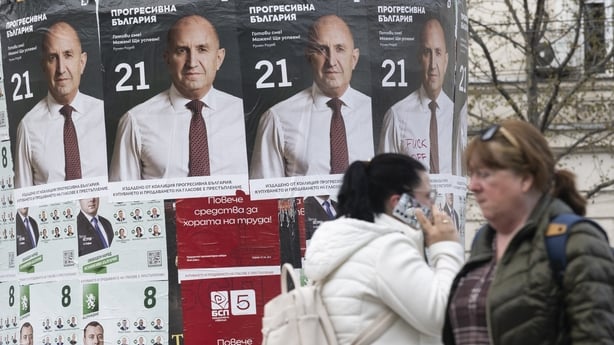
His campaign messages appealed to a broad spectrum of voters, gaining support among young people, the left and those who were simply frustrated by the lack of political stability in the country.
He also criticised Bulgaria’s adoption of the euro in January on the grounds that it reduces Bulgaria’s fiscal independence and could drive up inflation.
So does the pro-Russian label stack up?
In an interview with Bulgarian broadcaster bTV last week, Mr Radev said he opposed Bulgarian military aid being sent to Ukraine.
However, he also said that he would not block other countries from sending financial aid and arms to Kyiv, which suggests that he is unlikely to block future EU loans for Ukraine.
Mr Radev is "rhetorically mild" when it comes to Russia, professor Spasimir Domaradzki, a Bulgarian political expert and fellow at Visegrad Insight, told RTÉ News.
"He doesn’t look for open confrontation but sends constant signals that he doesn’t mind having open relations with Russia," said Prof Domaradzki, who lectures on politics at the University of Warsaw.
Reuters reported earlier this week that Mr Radev has talked about resuming the free flow of Russian oil and gas into Europe.
He has also said that recognising Crimea as Russia is a "realistic position," which clashes with EU policy on Ukraine.
Yet, Mr Radev, a former air force commander, denies accusations that he is pro-Russian, presenting himself as a guardian of national interests.
"I do not see what is pro-Russian about my position. My stance is entirely pro-Bulgarian," he told bTV in an interview last week.
Bilateral relations between Bulgaria and Ukraine are likely to be frosty once Mr Radev forms his government.
In 2023, as Bulgarian president, he said that "Ukraine insists on carrying on with this war, but the whole of Europe is paying the bills," according to reporting from Radio Free Europe.
That statement is widely at odds with the consensus view among most EU member states on the war.
In that same year, Ukrainian President Volodymyr Zelensky criticised Mr Radev during a bilateral meeting in front of cameras for his opposition to sending arms to Ukraine.
Mr Radev also criticised a 10-year defence pact signed between Kyiv and Sofia last month.
Bulgaria's next leader could find common ground at EU Councils with other sovereignist leaders like Czech Prime Minister Andrei Babiš and Slovak Prime Minister Robert Fico.
"A strong Bulgaria in a strong Europe needs critical thinking, needs pragmatism," Mr Radev told reporters after his election victory last Sunday.
"Europe has fallen victim to its own ambition to be a moral leader in a world without rules," he said.
It sounded both cryptic and eurosceptic.
Where Mr Radev could become an Orbán-style disruptor in the EU is if he pushes to restore Russian oil imports to Bulgaria for the first time since 2024.
The Kremlin welcomed Mr Radev's election win earlier this week. Given all that Bulgaria's next prime minister has said about Russia and his frosty relations with Kyiv, it is hard not to see him pursuing closer ties with Moscow.