The United Nations has harshly criticised the Israeli parliament's approval of a "cruel and discriminatory" new death penalty bill, warning that applying it in occupied Palestinian territory "would constitute a war crime".
Under the new law, passed in parliament yesterday, Palestinians in the occupied West Bank convicted by military courts of carrying out deadly attacks classified as "terrorism" will face the death penalty as a default sentence.
A spokesman for UN chief Antonio Guterres said the world body stood "against the death penalty in all its aspects, wherever".
"The discriminatory nature of this particular law makes it particularly cruel and discriminatory, and we ask that the Israeli government rescind it and not implement it," Stephane Dujarric told reporters in New York.
UN rights chief Volker Turk also called for the bill to be "promptly repealed", warning that it was "patently inconsistent with Israel's international law obligations".
Because Palestinians in the territory are automatically tried in Israeli military courts, the measure effectively creates a separate and harsher legal track.
We need your consent to load this rte-player contentWe use rte-player to manage extra content that can set cookies on your device and collect data about your activity. Please review their details and accept them to load the content.Manage Preferences
In Israeli civilian courts, the law allows for either death or life imprisonment for those convicted of killing with intent to harm the state.
Israel has only applied the death penalty twice. In 1948, shortly after the state's founding against a military captain accused of high treason and then in 1962 when the Nazi war criminal Adolf Eichmann was hanged.
Mr Turk stressed that "the death penalty is profoundly difficult to reconcile with human dignity", cautioning that "its application in a discriminatory manner would constitute an additional, particularly egregious violation of international law".
"Its application to residents of the occupied Palestinian territory would constitute a war crime."
The UN rights chief also expressed alarm at another bill currently before the Knesset aimed at establishing a special military court exclusively to prosecute crimes committed during and in the aftermath of Hamas's 7 October 2023 attack inside Israel, which sparked the war in Gaza.
That court would not have jurisdiction over crimes committed by Israeli forces in the occupied Palestinian territory.
"I urge the Knesset to reject this bill," Mr Turk said, warning that "by focusing exclusively on crimes committed by Palestinians, it would institutionalise discriminatory and one-sided justice".
His statement cautioned that "these legislative steps will further entrench Israel's violation of the prohibition of racial segregation and apartheid by discriminatorily targeting Palestinians, who are often convicted following unfair trials".
Meanwhile, the European Commission has described the introduction of the death penalty in Israel targeting Palestinians as a "clear step back" and a "clear negative trend" in terms of Israel's obligations on human rights, calling the move discriminatory in nature.
Israel's parliament passed the law making the death penalty a default sentence for Palestinians convicted in military court of lethal attacks.
Sixty-two politicians, including Prime Minister Benjamin Netanyahu, voted in favour and 48 against the bill, championed by far-right National Security Minister Itamar Ben-Gvir.
There was one abstention and the rest of the members were not present.
Spokesperson Anouar El Anouni said: "The approval of the deal in Israel is very concerning to us in the EU. This is a clear step backwards."
He called on Israel to "abide by its previously principled position, its obligation under international law and its commitment to democratic principles".
Read More: Israel passes death penalty law for Palestinians convicted of carrying out lethal attacks
The commission had expressed its opposition to the move "loud and clear" and the EU had communicated its concerns both at the highest level and through the bloc’s delegation in Tel Aviv, he said.
However, Mr Anouni declined to say if the European Commission would push to raise the issue in the context of the EU-Israel Association Agreement.
He told reporters: "Diplomatic engagement has taken place, is taking place and will continue to take place.
"This is part of our broader engagement, and this is what we do with our regular partners when we don't see developments eye-to-eye, and we're not on the same page in terms of different actions that are taken on both sides.
"It’s not for me here at this stage today, to be pre-judging ... or to speculate, in terms of the next steps that could be actually taken."
Death penalty law passed by Israel 'horrifying' - Tánaiste
Palestinians horrified by Israel's new death penalty law
Maisoun Shawamreh's fear for her son's fate kept her awake through the night in the occupied West Bank following the approval of the law in Israel.
"The mothers of prisoners - none of us slept last night," Ms Shawamreh told AFP as she joined a protest in Ramallah against the law.
Her son has been in detention for three years, awaiting sentencing on charges of attempted murder.
"He may or may not be subject to execution," she said, uncertain of what lies ahead.
Because Palestinians in the West Bank are automatically tried in Israeli military courts, the measure effectively creates a separate and harsher legal track.
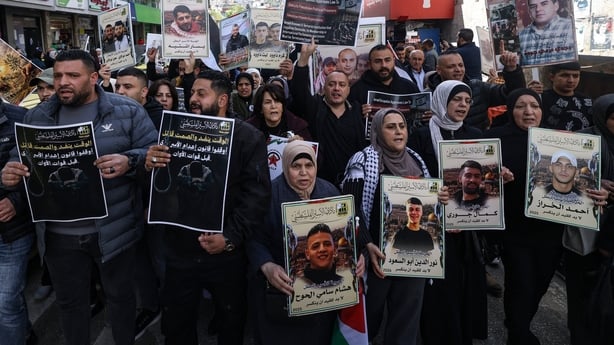
In Ramallah, dozens of activists, political factions and civil society groups gathered to protest the law.
Some held placards depicting a blindfolded prisoner flanked by two hanging nooses - a stark image of what they fear lies ahead.
"Stop the execution of prisoners law before it's too late," read the placards, held alongside portraits of imprisoned Palestinians.
Abdullah al-Zaghari, director of the Palestinian Prisoners Club, condemned what he described was an openly discriminatory law.
He said that the legislation "reflects the reality of the occupation".
"It applies to Palestinians - not to Israeli Jews who carry out daily violence against Palestinian civilians."
Another man, who works at an international humanitarian organisation, said the law was "horrible".
"But we expected it... What can you expect from a government with people like Netanyahu?" he said.
The new law is already facing legal challenges.
Several Israeli human rights groups, along with three members of parliament, filed petitions to the Supreme Court seeking to overturn the law.
The Association for Civil Rights in Israel (ACRI) said the law created "two parallel tracks, both designed to apply to Palestinians", and should be struck down on constitutional grounds.
The bill appears to conflict with Israel's Basic Laws, which prohibit arbitrary discrimination.