



The head of the Health Service Executive has said the country is "at the point of strong momentum" with between 220,000 and 240,000 doses of Covid-19 vaccines being administered this week alone.
Paul Reid said that 46,000 vaccines were administered yesterday but cautioned against slipping back on any gains as just over one in three people have been vaccinated with their first dose and one in eight having had both doses.
"There is still a lot to get through", he said.
Speaking on RTÉ's Morning Ireland, he said it it is still early days with the supply of the Johnson & Johnson (Janssen) vaccine but overall there have been really stronger supplies "across the board".
"We are at a really good point, which gives people confidence and reinforces hope. If you look at the momentum right now, this week alone we will have somewhere between 220,000 and 240,000" doses having been given.
With 35 vaccination centres open, two more will be added next week, "we are at the point of strong momentum", he said.
From today people aged 56 are being asked to register for an appointment to receive a coronavirus vaccine.
We need your consent to load this rte-player contentWe use rte-player to manage extra content that can set cookies on your device and collect data about your activity. Please review their details and accept them to load the content.Manage Preferences
Latest coronavirus stories
At a glance: What Covid changes mean for us this summer
Deliveries of the Johnson & Johnson #Covid19 vaccine are currently set to be about 40,000 below the expected levels for the month of May, but overall supplies are strong, HSE Chief Executive @paulreiddublin tells RTÉ's @MorningIreland | https://t.co/GF9eVgEqrU pic.twitter.com/YnREyoW0xc
— RTÉ News (@rtenews) May 7, 2021
Meanwhile, the HSE is still awaiting a decision from the Government about how it should proceed with the vaccination rollout after the National Immunisation Advisory Committee (NIAC) advised that the AstraZeneca and Johnson & Johnson (Janssen) vaccines should not be given to people under the age of 50.
Mr Reid said the core principles of the latest version of the HSE's rollout plan submitted to the Government are to stick to the strategy of vaccination by age, to maximise the pace of vaccinations, and to maximise the use of all available vaccines during May and June.
Asked if a million #Covid19 vaccines will be administered in May, HSE Chief Executive @paulreiddublin tells RTÉ's @MorningIreland 'We're really at the point of very strong momentum to give the public confidence' | https://t.co/GF9eVgEqrU pic.twitter.com/JcQyuhpgiq
— RTÉ News (@rtenews) May 7, 2021
He said, however, that this would require some flexibility in relation to the use of the Johnson & Johnson vaccine for people under the age of 50 and the HSE is awaiting a Government decision in relation to that.
Mr Reid said Johnson & Johnson deliveries are set to be about 40,000 less for May, with 100,000 being delivered rather than the expected 140,000.
He said hope is grounded on evidence such as reduced Covid-19 hospitilisations and deaths, correlated with the rollout of vaccinations.
Plan submitted wants to use the pharmacy sector
Speaking about the goals of the revised vaccination programme, Mr Reid said its focus is to ensure all available vaccines are used and are not held back and the plan submitted wants to use the pharmacy sector also.
"We don't want to have a situation where we have a large supply of Johnson & Johnson, for example, and not being able to administer those".
He also reiterated that the HSE does not want to encounter a situation where younger age groups are being vaccinated in larger numbers, while those in their 50s for example are still waiting for a vaccine.
He said the HSE has submitted the plan and there is ongoing dialogue with the Department of Health and the HSE awaits a decision, it does not stop the vaccine rollout.
Mr Reid said there is a very strong take up of the vaccine and he is " highly encouraged" by that.
"Take up has been very strong overall. As of last night, 452,000 have registered" on the HSE's online portal".
Conditions 'right to reduce restrictions' at maternity hospitals
Regarding the vaccination of pregnant women he said they are finalising all the details and it will be communicated early next week.
"What will be most likely is that the women through maternity hospitals and their consultants will be referred forward for a vaccine type and it will be administered through the vaccination centres."
Regarding hospital visits by partners of pregnant women, he said they believe conditions are right to reduce restrictions and he expects them to be lifted
He said while they believe that whole situation has improved in terms of lower risks of transmission they remain cautious.
"There are still risks out there and we do have to strongly encourage hospitals to take the right precautions to prevent risks of transmission."
He said where hospitals might see risks they should notify the HSE of them.
Mr Reid said the take up of the vaccine by healthcare staff has been "remarkably strong."
He said the advice is that for people working in frontline healthcare roles to take the vaccine as it creates a risk if they do not.
He said where a hospital sees any risks management needs to address it, as it is not appropriate that someone would expose that risk to others.
He said Ireland's measurement of Covid related deaths and cases has been quite conservative in terms of "what we capture, of what we count".
He was responding to research carried out in the US that shows 7,000 deaths have been caused by Covid-19 in Ireland, 2,000 more than the officially quoted figure.
"No doubt there will correlation done by research and our own figures and public health teams will do that. We have been noted internationally for taking the right approach in terms of our count whether its positive cases, our mortality. I am sure that correlation will be done shortly."
PCR test is 'gold standard'
When asked about the sale of antigen tests in shops, Mr Reid said that while these tests have have a role to play, "there is nothing of higher quality standard than PCR testing. It is well proven."
He advised that if you take just antigen testing alone, it is known that they have a higher level of accuracy among symptomatic people and those experienced in self-testing.
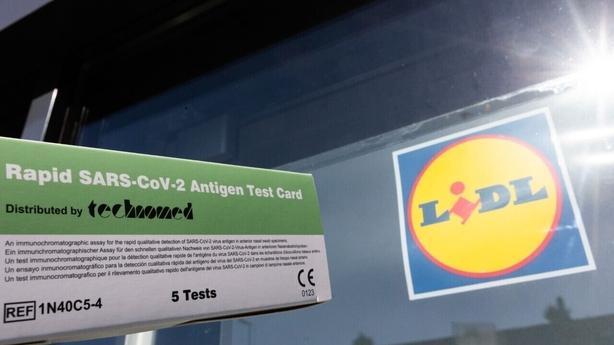
But, "if you are symptomatic do seek a GP referral for a PCR test. If you have a positive antigen test still seek a referral for a PCR test. It is the gold standard," he added.
Meanwhile, with one-third of the adult population having by now received at least one dose of a Covid-19 vaccine, Chief Medical Officer Dr Tony Holohan said yesterday it is time to feel hopeful and to start planning our summer.
He said that everyone wants the easing of restrictions next Monday to be a significant turning point in the pandemic and the choices people make now are vital to minimise the incidence of Covid-19 throughout May and June.
A comparison of vaccination strategies in EU countries published by the European Centre for Disease Control yesterday confirmed that the pace of the vaccination rollout in Ireland is exactly in line with the European average.
It also confirmed that limited supply of vaccines, late confirmation of shipments, and last-minute alterations to delivery quantities are presenting real challenges for all EU countries, not just for Ireland.
The HSE said yesterday it has so far vaccinated 63% of 65-to-69-year-olds who registered on its website, while another 15% now have appointments for vaccination.
Of the 60 to 64-year-olds who registered, 21% have been vaccinated while another 9% have been given appointments.
The HSE said another 100,000 people from the register, aged in their 60s and 50s, will be vaccinated next week.
Change to NI roll out of AstraZeneca
Meanwhile, head of Northern Ireland's vaccination programme Patricia Donnelly has said the rollout to the under-40 age group will be limited over the coming weeks due to the changed advice on who should get the AstraZeneca jab.
Ms Donnelly was commenting following the Joint Committee on Vaccination and Immunisation (JCVI) advice that people under 40 should be offered an alternative to the AstraZeneca vaccine due to a link to rare blood clots.
The advice already covered the under-30 age cohort.
The majority of people aged 30-39 will now be offered the Pfizer jab. People who have already received a first dose of AstraZeneca will receive a second dose of the same jab, while others can make an informed choice to have the AstraZeneca vaccine if they wish.
Yesterday, the German government decided to remove all restrictions on the use of the AstraZeneca vaccine in order to speed up the vaccination rollout there.
Germany had previously only allowed the AstraZeneca vaccine to be given to people over the age of 60.
It said the decision about who should get the vaccine should be made by doctors and that the risks of very rare side effects should be explained to patients in that process.
Additional reporting George Lee
