


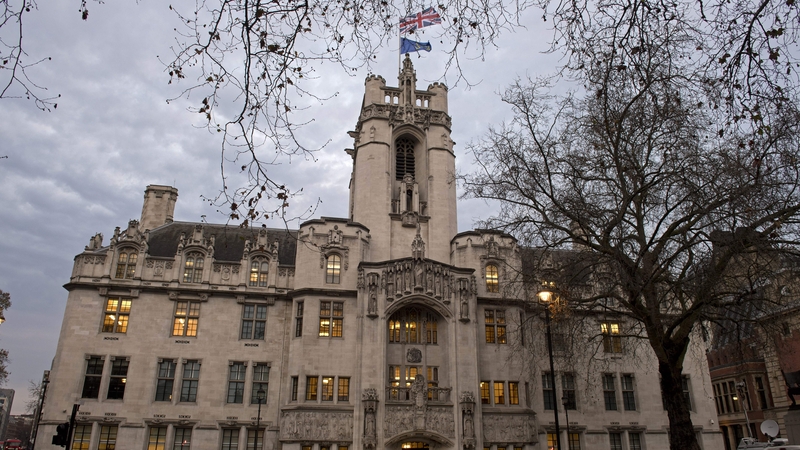
Britain's Supreme Court is to give its judgment in the legal battle over Brexit on 24 January.
The country's highest court will decide whether to reject or allow a government appeal against a High Court ruling that blocked the royal prerogative being used to trigger Britain's exit from the European Union without Parliament having a say.
The ruling was won by campaigners led by investment manager Gina Miller and hairdresser Deir Dos Santos.
In a case of major constitutional importance, three High Court judges unanimously decided last November that Prime Minister Theresa May did not have authority to use Crown "prerogative powers" to invoke Article 50 of the Lisbon Treaty to start the two-year process of negotiating the UK's departure from the EU.
The government is asking a record 11 Supreme Court justices to overturn the decision and rule the use of prerogative powers did not interfere with the sovereignty of parliament.
The decision will be handed down at 9.30am next Tuesday.
Meanwhile, UK Brexit Secretary David Davis has said Britain received some positive responses from Brussels overnight on Ms May’s Brexit plans.
Mr Davis also said Britain may not have fully freed itself from all European Union rules until 2021.
Speaking to the BBC, Mr Davis also said Britain will seek a customs deal that is as frictionless as possible.
Ms May took questions from MPs today over the plans she outlined yesterday in which she confirmed Britain will quit the single market.
She also warned she will walk away from EU exit talks rather than accept a "punitive" deal.
Mr Davis said Britain was not going to take "punishment" from the rest of the EU.
He also said Britain was "very determined' to agree a divorce deal with Brussels and a new trading relationship within the two-year negotiating process set out by Article 50 of the EU treaties.
At the end of two years, we will have our deals, what may take a little longer is implementation."
One of the first stages of the negotiation, which Ms May has promised to begin by April, will be to sign the EU up to the UK's proposed timetable, he said.
A German MEP and member of Angela Merkel's CDU party, meanwhile, has said that it is now clear that Brexit means a "hard Brexit".
Speaking on RTÉ's Morning Ireland, David McAllister said the other 27 member states have more clarity about what to expect from the UK government but would now have to wait until the end of March until Article 50 of the Lisbon Treaty is triggered and the negotiating process begins.
He said, however, that the UK will remain neighbours, friends and partners, including in NATO, and both sides are interested in getting a fair trade deal done.
Elsewhere, Sinn Féin President Gerry Adams reiterated calls for Northern Ireland to be given a special designated status in the EU during Brexit negotiations.
Mr Adams said the Taoiseach needed to argue for special status, and for the vote of the people of the North - who voted by a majority to stay in the EU - to be upheld.
He told RTÉ's Morning Ireland that there had to be an ongoing strategic engagement between the British and Irish governments to ensure Britain fulfills its obligations under the Good Friday Agreement.
Theresa May's #Brexit speech dominates Europe's front pages pic.twitter.com/qzkKYLRaTR
— RTÉ News (@rtenews) January 18, 2017
Mr Adams added that he believed the Irish Government acts as a junior partner to the British government and needed to remember it is an equal co-guarantor of the Good Friday Agreement.
Minister of State for European Affairs Dara Murphy rejected Mr Adams' claim.
Mr Murphy said that no one has been more of a champion for Northern Ireland issues than the Taoiseach who, he stressed, called for an all-island forum on Brexit to take place.

He welcomed that maintaining the common travel area had been highlighted by Ms May as one of her areas of concern.
However, he said, details of future trade deals remain very unclear which was worrying from an Irish point of view.
UK thinking must not be 'detachment from reality' - Maltese PM
Elsewhere, the Maltese Prime Minister has told the European Parliament that any deal struck with the UK would have to be inferior to EU membership.
Joseph Muscat told MEPs in Strasbourg that the remaining EU states are committed to striking a "fair deal" with the UK, but any final deal will "necessarily need to be inferior to membership".
He said thinking otherwise would be a "detachment from reality".
Malta currently holds the rotating presidency of the EU.
Mr Muscat told MEPs that there is "unequivocal unity" among EU states to preserve the indivisibility of the four freedoms of goods, services, capital and people.
The Maltese leader also added that he would like to see the European Parliament involved "as much as possible" in the Brexit talks once under way.
There was only a brief mention of Brexit from EU Commission President Jean-Claude Juncker, who said he welcomed Ms May's speech yesterday.
Addressing MEPs, he said "a speech alone cannot trigger negotiations" - which will only take place once Article 50 is formally activated.
He said that the EU executive will do everything to ensure the talks "yield good results".
Mr Juncker focused on the situation facing migrants, calling for reform of the Dublin Regulation within six months.
Conservative MEP Syed Kamall told MEPs he hoped the Maltese presidency would take the EU in a new direction.
Former Belgian prime minister and MEP Guy Verhofstadt said US President-elect Trump's comments on the EU breaking up should be a 'wake up call' to reform as soon as possible.
