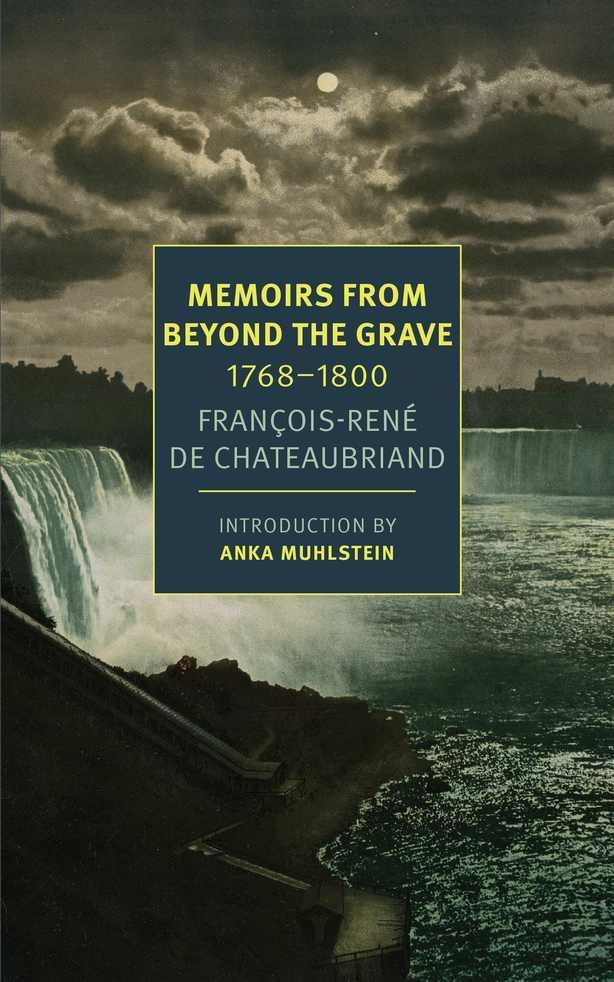
Memoirs from Beyond the Grave by Chateaubriand packs a punch over its 520 pages, an absorbing memoir of politics, travel and women in the eighteenth century.
Francois-René Vicomte de Chateaubriand (1768-1848) to give the man his full title, spent his boyhood in a medieval castle in St Malo in Brittany. He received a commission in the army in 1786 and saw the revolution of 1789 and all subsequent restorations and revolutions in the course of his exceptionally long life.
The bloody events of the French Revolution (of 1789) traumatised him sufficiently to prompt his booking a ticket to America in hopes of finding the elusive Northwest Passage. In truth he didn’t, like so many other doomed or disappointed adventurers. Subsequently, he returned to France and joined the royalist forces on hearing news of the arrest of King Louis XVI.
After defeat by revolutionary forces, he sought refuge in England and began work on the celebrated novels Atala and Rene, while working as a tutor and translator. Back in la Belle France, he fell out with the Bonaparte government and hoofed it to travel in Italy and Greece, and he even ventured as far as Jerusalem. Then, as you do, he returned to France through Spain.
Another string to his bow in the irresistible public life was added when King Louis XVIII appointed him as ambassador to Berlin and London. However, the author and public man endured yet another uneasy relationship with that august regime. Much of that uneasiness centred on his insistence on the freedom of the press – throughout his life, Chateaubriand remained an admirer of democracy as he first witnessed the phenomenon in America. He revered George Washington.
Memoirs from Beyond the Grave runs to 520 pages in the present edition, 550 pages with the detailed notes. Translator Alex Andriesse provides an illuminating essay, Chateaubriand in America, while Anka Mulhlstein’s introduction is particularly informative on the life and times of this doughty individual who experienced so much of the world of his day.
Much to Chateaubriand’s chagrin, a convoluted publishing development meant that these memoirs were scheduled to appear in their original French with unseemly haste, as he saw it, shortly after his impending death. He had wanted the publishers to wait 50 years, and he was also appalled that they were serialised in newspapers as he believed that such serialisation ruined the unity of the work.
Indeed, perhaps partly as a diversionary tactic, he started to work feverishly on a drastic revision involving corrections and amendments when he discovered that the book was to be published earlier than he wished for. It was really to little avail as these amendments did not appear in the first edition and readers had to wait a century for the revised text.
Vicomte de Chateaubriand envisaged the book as a tripartite structure, detailing in the first third his life as a soldier, then a traveller, with the final part detailing his life as a politician.
Aside from travel and political upheaval and revolutionary fervour as it impacted before his eyes, this sometimes flamboyant account encompasses Chateubriand’s life-long obsession with various women, notably his wife, Celeste de Lavigne, whom he married when she was 18. The couple were separated by his army posting and his English sojourn, and in truth they had had a somewhat cold, functional relationship.
The revered French critic, Charles Augustin Saint-Beuve (1804-1869) enjoyed these memoirs, which, aside from that aphoristic current of wisdom that runs throughout also had a wild, poetic thread. Saint-Beuve poked a gentle jibe: "At the most critical and decisive moments, he turns into a dreamer and starts talking to swallows and crows in the trees along the road." Charles Baudelaire deemed him " a master when it came to language and style, while Marcel Proust felt he owed a debt to this "marvellous and transcendent artist."
The great Bavarian writer WG Sebald (1944-2001) was undoubtedly influenced by Chateaubriand, whose travels in Norfolk were retraced by Sebald in The Rings of Saturn. Reading him in English in any case - and Sebald worked closely with his English translators - the influence appears to be there in the somnolent drift of his almost ethereally flowing sentences.
The American writer Paul Auster has deemed Memoirs from Beyond the Grave "the best autobiography ever written... The old viscount could write one hell of a sentence. It’s an incredible book." Argentinian-Canadian novelist Alberto Manguel has also enthused as follows: "To read Chateaubriand is to witness the subjective and yet comprehensive unfolding of a society’s change: of customs, prospects, ethics, conventions."
"Bourboniste by honour, royalist by reason and republican by inclination" was the esteemed writer's summary of himself, and where he stood some three centuries ago.