

Analysis: Ireland's EV fleet of just over 4% of total cars is exactly the EU average, but our 4,000 public chargers are well below the number they should be
Most EV owners charge their cars at home. If they're using night-rate electricity, their transport fuel bills (€/km) will be roughly 1/3 the price of petrol or diesel, according to SEAI's fuel price comparison. If charging using self-generated electricity from solar panels, their bills could be even lower.
But for anyone living in an apartment or terraced dwelling, they’ll probably have to rely on public EV charging. Many apartments have private parking, but not EV charging. For on-street parking, insufficient regulations are currently precluding options such as kerb chargers or cross-pavement chargers that are available in other countries.
We need your consent to load this rte-player contentWe use rte-player to manage extra content that can set cookies on your device and collect data about your activity. Please review their details and accept them to load the content.Manage Preferences
From RTÉ News, EV drivers in Ireland paying more to charge their cars
Public charging is also often necessary for longer trips. The average range for a new electric car is 400km and the average trip distance in Ireland is just 13km. That's more than enough for most cars for most trips. However, for anyone with a lower-range older EV, public charging will be necessary for those longer trips.
So what is the state of Ireland’s public EV charging infrastructure? Unsurprisingly for a nation of story-tellers, accounts of bad experiences using public EV charging get around. There is real human drama in waiting to charge while there’s a wailing baby in the back seat and you still have miles to go before you sleep. Bad news travels fast.
We need your consent to load this rte-player contentWe use rte-player to manage extra content that can set cookies on your device and collect data about your activity. Please review their details and accept them to load the content.Manage Preferences
From RTÉ Radio 1's Drivetime, Lord Mayor of Dublin Ray McAdam calls for legal EV home charging in the capital
But what does the data say about Ireland’s public EV chargers? The 2023 EU Alternative Fuels Infrastructure Regulation (AFIR) contains rules and definitions for calculating minimum infrastructure requirements for alternative fuel vehicles (electricity, hydrogen or natural gas). AFIR uses the term 'publicly accessible recharging station’ to cover both public and private operated chargers.
EV chargers are measured in kWs. Slow AC chargers typically range from 7kW to 22kW whereas fast DC chargers can range from 50kW up to 350kW. The AFIR stipulates that "recharging stations [...] are deployed in a way that is commensurate with the uptake of light-duty electric vehicles", i.e. each EU country has their own dynamic target based on the changing size of their EV fleet.
We need your consent to load this rte-player contentWe use rte-player to manage extra content that can set cookies on your device and collect data about your activity. Please review their details and accept them to load the content.Manage Preferences
From RTÉ News Behind the Story podcast, what's happening with the electric car market?
The formula to calculate the total charging capacity of all public chargers is as follows: for every fully electric car "a total power output of at least 1.3kW" and for every plug-in hybrid electric car "a total power output of at least 0.8kW". So once we know the number of EVs in Ireland we can calculate the target for the total size of public EV charging infrastructure.
According to the European Alternative Fuels Observatory (EAFO), at the end of 2025 Ireland had a fleet of 155,776 EVs made up of 95,123 fully electric vehicles and 60,653 plug-in hybrid electric vehicles. Using the AFIR target formula, the EAFO website calculates Ireland’s public charging target as 182,389KW. The actual power output of all publicly accessible chargers in Ireland for roughly the same period is 178,065 kW. In percentage terms that’s 98% compliance. Pretty good, you might say.
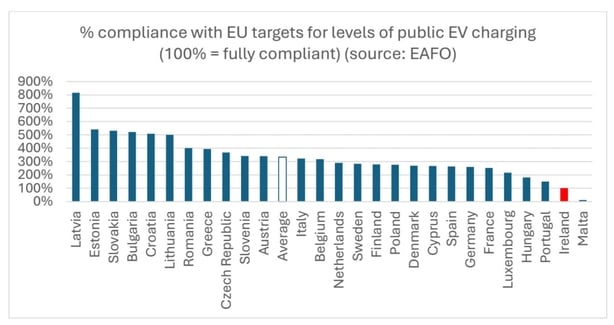
Except comparatively speaking, it’s not so good. Compared to other EU countries, Ireland ranks 2nd lowest ahead of tiny Malta for AFIR compliance. Across the EU, the average level of compliance with the AFIR target is 333%. Ireland has about 4,000 public EV chargers. If Ireland had the EU average level of AFIR compliance for the current EV fleet, there would be 13,000 chargers.
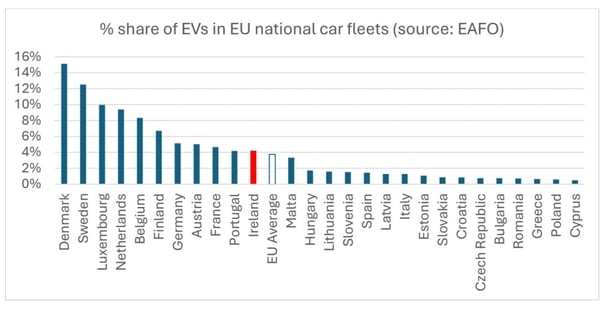
How much does this level influence the amount of EVs in Ireland? Interestingly, data on the share of EVs in EU member states shows Ireland has an EV fleet of just over 4% of the total car fleet, which is exactly the EU average. So Ireland has below average levels of public EV charging infrastructure with average levels of car fleet electrification. Imagine what would be possible if Ireland’s public charging infrastructure was average or even above average.
Many factors influence the levels of EVs in each country such as the level of incentives for EVs, disincentives for non-EVs, relative cost of cars and fuels, number of EVs models available, cost of finance and buyer and public attitudes. International research suggests that more public charging infrastructure does increases the rate of EV adoption, though with some caveats (details below).
Current Irish government targets are for 30% of the private car fleet to be electrified by 2030. So more infrastructure, which the Government is planning, will definitely support a growing EV fleet. By comparison, Norway currently has a 35% fleet of electric cars, the highest in the world. It took Norway approximately 10 years to get from a 22% share of sales to greater than 90% share of sales. For reference, Ireland’s share of sales from EVs in 2025 was 30%.
The crucial caveat for public charging infrastructure is it only increases EV adoption if people notice it and frequently they don’t. International research and ongoing research I'm involved in points to relatively low levels of awareness of public EV charging infrastructure in Ireland.
We need your consent to load this rte-player contentWe use rte-player to manage extra content that can set cookies on your device and collect data about your activity. Please review their details and accept them to load the content.Manage Preferences
From RTÉ Brainstorm, why electric cars need to be heard as well as seen
This might be due to different routines. Refuelling a car is a very routine-based activity. Noticing is also routine-based; we mostly see what we expect to see. However, further research is required to make a distinction between low awareness based on pure perception versus a genuine absence of charging infrastructure.
Nevertheless, for EV public infrastructure to become part of a non-EV driver’s consciousness, extra effort will be required to make chargers conspicuously visible. Ireland needs more public EV chargers because we need more EVs. But Ireland also needs more than EVs - i.e. public transport, walking and cycling - to be truly sustainable.
Follow RTÉ Brainstorm on WhatsApp and Instagram for more stories and updates
The views expressed here are those of the author and do not represent or reflect the views of RTÉ