


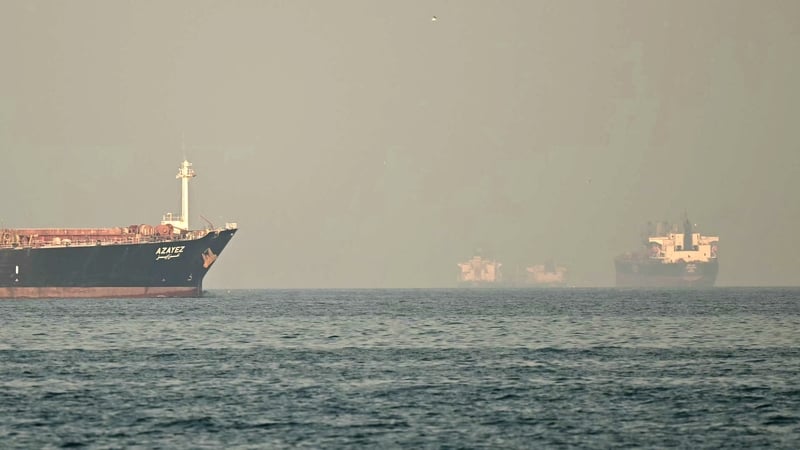
Analysis: As the closure of this vital shipping route shows, the structural vulnerability of maritime trade and supply chains is often underestimated
By Sarah Schiffling, Hanken School of Economics and Nikolaos Valantasis Kanellos, TU Dublin
The Strait of Hormuz has been declared closed, effectively stopping 20% of global oil and gas supplies, and oil prices have increased in response. But the escalation is less about a physical closure of the Strait of Hormuz than about the strategic weaponisation of risk.
Iranian actions against ships and infrastructure on this critical maritime transport route have resulted in a near stoppage of vessel movements. This is not simply disruption, but the strategic use of maritime vulnerability as leverage. The longer disruption persists, the worse the consequences for the global economy will be.
We need your consent to load this rte-player contentWe use rte-player to manage extra content that can set cookies on your device and collect data about your activity. Please review their details and accept them to load the content.Manage Preferences
From RTÉ Radio 1's Morning Ireland, Dr Nikolaos Valantasis Kanellos from TU Dublin on how oil, gas and shipping costs have surged over threats to the Strait of Hormuz
While Iran targeted several vessels, as well as port and energy infrastructure, actual damage has so far been limited. The strait is not closed because of any physical barrier, but because of the perceived risk level due to which shipping companies have told their vessels to reroute or seek shelter. The geography of the region dictates the dependency on the one narrow outlet of the Persian Gulf. While there is some spare capacity in pipelines that bypass the Strait of Hormuz, this would only account for a fraction of the usual 20 million barrels that are shipped here every day. And those pipelines still end within the region that has now become target to Iran's retribution.
The current transport disruptions echo those caused by the Houthi threats and attacks on shipping in the Red Sea in 2024. This crucial access route to the Suez Canal is another key maritime chokepoint. In response to the heightened risk, carriers have rerouted around the Cape of Good Hope. That two-week detour results in higher freight rates and longer lead times. Nevertheless, it has been seen as preferable by so many carriers that the number of vessels crossing the Suez Canal decreased by half from 2023 to 2024. The route is not officially closed, but the attacks have still affected supply chains globally.
The war in Ukraine has affected another maritime chokepoint, namely the Black Sea. The lack of Ukrainian food exports has hit especially populations in poorer regions of the world, as Ukraine is usually a key food supplier to the World Food Programme. For a while, the Black Sea Grain Initiative allowed for limited shipping. There are few alternatives. Other transport modes such as river barge and rail are being used but cannot move the huge volumes that are usually shipped by sea. In response, food prices increased globally.
We need your consent to load this rte-player contentWe use rte-player to manage extra content that can set cookies on your device and collect data about your activity. Please review their details and accept them to load the content.Manage Preferences
From RTÉ Radio 1's The Business. how the Red Sea shipping attacks in 2024 increased freight costs and shop prices
The structural vulnerability of maritime trade is often underestimated. Approximately 80% of global trade by volume moves by sea, through straits, canals and passages that cannot be redesigned or relocated. A small number of chokepoints carry a disproportionate share of those flows. Supporting infrastructure like ports is capital intensive, immobile and depends on predictability.
Thin margins make maritime transport sensitive to cost increases or delays. When disruption hits, it cascades rapidly through just-in-time supply chains. In contrast to land transport, path redundancy is limited and rail, river or pipeline alternatives cannot meet the scale of maritime transport. When a chokepoint falters, there is rarely a parallel system ready to absorb the shock, which makes maritime trade especially sensitive to disruption.
As seen with recent examples, a strait does not need to be blocked to be effectively closed. Rising insurance premiums or cancelling risk covers can signal danger. Shipping companies bound by fiduciary duty to crews and shareholders reroute or suspend operations. Governments have limited ability to compel private carriers into high-risk zones. Even after Operation Prosperity Guardian sought to reassure shippers in the Red Sea, many continued to reroute, an example of how interdependence itself can be weaponised when trade flows depend on a small number of strategic nodes. Confidence is hard to restore as markets and operators need sustained proof of safety, not just an assertion.
We need your consent to load this rte-player contentWe use rte-player to manage extra content that can set cookies on your device and collect data about your activity. Please review their details and accept them to load the content.Manage Preferences
From RTÉ News' Behind the Story podcast, how the Iran crisis could hit your pocket
Even where alternatives exist, substitution comes at a cost. Rerouting vessels around the Cape of Good Hope adds fuel consumption, crew time, insurance expenses, higher freight rates and increased emissions. Rail, river or pipeline options are typically more expensive and constrained in capacity. These adjustments strain infrastructure elsewhere, creating bottlenecks rather than solving them.
The economic burden ultimately falls on consumers through higher energy prices, more expensive goods and renewed inflationary pressure. Maritime chokepoints therefore do not just shape trade routes, but redistribute costs across economies, exposing how efficiency-driven global supply chains leave little slack when disruption strikes.
Mitigation measures are challenging. While it is good practice to have several sources for supplies, targeting certain chokepoints can cut off many supply chains at once, like the Suez Canal affecting all traffic between Asia and Europe. Other resources are only located in certain areas, as with OPEC now having most of its output limited by the disruption in the Strait of Hormuz.
Disruptions at maritime chokepoints are no longer an anomaly and they are likely to remain an enduring feature of geopolitical tension
Military action can be used to assert the safety of chokepoints, but this can be counter-productive since the key issue that "closes" a chokepoint is the perceived risk. Naval escorts are costly and resources are limited. Alternatively, emergency stockpiles can give nations and companies some resilience. But such measures require a careful consideration of risk appetite versus willingness to commit resources to preparedness.
Disruptions at maritime chokepoints are no longer an anomaly and they are likely to remain an enduring feature of geopolitical tensions. Indeed, some chokepoints matter more than others. The Malacca Strait between the Indian Ocean and the South China Sea carries such volumes of trade that a sustained disruption there would test the resilience of the global economy in ways not yet experienced.
Follow RTÉ Brainstorm on WhatsApp and Instagram for more stories and updates
Dr Sarah Schiffling is an Assistant Professor in Supply Chain Management & Social Responsibility and the Deputy Director of the HUMLOG Institute at the Hanken School of Economics, Finland. Dr. Nikolaos Valantasis Kanellos is a Lecturer in Logistics and Programme Coordinator of the MSc Logistics and Supply Chain Management course in the School of Business Technology, Retail, and Supply Chain at TU Dublin.
The views expressed here are those of the author and do not represent or reflect the views of RTÉ
