


By Ken Foxe (@kenfoxe)
It has long been a fact of Irish life that politicians – once promoted to the lofty office of Minister – do their best to look after their own constituency. With a pot of funding at their disposal, a long succession of Fianna Fáil politicians blatantly favoured their home counties when it came to the allocation of lottery money, and other discretionary funds.
After they were swept into power in 2011, the Fine Gael and Labour government promised however, a new era of politics, and an end to the ‘nod and winks’ of the past. And one Minister, Fine Gael’s Michael Ring – who ended up responsible for sports lottery funding – even tried to develop a new system to reward counties that had lost out in the past. Nonetheless, several of his government colleagues continued to look after their home turf.
It is not just lottery funding however, where senior politicians have a high level of discretion over where money goes. Another area in which patterns of expenditure, which seem favourable to the constituencies of certain Ministers, can be seen is in private housing grants, the RTÉ Investigations Unit has established.
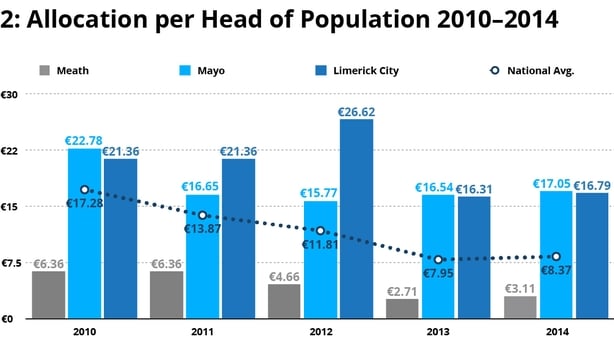
In 2010 under Fianna Fail, Mayo and Limerick City managed to get €4.2 million of the €79 million funding available, around 5.3% of the total. However since the change of government Mayo and Limerick’s share of the pot has grown by 57%. Last year the two constituencies – home to Taoiseach Enda Kenny, Finance Minister Michael Noonan and the then Housing Minister Jan O’Sullivan – together received 8.3% of the total fund.
The 2014 grants, worth a total of €38.4 million, were announced by then Junior Minister at the Department of the Environment Jan O’Sullivan, and are used to help the elderly and those with disabilities carry out renovations to their homes.
Both Mayo and Limerick City did deserve a somewhat above average allocation, based on the latest census figures, which show a national disability rate of 13 per cent and that 11.7 per cent of people in Ireland are over the age of 65. Mayo has a high elderly population (14.9%) while Limerick City has a large proportion of people with disabilities (18.2%). Limerick City’s population of over 65s is also above average (13.2%) while County Mayo is only marginally above average for disabilities (13.6%).
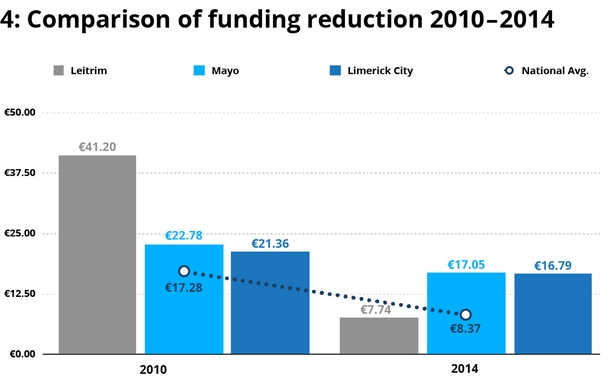
However, the level of extra funding those figures would justify is nowhere near double the average, which is what happened in 2013 and 2014. If the money had been allocated strictly on the basis of population, the allocation should have been the equivalent of around €8.37 per head.
That is not what occurred last year however. Instead, Minister Jan O’Sullivan’s own constituency of Limerick City – also home to Finance Minister Michael Noonan – got €16.79 per person, the second highest rate in the country. Only one local authority area was higher, and that was Mayo, Taoiseach Enda Kenny’s home county, where funding per person was €17.05.
Other local authorities fared comparatively poorly in their allocations with Meath getting the equivalent of just €3.11 for each of its citizens.
The Department of the Environment and the Department of the Taoiseach have both categorically stated to the RTÉ Investigations Unit that the funding was allocated in a ‘transparent and fair’ way. They said using a population per county basis to analyse housing allocations was flawed and did not take into account demand, level of need and putting the money to best use.
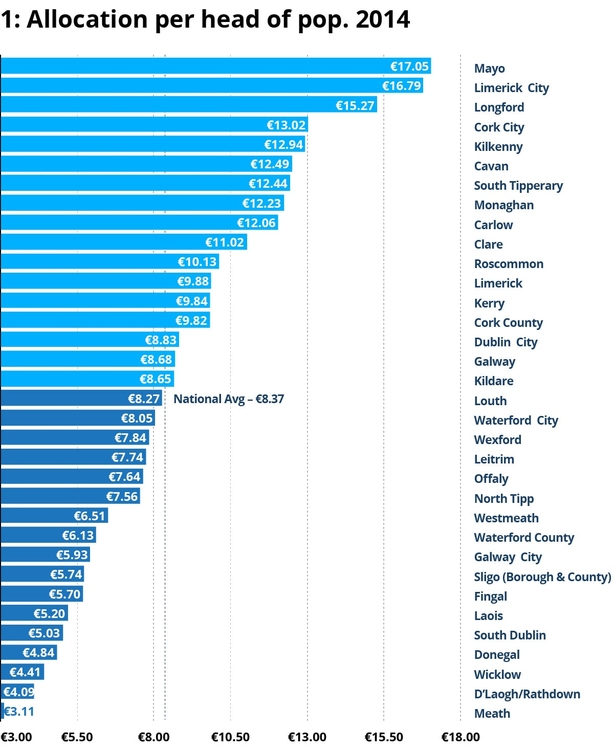
The pattern in the table above had been the same in 2013, with Mayo first in the league table, and Limerick City in a narrow second place. The chances of those two counties randomly appearing as the first two in the funding table for 2014 are the equivalent of around 1 in 350.
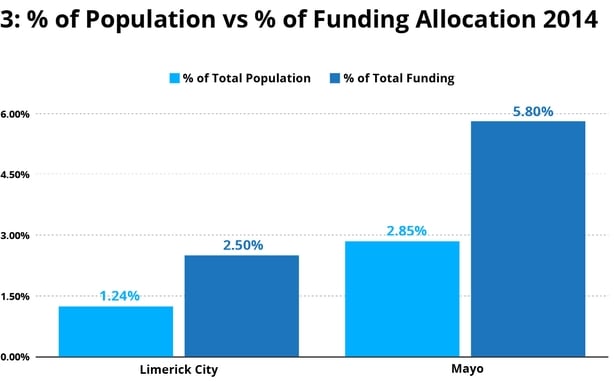
Both Limerick City and Mayo did twice as well as might have been expected had the funding been allocated based strictly on population. In 2014, Mayo received €2.23 million in funding, 5.8 per cent of the total pot: its population of just over 130,000 is 2.8 per cent of the national total. Limerick City managed to procure €958,000 in the grants, 2.5 per cent of all the funding available yet its population represents just 1.24 per cent of the national total.
Mayo’s annual funding was well above the average of what might have been expected of a local authority area with just 130,000 people. Although its population is more or less the national average, the €2.23 million it was allocated last year was nearly double the €1.129 million national average in funding.
Mayo and Limerick City also proved resilient in securing funding over the five years of figures that were made available to RTÉ. This covered a period during which a general election took place, and saw Fine Gael and Labour take power in March 2011.
The annual funding levels of Mayo and Limerick City did fall as the recession bit and the new coalition made decisions on where the grants would go from 2012 onwards. However, while other counties suffered a 50% reduction in their allocations – Mayo and Limerick City escaped more lightly.
Over the five years, Limerick City’s allocation fell by 21.4 per cent while Mayo suffered a 25 per cent decline. Other counties had their funding decimated however, with Leitrim losing a massive 80 per cent in its allocation during the period since 2010.
Dr Jane Suiter, a political scientist at DCU, who has studied extensively patterns of government funding and how it is allocated, said: ‘In the last two years this appears to clearly fit the pattern we have seen before where the state’s resources are delivered disproportionately to the constituencies of key ministers.
‘We know this has been a long running problem in school building, in roads, in sports capital allocations and perhaps also in health.’
A statement on behalf of Jan O’Sullivan, who is now Minister at the Department of Education, said that allocations were ‘rarely, if ever’ made according to population size.
A spokesman said other factors including the proportion of local authority housing stock, its age and condition, and the age profile of the resident population were all important. ‘Every discretionary funding line has its own transparent criteria that ensures this goal is reached,’ he said.
The spokesman said that there were major cuts to funding and that allocations were made according to the number of applications at hand in each local authority and also contractual agreements that were in place. He said: ‘These criteria ensured that the reducing budget was targeted at those local authorities with the greatest demand as evidenced by approvals made and the waiting list of applications.’
Other Funding
Minister O’Sullivan’s spokesman also pointed to three separate allocations of funding for vacant local authority housing, for unfinished housing estates and for energy efficiency. These three funds taken together were worth €40 million – roughly the same amount of funding as is given out in private housing grants each year.
The spokesman said that these allocations were not made on the basis of population either but targeted problem areas like Dublin City Council for vacant units and Co Cavan for ghost estates. Dublin City Council ended up getting more than a quarter of all the vacant housing fund, much more than the 11.5% that would have been justified by population alone. Similarly, Cavan received 9% of the ghost estate fund, despite its 1.59% of national population, because of its high rate of unfinished housing.
The spokesman also said another allocation of €15 million for energy efficiency had ended up being quite heavily skewed towards Cork City because of the large amount of social housing there.
He said: ‘As is clear ... no housing funding is allocated solely on the basis of population for very sound public policy reasons. Therefore using a population per county basis to analyse housing allocations is inaccurate and deeply flawed. Drawing conclusions of political bias from that misplaced analysis is without foundation, ignores the transparent criteria on which each allocation is made and grossly unfair.
‘A range of transparent criteria are used for each housing measure that ensures the available finance is aligned to demand, level of need and put to best use. Allocations are made solely and exclusively on these criteria.’
The Department of the Taoiseach and the Department of the Environment also said it was unfair to analyse allocations on a population basis and that funding was awarded in a transparent way. The Department of Finance referred queries relating to the allocation of funding back to the Department of the Environment.
You can read more of Dr Jane Suiter's research on how funding has historically favoured the constituencies of Ministers here and here.
