


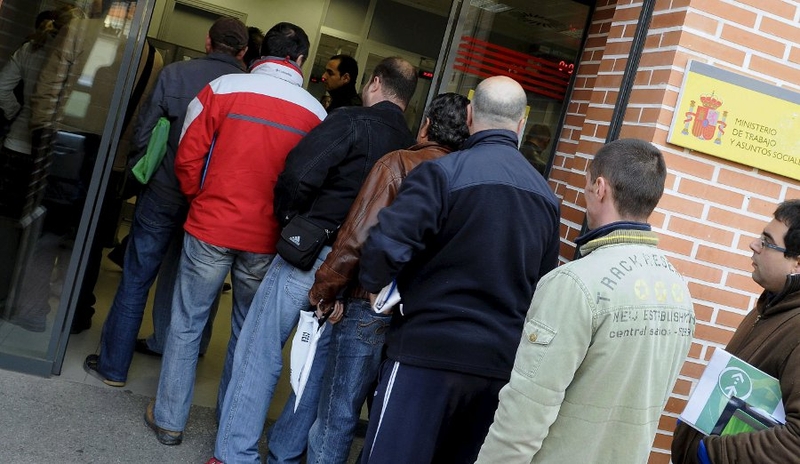
Unemployment across the 17 EU countries that use the euro is on course to hit 20 million this year.
This is according to figures showing the jobless rate hit another record high - the latest set of weak economic data for the currency bloc.
Eurostat, the European Union's statistics office, said that the unemployment rate rose to 12.2% in April from the previous record of 12.1% the month before. 95,000 people joined the ranks of the unemployed, taking the total to 19.38 million.
At this pace, unemployment in the currency bloc - which has a population of about 330 million - could breach the 20 million mark this year.
The figures, once again, mask big disparities among the euro countries. While over one in four people are unemployed in Greece and Spain, Germany's rate is stable at a low 5.4%.
The differences are particularly stark when looking at the rates of youth unemployment. While Germany's youth unemployment stands at a relatively benign 7.5%, well over half of people aged 16 to 25 in Greece and Spain are jobless. Italy's rate has ticked up to over 40%.
The differences reflect the varying performance of the euro economies - Greece, for example, is in its sixth year of a savage recession.
Germany's economy has until recently been growing at a healthy pace. As a whole, the euro zone is in its longest recession since the euro was launched in 1999. The six quarters of economic decline is longer even than the recession that followed the financial crisis of 2008, though it is not as deep.
By contrast the US economy has been growing steadily since the end of its recession in 2009 and the jobs market has started to improve, with the unemployment rate falling to 7.5% in April.
Though the euro zone is the epicentre of Europe's debt crisis, other countries in the region are struggling to recover as well. Some, like Britain, are also pursuing deficit reduction measures at a time when demand in their main export market - the euro zone - is falling.
As a result, the wider 27-nation EU, which includes the non-euro countries such as Britain and Poland, has seen unemployment ratchet higher in recent months. In April it was flat at 11%.
One of the reasons behind Europe's economic decline is governments' focus on cutting debt aggressively by raising taxes and cutting spending programmes.
With many governments still pulling back on spending and business and consumer confidence still low, economists do not expect any dramatic recovery to emerge over the coming months.
The sharpest change in unemployment rates among the 17 euro countries was in Cyprus, which saw its jobless rate rise to 15.6% from 14.5%. The small Mediterranean island nation became the fifth euro country to seek financial assistance in March.
The difference with the other bailouts was that the country was asked to raise a big chunk of its rescue money from bank depositors - a shock decision that led to a near two-week shutdown of the banks and battered economic confidence.
The European Central Bank has sought to make life easier for Europe's hard-pressed businesses and consumers by cutting its main interest rate to the record low 0.5% earlier this month. Another cut is possible, but most economists say it's unlikely, even though the inflation rate is still under the ECB's target of just below 2%.
Eurostat also said today that inflation in the euro zone rose to 1.4% in the year to May from the 38-month low of 1.2% recorded in April. It blamed rising food, alcohol and tobacco prices for the uptick.
Analysts said the ECB is more likely to take measures to shore up lending to small and medium-sized businesses, one of the main job creators in Europe. Such companies are currently not taking out many loans for fear the economy might worsen and because banks are charging high rates.
