


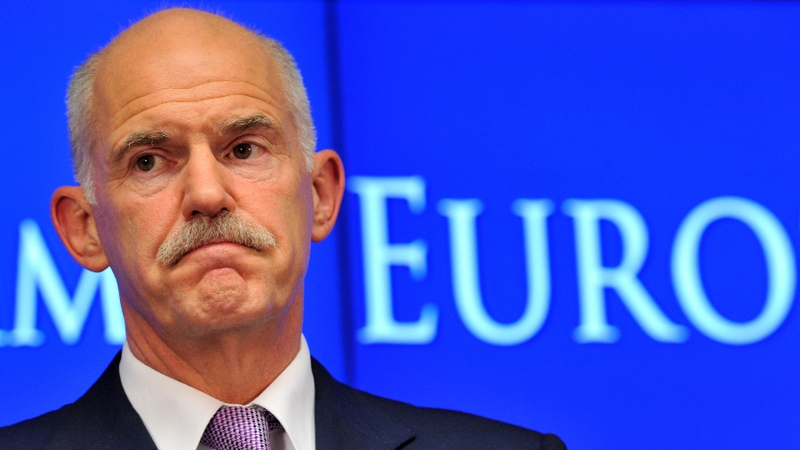
Greek Prime Minister George Papandreou has defiantly declared that his controversial referendum on his country's new bail-out will take place.
At an emergency meeting of his cabinet tonight, he also said he believed his party would win a vote of confidence in parliament this Friday. But analysts say that unrest in his PASOK party could still result in Mr Papandreou's government collapsing.
Mr Papandreou shocked the euro zone and his ministers with his announcement of a referendum on Monday. According to his spokesman, Mr Papandreou told Ministers in no uncertain terms that the referendum would go ahead and he would win the confidence vote later this week.
One of his own MPs, Melina Apostolaki, has resigned over at the referendum decision, thereby reducing the PM’s parliamentary majority to just two votes.
With more of Mr Papandreou’s MPs calling for the referendum to be shelved, analysts believe that the government could still collapse.
French President Nicolas Sarkozy and German Chancellor Angela Merkel have hastily arranged a meeting tomorrow with the European Central Bank and the International Monetary Fund.
Mr Papandreou is also invited, and he can expect a very frosty reception from EU leaders who are furious at his actions and the market chaos they have triggered.
The French and German leaders, in a joint statement, also said they were determined to implement the Greek debt rescue plan.
Euro zone leaders agreed last week to hand Athens a second, €130 billion bail-out and a 50% write-down on its huge debt. The price of the package is a programme of harsh state spending cuts that have unleashed a tide of anger among Greeks.
EU leaders said they "fully trust" Greece will stick to commitments to reduce spending in return for new rescue funding. In a joint statement, EU president Herman Van Rompuy and European Commission president Jose Manuel Barroso said: "We fully trust that Greece will honour the commitments undertaken in relation to the euro area and the international community."
But the chairman of the group of euro zone finance ministers said Greece risked bankruptcy, should the country deliver a 'no' vote.
Luxembourg premier Jean-Claude Juncker also told RTL radio that the Greek prime minister made his decision without informing his European colleagues.
Papandreou, whose ruling Socialist party has suffered several defections as it pushes waves of austerity measures through parliament while protesters rally outside, said he needed wider political backing for the fiscal measures and structural reforms demanded by international lenders.
European stock markets tumbled today, hit by fresh fears for the euro zone crisis after Greece's news.
Referendum news a "grenade" - Creighton
A leader in German Chancellor Angela Merkel's centre-right coalition said today he was "irritated" by Papandreou's announcement.
Rainer Bruederle, parliamentary leader for Free Democrats (FDP) who share power with Chancellor Angela Merkel's conservatives, was speaking to German radio.
European affairs minister Lucinda Creighton also criticised the move. "The summit last week was to deal with the uncertainty in the euro zone...and this grenade is thrown in just a few short days later," she told Reuters.
Analysts said the latest opinion poll showed a majority of Greeks took a negative view of the bail-out deal. The renewed uncertainty is likely to be an embarrassment for G20 leaders in France this week trying to coax China into throwing the euro zone a financial lifeline.
"If there was to be a referendum, we may reasonably conclude that they may not accept the austerity measures. We may conclude that it will bring the pack of cards tumbling down," a London-based analyst said.
Early reactions to the surprise move ranged from accusations that Papandreou was gambling with the country's future and predictions of default, to questions over the legality of the referendum and statements by lawmakers that a "No" vote would force his resignation and early elections.
Nobel prize-winning economist Christopher Pissarides caught the mood of uncertainty: "It is difficult to predict what will happen to Greece if they reject it. It will be bad enough for the European Union and the euro zone in particular, but it will be far worse for Greece''.
"In the scenario of a 'No' vote Greece would declare bankruptcy immediately, they would default immediately. I can't see them staying within the euro," he said.
Analysts were divided over whether Greek voters would accept the deal, but agreed that a damaging month or two of market volatility lay ahead while pollsters repeatedly took the Greek voters' pulse and European leaders looked on nervously.
Papandreou told the Greek voters it was up to them to decide the country's fate. "We trust citizens, we believe in their judgment, we believe in their decision," he told Socialist party deputies. "In a few weeks the EU agreement will be a new loan contract... we must spell out if we are accepting it or if we are rejecting it."
Papandreou, grappling with Greece's worst financial crisis in 40 years, said the referendum would take place in a few weeks. Finance Minister Evangelos Venizelos told Greek TV it would probably be held early next year.
Opposition parties accused Papandreou of looking for a way out for his embattled party by dragging Greece, which has seen violent clashes between anti-austerity protesters and riot police, through a lengthy period of political instability.
Papandreou also said he would ask for a vote of confidence to secure support for his policy for the rest of his four-year term, which expires in 2013. Analysts said he was likely to win that, despite dissent among his parliamentary team, and parliament officials said the confidence debate would begin on Wednesday, with a vote on Thursday or Friday.
Greece is due to receive an €8 billion tranche in mid-November, but that is likely to run out during January, around the time of the referendum, leaving the government with no funds if there is a "no" vote.
