


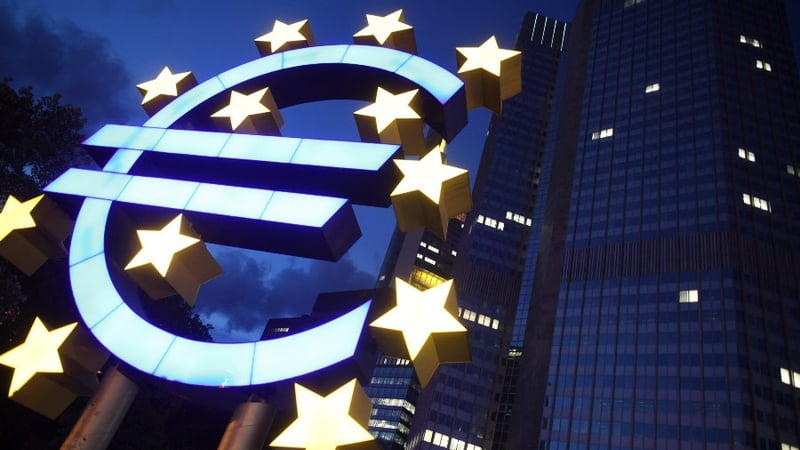
European Central Bank president Jean-Claude Trichet has said the ECB was reviewing the risks to price stability, suggesting the bank could tone down its view on inflation pressures.
While he said the ECB expected inflation to remain above 2% in the months ahead, he avoided saying there were 'upside risks to price stability' - language he used after the bank's last monetary policy meeting on August 4.
'Risks to the medium-term outlook for price developments are under study in the context of the ECB staff projections that will be released early September,' Mr Trichet said.
A downward revision in the ECB's view of the threat posed by inflation would relieve any pressure for it to follow up the two interest rate rises it has made this year with another hike.
Annual inflation Europe's biggest economy Germany eased to 2.3% in August, data showed today, giving the ECB one more reason not to hike borrowing costs any time soon.
He also defended the purchase of Italian and Spanish debt on the secondary markets as in keeping with the mandate of the ECB.
Mr Trichet urged euro zone governments to rapidly implement a rescue package they approved in July to resolve the region's debt crisis.
'The full and timely implementation of the July 21 agreement between heads of state or government is of essence in this respect,' Mr Trichet told the European Parliament's economic affairs committee.
Mr Trichet maintained that there was no liquidity problem for European banks, adding that euro zone economic growth would continue at a modest pace.
Meanwhile, German chancellor Angela Merkel has warned in a campaign speech today that countries that do not do their homework on reducing debts will not be able to count on support from euro zone countries.
Mrs Merkel told a rally in the northeastern state of Mecklenburg-Vorpommern that countries which are willing to make a lasting and credible detour away from policies of heavy indebtedness can count of solidarity from other euro zone states.
'But those that don't do their homework will not get our support,' Mrs Merkel said at the rally of her conservative Christian Democrats in the state capital Schwerin ahead of an election on Sunday.
Mrs Merkel also spoke out once again against the issuance of joint euro zone bonds.
She said it defies 'common sense' to try to solve the sovereign debt crisis simply by putting all nations' debts into a single pot.
Separately, EU Economic and Monetary Affairs Commissioner Olli Rehn has said that euro zone economic growth is likely to slow further after the second quarter because of higher oil prices and financial market turmoil.
Euro zone economic growth slowed to 0.2% quarter-on-quarter in the April-June period, from 0.8% in the first three months of the year.
‘Short-term indicators for the euro area point to a further moderation of growth,’ Rehn said in a speech prepared for delivery to the European Parliament's economics committee.
‘The deterioration of the growth outlook is a consequence of a combination of various factors, such as higher oil prices in the first half of the year, and more recently, a less supportive external environment and - yes - the impact of the financial market turmoil,’ Mr Rehn said.
The European Commission forecast earlier this year that euro zone economic growth would slow to 1.6% in 2011 from 1.8% in 2010.
The Commission will release its next forecast for 2011 on September 15.
Mr Rehn said there were ‘rather high expectations’ that eurobonds - a collective means of European countries raising money from the markets as opposed to individual states - could help solve the debt crisis.
The Commissioner said this would have ‘unavoidable implications’ for fiscal sovereignty.
Earlier, the leader of the euro zone finance ministers' grouping, Jean Claude Juncker, said he was very happy with the progress that Ireland was making in tackling the nation's debt crisis.
ECB scales back bond buys again
Separate ECB figures showed that the bank reduced its buying of euro zone government bonds last week to €6.65 billion. The bank further scaled back its intervention after its initial foray into debt markets helped Italian and Spanish borrowing costs to ease.
The reduction in the purchases from €14.3 billion in the previous week followed a similar pattern to the ECB's first intervention in the debt market last year, when it also scaled back its bond buys after making an impact in the first week.
The ECB reactivated its controversial bond-buying programme earlier this month after Italy and Spain came closer to succumbing to the debt crisis after a fierce market attack.
The central bank's latest purchases, which span the period of August 18-24, sent the programme's total to €115.5 billion. The bank does not break down the purchases by country.
The ECB resumed its purchases following a 19-week pause in the programme, despite opposition from a four-man group on its policymaking Governing Council, led by Germans Jens Weidmann and Juergen Stark.
EU cool on Lagarde bank capital call
Europe has given a cool reception to a demand from the International Monetary Fund's new head Christine Lagarde to force its banks to bulk up their capital.
Lagarde, speaking at an annual meeting of central bankers in Jackson Hole, Wyoming, on Saturday, urged politicians to 'act now' or risk seeing the fragile recovery derailed. She said banks needed 'urgent recapitalisation'.
In an apparent reference to the speech, Rehn noted today that European banks had significantly higher capital than a year ago.
‘This has been confirmed by the stress tests in July. In the run-up of the tests, European banks increased their capital by some €50 billion,’ Rehn said.
He said that banks whose capital positions were found to be too weak by the stress tests were required to take appropriate action within 6 to 9 months.
While private sector solutions - rights issues, the sale of assets and mergers - were preferred, governments would intervene with public money if such solutions were unavailable.
‘Despite these measures to reinforce capital, EU banks have experienced difficulties in their access to funding in recent weeks,’ Rehn said.
‘As the necessary recapitalisation of EU banks proceeds, we expect their funding conditions to improve. And of course, the banks have access to the provision of liquidity by the central banks, as noted over the weekend,’ he said.
Earlier this month, large French and Italian banks suffered steep share price declines on speculation about their financial strength, prompting France, Italy, Spain and Belgium to impose short-selling bans.
Pressure on European banks to raise more capital had increased in July after European stress tests found eight banks failed to meet capital requirements, revealing a total capital shortfall of €2.5 billion.
