

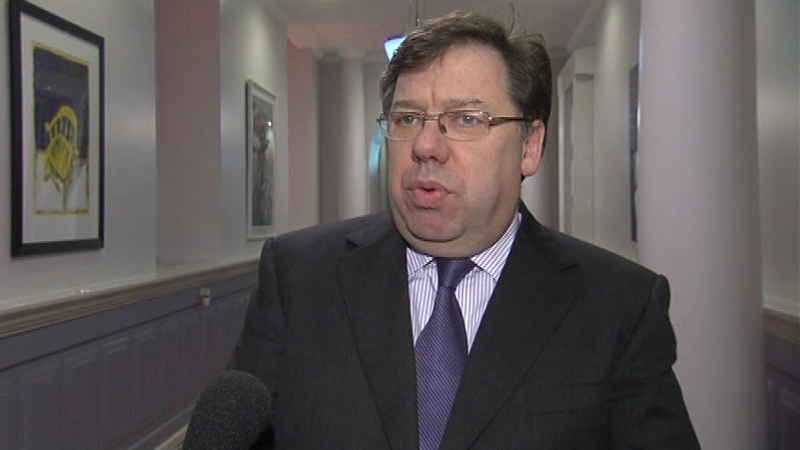
Taoiseach Brian Cowen has said Ireland is making no application to Europe or the IMF for the funding of the State.
But Mr Cowen said the Government would continue to work with partners to find ways of bringing stability to financial markets.
The Taoiseach said what was needed was ‘calm heads and cool consideration’ of all the complex issues involved.
Mr Cowen said contacts would continue at EU level on the Irish debt crisis and the stability of the euro, including a meeting of finance ministers over the next two days.
However, earlier a top European policymaker said aid would be available for Ireland's banking sector or the state itself, after a report suggested Dublin could seek money for its stricken banks from an EU emergency fund.
EU sources have said talks on a possible bailout are under way and it is unlikely to hold out without assistance.
Media reports here say that Finance Minister Brian Lenihan could raise the issue this week in Brussels.
Finance ministers from euro zone states hold monthly talks tomorrow and ministers from other EU states join them for an ECOFIN meeting on Wednesday.
The European Central Bank's Vice President Vitor Constancio said aid would be available whether it was for Ireland's banks or the state and confirmed talks were under way.
'The Irish state is financed until part of next year, but it is also a problem of the banks that are at the centre of the problems in Ireland and considerations have to be pondered,' he told a news conference in Vienna.
'There has been dialogue with European institutions, but so far no formal request,' he said. Constancio said such help, if needed, could involve the €440 billion European Financial Stability Facility (EFSF) set up after Greece was forced to seek help in May.
Euro zone member states are ready to act ‘as quickly as possible’ if debt-stricken Ireland has to ask for help, the head of the Eurogroup of finance ministers, Jean-Claude Juncker said later.
Mr Juncker, describing any such Irish approach as ‘theoretical,’ said that if Dublin sought help, ‘we would be ready to respond to this request as soon as possible.’
For the moment, however, he said ‘Ireland has not formulated such a demand ... and we are not supposed to busy ourselves with a theoretical demand.’
‘The decision rests with the Irish government. I am not making a public recommendation to Ireland,’ he added.
The EU wants Ireland to accept aid, sources have said, to avert a Greek-style scenario where budget problems in one country plunge the entire euro zone into crisis - even though its debt requirements are funded until mid-2011.
Germany has been blamed for aggravating problems by pushing the idea of asset value reductions for private bondholders under a permanent euro zone rescue mechanism it wants in place from 2013.
Germany, the EU's chief paymaster, has said it is not exerting pressure on Ireland to accept aid now.
Greek Prime Minister George Papandreou said Berlin's demand that banks and bond markets share the pain of a sovereign debt default could force some euro zone economies toward bankruptcy.
'It created a spiral of higher interest rates for countries that seemed to be in a difficult position, such as Ireland or Portugal,' Papandreou said during a visit to Paris.
'This could create a self-fulfilling prophecy. This could break backs. This could force economies towards bankruptcy,' he added.
Such has been the market turmoil the leaders of France, Germany, Italy, Spain and Britain issued a statement at a G20 summit in Seoul last week, confirming that holders of existing euro debt would not take a hit.
EU wants quick solution to Ireland's problems
Meanwhile, European Central Bank policymaker Ewald Nowotny said today he did not expect Ireland's woes to spread to Spain and Portugal as European authorities wanted to find a quick solution to the problems.
Asked in a radio interview if Portugal and Spain would take aid if Ireland did, Nowotny, an ECB Governing Council member, said: 'No, I do not expect that. That is exactly the reason why the EU wants to find a quick, good solution to Ireland, so that there will be no spill-over'.
Mr Nowotny is head of the Austrian central bank.
The 'unfounded worries' over the Irish economy will be dispelled following Dublin's 'adequate response' to its fiscal squeeze, Bank of Spain governor Miguel Angel Fernandez Ordonez said today.
Fernandez Ordonez, who is also a member of the European Central Bank's governing council, said it was not his place to tell Ireland what to do.
'We can expect that the adequate response of the Irish authorities as well as the clarifications provided by France, Germany, Britain, Italy and Spain at the G20 summit in Seoul over the mechanisms in place to resolve the EU debt crisis will help to calm markets and dispel unfounded worries,' he added.
The finance ministers of EU heavyweights Britain, France, Germany, Italy and Spain issued a joint declaration on Friday insisting that bond market jitters over a future bailout fund were misplaced since any new bailout mechanism would only come into effect after mid-2013.
Spain, like Ireland, is struggling with burgeoning public debt and deficit levels and as a result have had to pay ever higher returns to bond buyers in order to raise funds.
Bail-out could be used directly for banks - source
The special EU bail-out facility could not be used directly to support a country's banks, a source at the European Financial Stabilisation Facility (EFSF) has said.
However, a segment of any bail-out could go to help the banking sector as long as the amount was declared and politically agreed 'up front' as part of a larger package going to support a member state.
The source drew attention to the one off €110 billion Greek rescue package agreed last May.
On that occasion €10 billion was set aside for the Greek banking sector. The amount was fully agreed and politically cleared as part of the country programme agreed between Greece, the EU and the IMF.
The EFSF was set up at a special meeting of finance ministers in May to agree a huge bail out fund for future Greek style crises. The Luxembourg-based facility, which is a registered company with a Triple A rating, can raise up to €440 billion on the international markets, based on intergovernmental guarantees from other members states.
The €440 billion component is complemented by €250 billion from the IMF and €60 billion from the European Commission to make the total rescue facility of €750 billion.
The source said that the amount of money which could be set aside for the banking sector, as part of a rescue package for the whole country, would be a political decision.
‘The important thing is that it would be up front’, the source told RTÉ.
The source repeated that it had received no request from the Irish government or euro zone countries on support for the Irish economy.
The head of the EFSF, Klaus Regling, is expected to attend the meeting of euro zone finance ministers in Brussels tomorrow.
The source stressed that this was standard procedure and did not relate to current developments.
