

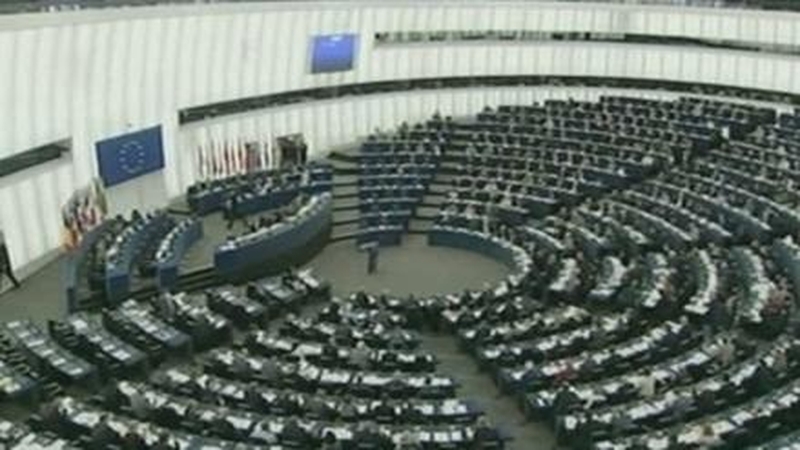
The European Parliament has approved the world's toughest curbs on bank bonuses as part of wider efforts to limit risk in a sector shored up by taxpayers.
EU finance ministers are set to endorse the new law next Tuesday with the curbs taking effect from the start of next year. Under the rules, only 30% of a bonus can be paid up-front, with the rest deferred by up to five years.
The EU assembly voted by 625 in favour of the new law with 28 against and 37 abstentions. The new rules also force banks to set aside more capital against repackaged securities held on their trading books.
The aim is to learn from the financial crisis when the value of securities linked to defaulting home loans crashed, forcing governments to step in with rescue packages.
‘The amendments to the Capital Requirements Directive voted today by the European Parliament target the investments and practices that lie at the root of the recent crisis.
EP Commissioner Michel Barnier welcomed the agreement: ‘The requirements on pay and bonuses send a strong political message: there will be no return to business as usual.
The EU is leading the way in curbing unsound remuneration practices in banks. Banks will need to change radically their practices and the mentality that have led in many cases to excessive risk-taking and contributed to the financial crisis.
‘The tougher capital requirements for banks' trading books and their investments in securitisations - the kind of highly complex products that have caused huge losses for banks - will ensure that banks hold significantly more capital to cover their risks.
'This will make the sector as whole better able to resist stress.’
The following are the main elements of the new rules that amend the existing capital requirements directive.
BONUS CURBS
* For the first time bank pay will come under the scope of the EU's bank capital rules.
* The curbs are more specific and tougher than the recommendations on limiting bank pay agreed last year by the Group of 20 countries and already being applied in the EU.
* The law gives national regulators in the EU binding powers to take action against banks that fail to comply with the new rules, such as requiring extra capital.
* Only 30% of a total up-front bonus may be paid in cash and only 20% of large bonuses - which will be defined collectively by the EU's national bank supervisors.
* At least half of a bonus must be paid in a mix of contingent capital - funds that can be used when a bank is in trouble - and shares, which must be retained for an appropriate period.
* At least 40% of a bonus must be deferred for 3-5 years, rising to 60% for a large bonus.
* There must be a claw back mechanism if the bonus was paid for performance that turned out to be weaker than predicted.
* The curbs will apply to senior management, risk takers, controller functions and any employee whose remuneration puts them in the same pay bracket at senior management. They will not apply to commission on selling bank products.
* Curbs on bonuses at bailed out banks will be stricter.
* The rules will also apply to foreign banks operating in the EU and to subsidiaries of EU banks in non-EU countries.
* Each bank must set a maximum limit on the size of staff bonuses, which must be proportional to salary. Bank supervisors will check to see if the evaluation is appropriate.
TRADING BOOKS
* The new law also requires banks to hold more capital against securities which repackage other securities, known as re-securitisation.
* The tougher rules on re-securitisation will be phased in between December 31 2011 and December 31 2013.
