

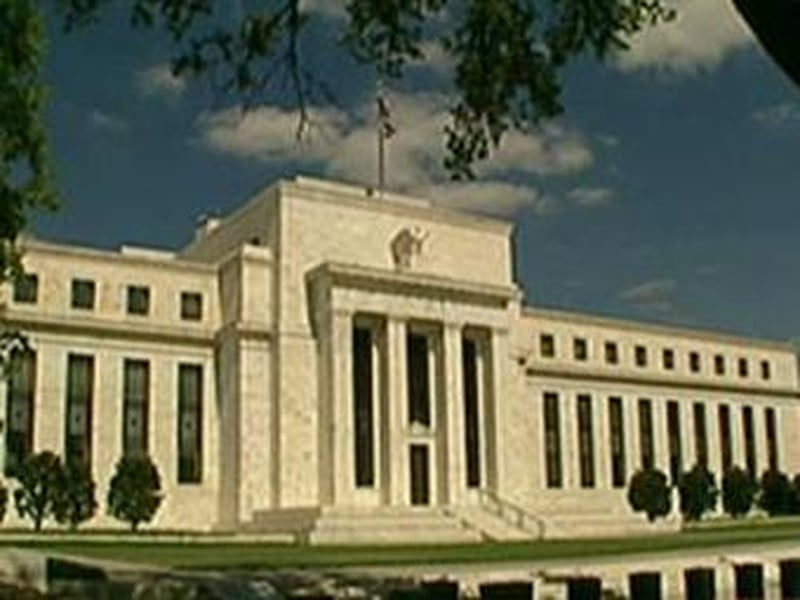
The US Federal Reserve this evening painted a picture of a country slowly recovering from recession, but still struggling with unemployment, according to the latest Beige Book report.
'Overall economic activity increased somewhat since the last report across all Federal Reserve Districts except St Louis,' the Fed said in a report to be used at the next meeting of the bank's policy-making body on April 27-28.
'While labour markets generally remained weak, some hiring activity was evident, particularly for temporary staff,' the report added.
While the report - which separates the US into 12 Federal Reserve districts - had some good news on sales and some sectors, it was mostly mixed.
'Districts generally reported increases in retail sales and vehicle sales,' the Beige Book said. Mining and energy production and exploration increased in such sectors as metals and petroleum, it added.
Following on from another US report earlier today which pointed to increased consumer spending, the Fed said 'district reports indicated that consumer spending increased during the reporting period'. Manufacturing activity also increased since the last report across most of the country.
The residential property market was also seen as improving, 'albeit from low levels' and not in all districts.
The US Federal Reserve has continued to keep ultra-low interest rates in the hope of spurring economic growth, ignoring warnings that inflation could be building.
'Retail prices generally remained level, but some input prices increased. Where producers faced cost pressures on inputs, they were largely unable to pass those prices downstream to selling prices,' today's report said.
Bernanke says rates to stay low for some time
A moderate US economic recovery is likely to warrant very low interest rates for a long time, Federal Reserve Chairman Ben Bernanke testified today.
Refusing to rule out the risk of a double-dip recession, Bernanke told US lawmakers that inflation is not an immediate concern, giving the Fed room to maintain its highly stimulative policies.
'The Federal Open Market Committee has stated clearly that they currently anticipate that very low, extremely low rates will be needed for an extended period,' Bernanke said in response to questions from lawmakers of the Joint Economic Committee.
However, he stressed that this commitment was based upon certain conditions in the economy, including underused productive capacity, high unemployment and anchored inflation expectations.
'If those conditions cease to hold and we anticipate changes in the outlook then of course we will respond to that,' Bernanke added. He said inflation figures remain subdued, and long-term inflation expectations remain contained.
A government report today showed US consumer prices climbed 2.3% in March compared with a year ago. They rose just 1.1% when food and energy were excluded, the smallest increase in more than six years.
Bernanke said the risk of a renewed contraction was 'not negligible' but the threat had receded in recent months. He said growth was still weighed down by weakness in the construction sector and battered state and city budgets.
The chairman cited encouraging signs layoffs are slowing and employment 'has turned up'.
Mr Bernanke also today told US lawmakers that they faced 'difficult choices' in cutting the country's deficit and that action can not be delayed.
'Addressing the country's fiscal problems will require difficult choices, but postponing them will only make them more difficult,' he told lawmakers.
He said the pace of the US recovery would be 'moderate', warning 'significant' time would be needed to claw back jobs lost in the recession.
'If the pace of recovery is moderate, as I expect, a significant amount of time will be required to restore the 8.5 million jobs that were lost during the past two years,' he said.
The Fed boss said data suggested demand would be enough to 'promote a moderate economic recovery in coming quarters,' as the US continues its tough slog out of recession.
He pointed to improved consumer spending - traditionally a strong driver of the US economy - as one factor aiding the recovery. 'Consumer spending should be aided by a gradual pickup in jobs and earnings, the recovery in household wealth from recent lows, and some improvement in credit availability,' Mr Bernanke said.
But he warned the economy continued to face strong headwinds. 'I am particularly concerned about the fact that, in March, 44% of the unemployed had been without a job for six months or more,' he stated.
